Null Infinity
Keywords
Summary
144 words
Critical Evaluation
Value of the Information & Strength of the Argument
The talk provides a clear and insightful overview of the connections between soft theorems, memory effects, and asymptotic symmetries, which are central to modern research in quantum gravity. Pasterski’s argumentation is well-structured, building from basic concepts to more advanced topics. She effectively motivates the importance of null infinity and the BMS framework, and she addresses audience questions with expertise. The presentation is valuable for researchers and graduate students in theoretical physics, offering both a review of known results and a glimpse into ongoing research directions.
Scientific Rigor, Source Quality, Title Accuracy
The talk is scientifically rigorous, referencing foundational works by Bondi, van der Burg, Metzner, and Sachs, as well as more recent contributions by Strominger and others. The sources are appropriate and well-integrated into the discussion. The title accurately reflects the content, which focuses on null infinity and its role in scattering theory. The presentation is consistent with established literature, and the speaker’s expertise is evident. No significant discrepancies or unsupported claims were noted.
173 words
Title / Content Match
The title accurately reflects the focus on null infinity as the arena for asymptotic symmetries and scattering.
Quality & Reliability
8/10
The talk is a technical seminar by a leading researcher in the field, presenting established results and ongoing research. The content is consistent with known literature on asymptotic symmetries and soft theorems, though it is not peer-reviewed in this format.
Key Moments
Markers derived by PSI from the transcript: the creator did not define chapters.
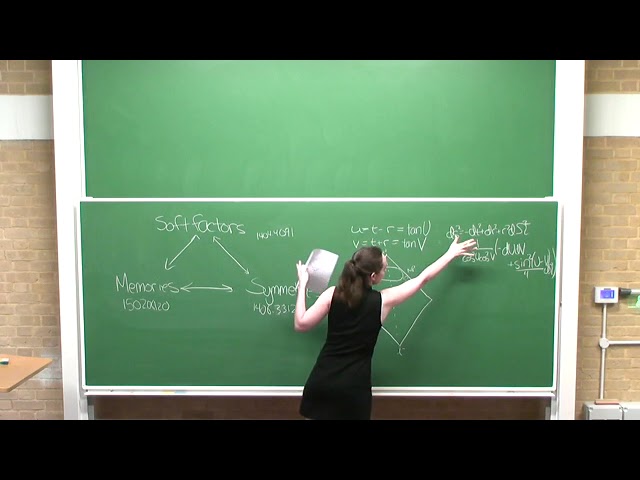
- Introduction to the triangle of relations: soft theorems, memory effects, and asymptotic symmetries.
- Discussion of the Penrose diagram for flat spacetime and the role of null infinity.
- Introduction of stereographic coordinates and conventions for the metric.
- Presentation of the metric expansion near null infinity following Bondi et al.
- Explanation of the constraint equations and the free data on null infinity.
- Discussion of asymptotic symmetries: supertranslations and superrotations.
- Connection between asymptotic symmetries and soft graviton theorems.
- Mention of the gravitational memory effect and its relation to the BMS symmetries.
- Extension to electromagnetism and the role of gauge symmetries.
- Q&A session addressing questions about the scalar field and other topics.
Cited Sources
- Isaac Newton Institute for Mathematical Sciences — The talk was hosted at the Isaac Newton Institute, and the description provides a link to the institute's website.
- Isaac Newton Institute LinkedIn — The description includes a link to the institute's LinkedIn page.
Concurring Sources
- Bondi, van der Burg, Metzner, and Sachs (1962) — Foundational work on asymptotic symmetries in general relativity, referenced in the talk.
- Strominger (2014) — Recent work connecting soft theorems to asymptotic symmetries, mentioned in the talk.
Contribution & Novelties
The talk provides a comprehensive overview of the current understanding of null infinity in the context of scattering amplitudes and asymptotic symmetries. It synthesizes foundational results with recent developments, offering a clear picture of the interconnectedness of soft theorems, memory effects, and BMS symmetries. The presentation is particularly valuable for its pedagogical approach, making complex topics accessible to a specialized audience.
Pour aller plus loin :
- BMS symmetry — Wikipedia article on the BMS group, which is central to the talk.
- Soft graviton theorem — Wikipedia article on the soft graviton theorem, a key concept discussed.
- Gravitational memory effect — Wikipedia article on the gravitational memory effect, which is related to the talk’s content.
114 words
Radar Profile
The radar profile shows high scores in technical level and information quality, reflecting the advanced and rigorous nature of the talk. The moderate score in quantity of information suggests a focused presentation rather than a broad survey. The overall reliability is high, consistent with the speaker's expertise and the established nature of the topics.