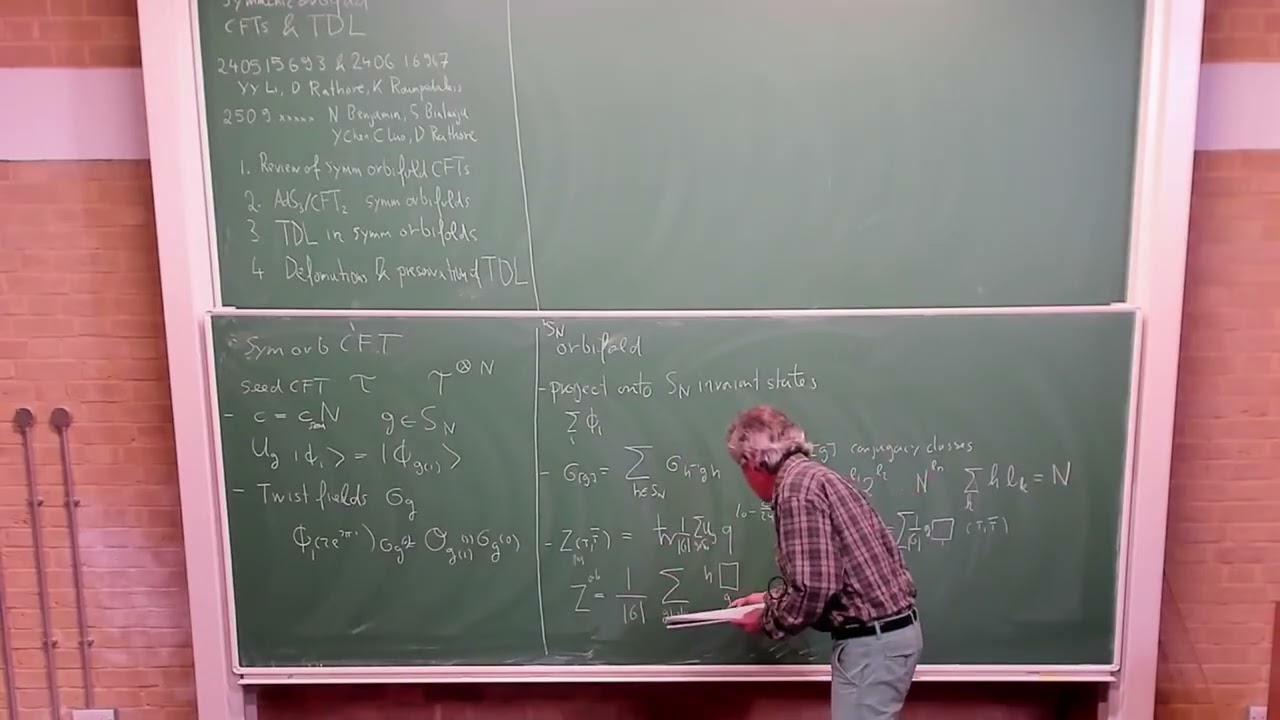
Prof. Michael Gutperle | Symmetric orbifold CFTs and their topological defect lines
Keywords
Summary
159 words
Critical Evaluation
Value of the Information & Strength of the Argument
The lecture provides a comprehensive overview of symmetric orbifold CFTs, emphasizing their role in holography. The argumentation is well-structured, building from basic definitions to advanced applications. The speaker effectively uses mathematical formalism to support his claims, and the discussion of large-N factorization and universality is particularly insightful. The value lies in the synthesis of known results and the clear presentation of the connection between symmetric orbifolds and holographic dualities.
Scientific Rigor, Source Quality, Title Accuracy
The lecture demonstrates scientific rigor through the use of established mathematical frameworks and references to prior work (e.g., Dijkgraaf-Verlinde-Verlinde, Brown-Henneaux). The sources cited are appropriate and relevant. The title accurately reflects the content, which is a focused discussion on symmetric orbifold CFTs and their topological defect lines. The lecture is part of a recognized research program at the Isaac Newton Institute, adding to its credibility.
149 words
Title / Content Match
The title accurately reflects the content, which focuses on symmetric orbifold CFTs and their topological defect lines.
Quality & Reliability
8/10
The lecture is given by a recognized expert in the field, based on established theoretical frameworks and published research. The content is technical and consistent with current knowledge in conformal field theory and holography. However, as a seminar talk, it presents a personal perspective and does not undergo peer review.
Key Moments
Markers derived by PSI from the transcript: the creator did not define chapters.
- Introduction and overview of symmetric orbifold CFTs.
- Construction of twist fields and the action of S_N.
- Discussion of modular invariance and the orbifold partition function.
- Introduction of Hecke operators and covering surfaces.
- Large-N factorization and universality in correlation functions.
- Connection to AdS3/CFT2 duality and Brown-Henneaux central charge.
- Discussion of D1-D5 system and the emergence of symmetric orbifold.
- Introduction to topological defect lines in rational CFTs.
- Construction of topological defect lines using modular matrices.
- Fusion rules and concluding remarks.
Cited Sources
- INI Seminar Page — Event page for the seminar, providing details about the talk and the program.
- Isaac Newton Institute — Official website of the Isaac Newton Institute, where the seminar was hosted.
- LinkedIn - Isaac Newton Institute — LinkedIn page of the Isaac Newton Institute, providing institutional context.
Concurring Sources
- Dijkgraaf, Verlinde, Verlinde - Operator Algebra in CFT — This paper discusses the operator algebra of symmetric orbifold CFTs, supporting the lecture's content.
- Brown, Henneaux - Central Charges in AdS3 — This paper establishes the central charge in AdS3 gravity, relevant to the holographic discussion.
Contribution & Novelties
The lecture provides a clear and comprehensive review of symmetric orbifold CFTs, emphasizing their holographic properties and the role of topological defect lines. It synthesizes known results and presents them in a coherent framework, highlighting the universality and large-N factorization. The discussion of topological defect lines offers a modern perspective on the subject.
Pour aller plus loin :
- Symmetric orbifold CFTs and holography — Foundational paper by Dijkgraaf, Verlinde, and Verlinde on the subject.
- AdS3/CFT2 duality — Maldacena’s original paper on AdS/CFT, including the D1-D5 system.
- Topological defect lines in CFT — Review of topological defects in conformal field theory.
100 words
Radar Profile
The radar profile shows high scores in all dimensions, indicating a technically rigorous and information-dense lecture. The slightly lower score in 'quantite_information' relative to others suggests a focused scope rather than a broad overview.