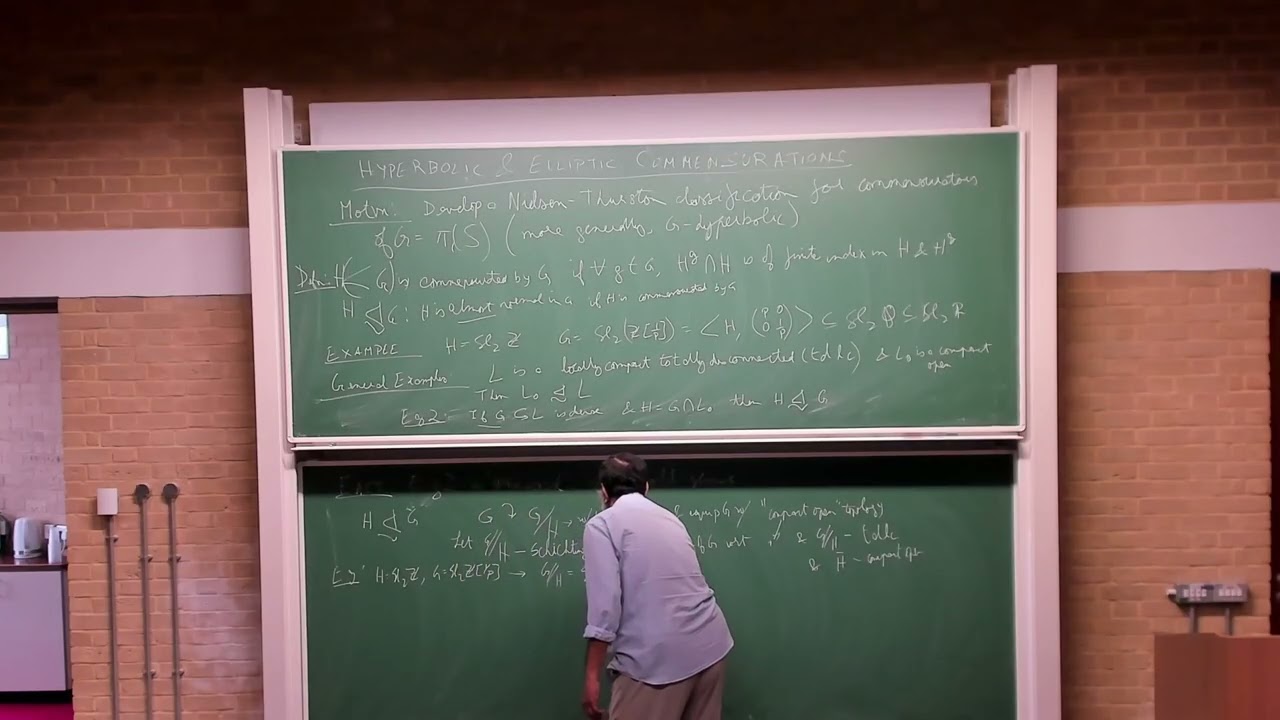
Hyperbolic and elliptic commensurations
Keywords
Summary
157 words
Critical Evaluation
Value of the Information & Strength of the Argument
The talk provides valuable insights into a specialized area of geometric group theory, offering a new framework for understanding commensurations. The argumentation is rigorous, building from definitions to theorems and examples. The speaker clearly explains the motivation and connections between different concepts, making the content accessible to an expert audience. The use of examples, such as SL2Z and Bass-Serre trees, helps illustrate abstract ideas. The presentation is well-structured, moving from general theory to specific results and open questions.
Scientific Rigor, Source Quality, Title Accuracy
The talk demonstrates high scientific rigor, with clear definitions and references to known results (e.g., Rips machine, Hilbert-Smith conjecture, work by Mosher, Handel, and others). The speaker acknowledges joint work with Alex Margolis. The title accurately reflects the content, which focuses on classifying commensurations as hyperbolic or elliptic. The talk is part of a formal seminar series at the Isaac Newton Institute, adding to its credibility. No comments were provided for analysis.
165 words
Title / Content Match
The title accurately reflects the content, which focuses on classifying commensurations as hyperbolic or elliptic.
Quality & Reliability
8/10
Talk by a leading expert in geometric group theory, presenting recent research results with references to known theorems and constructions. The content is technical and appears rigorous, though not peer-reviewed in this format.
Key Moments
Markers derived by PSI from the transcript: the creator did not define chapters.
- Introduction and motivation: Nielsen-Thurston classification for commensurators.
- Definition of commensurated subgroup and almost normal subgroup.
- Example: SL2Z in SL2Z[1/p] as an elliptic commensuration.
- Connection to TDLC groups and Schlichting completion.
- Cayley-Abels graph and metric bundle structure.
- Definition of strongly hyperbolic commensuration and theorem with Margolis.
- Restrictions on the quotient space and boundary, relation to Hilbert-Smith conjecture.
- Examples of hyperbolic commensurations using surface groups and free groups.
- Definition of elliptic commensuration and quasi-isometry condition.
- Discussion of open questions and future directions.
Cited Sources
- INI Seminar page — Event page for the talk, providing context and programme information.
- Isaac Newton Institute — Institute website, general information about the research environment.
- LinkedIn - Isaac Newton Institute — Institute's LinkedIn page, for institutional context.
Concurring Sources
- INI Seminar page — Official event page, confirming the talk's details and programme.
Contribution & Novelties
The talk presents a novel framework for classifying commensurations of hyperbolic groups, introducing the concepts of hyperbolic and elliptic commensurations. It bridges the theory of TDLC groups with geometric group theory, offering new insights into the structure of commensurated subgroups. The results with Margolis provide a classification theorem for strongly hyperbolic commensurations. The talk also highlights open questions and potential connections to the Hilbert-Smith conjecture.
Pour aller plus loin :
- Nielsen-Thurston classification — Foundational classification of surface homeomorphisms, motivating the talk’s framework.
- Hyperbolic group — Key concept in geometric group theory, central to the talk.
- Totally disconnected locally compact group — Relevant to the TDLC perspective used in the talk.
- Hilbert-Smith conjecture — Mentioned in the talk as a restriction on boundaries.
122 words
Radar Profile
The radar profile shows high scores in all dimensions, with particularly strong technical depth and information quality. This reflects a highly specialized and rigorous mathematical talk, suitable for experts in the field.