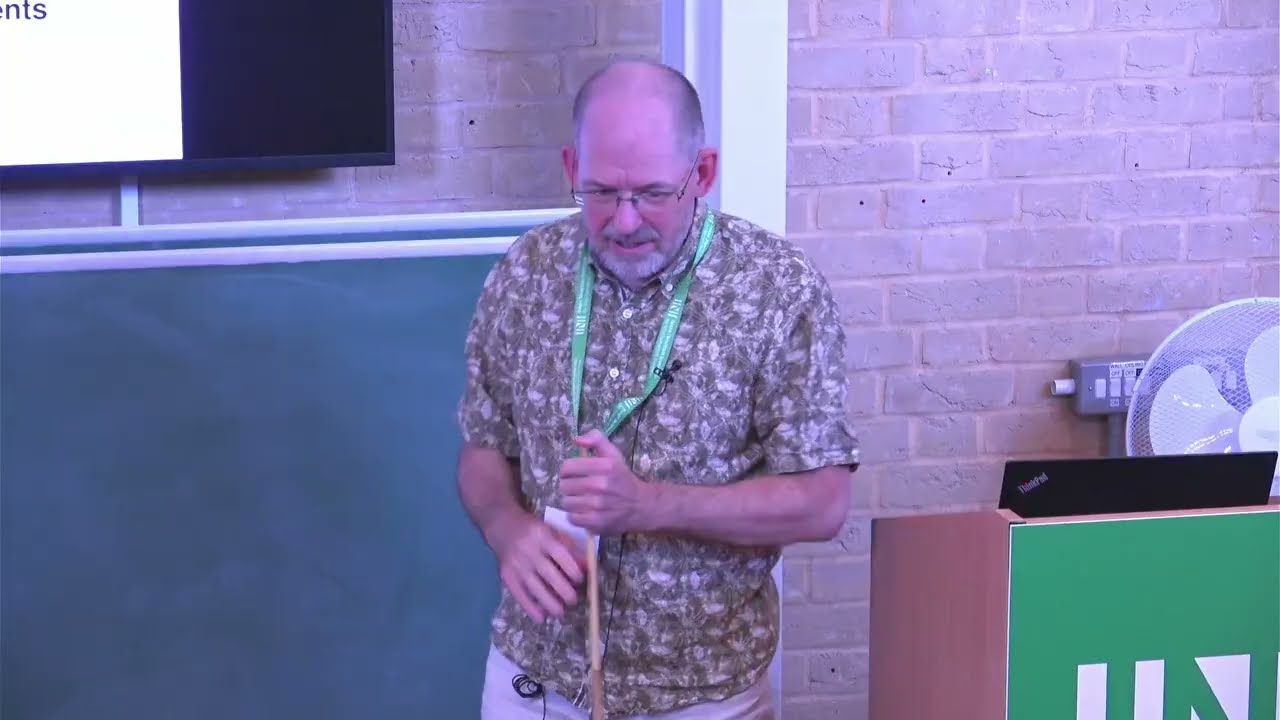
Prof. Ilya Pavlyukevich | How to simulate Lévy flights in a steep potential
Keywords
Summary
137 words
Critical Evaluation
Value of the Information & Strength of the Argument
The talk provides valuable insights into the numerical challenges of simulating SDEs with heavy-tailed noise and steep potentials. The argumentation is rigorous, combining theoretical results (e.g., moment existence theorems) with numerical evidence. The speaker clearly explains the pitfalls of naive approaches and justifies the proposed splitting scheme with both theoretical convergence results and practical demonstrations. The presentation is well-structured, moving from a simple illustrative example to a general framework, and includes a discussion of assumptions and limitations.
Scientific Rigor, Source Quality, Title Accuracy
The talk is scientifically rigorous, with references to the speaker’s own work and that of others (e.g., Hutzenthaler, Jentzen, Kloeden). The sources mentioned are credible and relevant. The title accurately reflects the content, focusing on simulation methods. The description provides links to the Isaac Newton Institute and the specific seminar page, which are reliable sources. The talk is part of a research program, indicating peer-reviewed context.
158 words
Title / Content Match
The title accurately reflects the content: the speaker discusses simulation methods for Lévy flights in steep potentials, focusing on numerical challenges and a novel splitting scheme.
Quality & Reliability
8/10
Presentation by a recognized expert at a leading mathematical institute, based on rigorous theoretical results and numerical experiments. The talk is technical and assumes advanced knowledge, but the methodology is sound and the claims are supported by theorems and simulations.
Key Moments
Markers derived by PSI from the transcript: the creator did not define chapters.
- Introduction of the model equation: dx = -x^9 dt + dz, with z a Cauchy process.
- Discussion on moment existence: despite heavy tails, moments up to order 9 exist due to dissipative drift.
- Benchmark: explicit invariant density and moments for the example, used for comparison.
- Failure of Euler scheme: explosions and loss of trajectories, leading to underestimation of moments.
- Introduction of tamed Euler scheme and its limitations for Lévy noise.
- Proposal of splitting scheme: separating noise and deterministic flow, with explicit solution for the ODE.
- Numerical results: splitting scheme converges to benchmark moments, except for high-order moments which converge slowly.
- Importance of operator ordering: reversed splitting fails due to non-integrable noise increments.
- General multi-dimensional setting and assumptions for the scheme, including one-sided Lipschitz condition.
Cited Sources
- Isaac Newton Institute for Mathematical Sciences — Host institution and general information.
- Seminar page for the talk — Details of the seminar and related program.
Concurring Sources
- Hutzenthaler, Jentzen, Kloeden (2012) on tamed Euler — Paper showing divergence of Euler scheme for superlinear drifts and proposing tamed Euler.
Contribution & Novelties
The talk presents a novel splitting scheme for simulating SDEs with heavy-tailed Lévy noise and steep potentials, addressing the failure of standard methods. It provides theoretical convergence results and practical guidance. The approach is original in its combination of Lie-Trotter splitting with explicit deterministic flow, preserving moment integrability.
Pour aller plus loin :
- Lévy process — Background on Lévy processes and their properties.
- Cauchy distribution — Properties of the Cauchy distribution, relevant to the noise model.
- Euler–Maruyama method — Standard numerical scheme for SDEs, whose limitations are discussed.
- Tamed Euler scheme — Alternative scheme for stiff drifts, mentioned in the talk.
- Lie–Trotter product formula — Mathematical basis for the splitting scheme.
111 words
Radar Profile
The radar profile shows high scores in technical level and information quality, reflecting the advanced and rigorous nature of the talk. The moderate score in quantity of information is due to the focused scope, while the reliability score is high given the expert presenter and institutional backing.