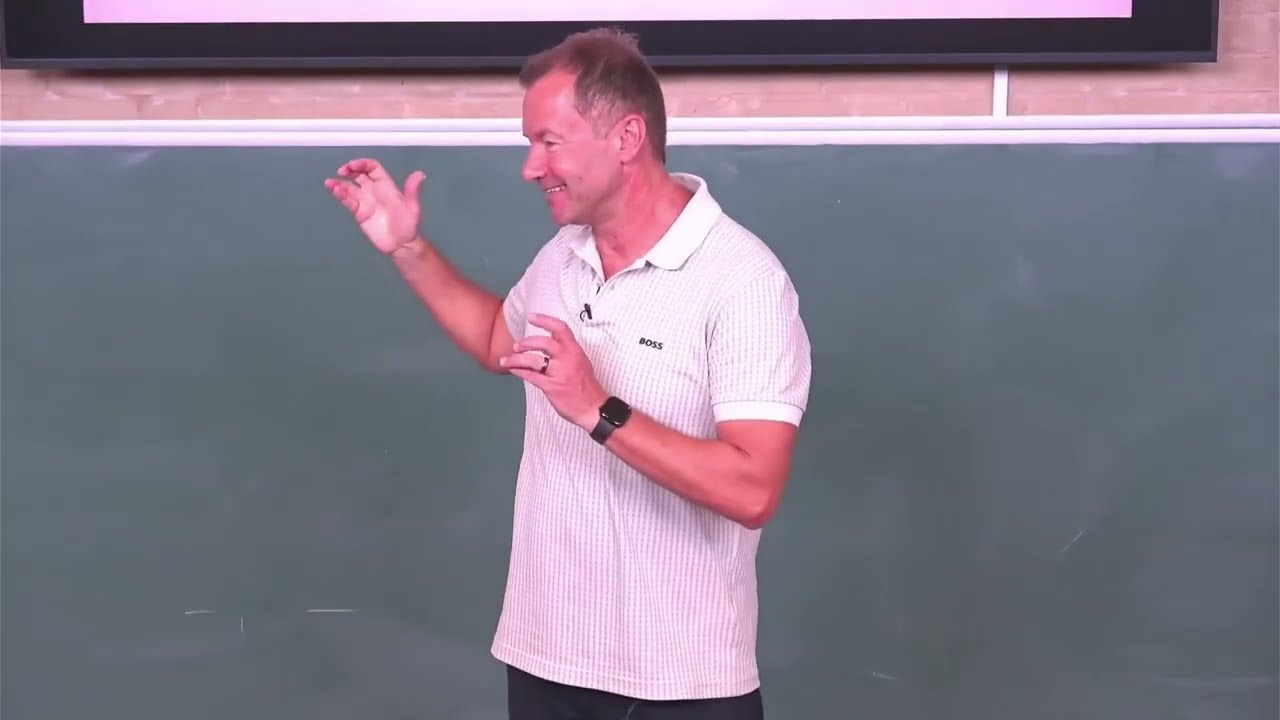
Prof. Igor Mezic | Masterclass: Koopman/operator theory I - Three Points of View in Dynamical Sys...
Keywords
Summary
183 words
Critical Evaluation
Value of the Information & Strength of the Argument
The lecture provides a high-value introduction to Koopman operator theory, emphasizing both theoretical foundations and practical applications. Mezic’s argumentation is clear and well-structured, building from simple examples to general principles. He effectively demonstrates the unifying power of the Koopman operator, showing how it connects classical dynamical systems theory with modern data-driven approaches. The inclusion of motivating applications (soft robotics, sports analytics, climate science) illustrates the practical relevance. The mathematical exposition is rigorous, with careful definitions and explanations of key concepts such as the generator, eigenfunctions, and function spaces. Mezic also addresses potential pitfalls, such as the need for appropriate function spaces in dissipative systems, and discusses the historical development, providing context for current research.
Scientific Rigor, Source Quality, Title Accuracy
The lecture is scientifically rigorous, delivered by a leading expert in the field. Mezic references key historical works (Koopman 1931, von Neumann, Carleman) and modern developments (e.g., EDMD, applications in fluid mechanics). The title accurately reflects the content, which is a masterclass on Koopman operator theory. The lecture is part of a formal seminar series at the Isaac Newton Institute, ensuring a high standard of quality. No external sources are cited in the description beyond the institute’s website and seminar page, but the speaker’s expertise and the institutional context lend credibility. The content is well-organized and technically accurate, with appropriate caveats about assumptions and limitations.
234 words
Title / Content Match
The title accurately reflects the content: a masterclass on Koopman operator theory, focusing on three viewpoints in dynamical systems, the Koopman operator and generator, and linear systems.
Quality & Reliability
9/10
Lecture by a leading expert in Koopman operator theory, part of a formal seminar series at the Isaac Newton Institute. The content is mathematically rigorous, with clear definitions, theorems, and historical context. The speaker is a recognized authority, and the presentation is well-structured. Minor caveats: some informal remarks and a brief political aside, but these do not affect the scientific content.
Key Moments
Markers derived by PSI from the transcript: the creator did not define chapters.
- Introduction and plan for the three lectures.
- Motivating examples: soft robotic arm, football prediction, sea ice modes.
- Three viewpoints on dynamical systems: trajectory, state-space, spectral.
- Definition of the Koopman operator and its properties.
- Historical context: Koopman's 1931 paper and von Neumann's ergodic theorem.
- Simple linear systems and the algebra of Koopman eigenfunctions.
- The generator of the Koopman operator and its connection to Lie derivatives.
- Function spaces: L2 vs. Wiener algebra for dissipative systems.
- Discussion of continuous spectrum and chaotic dynamics.
- Summary and outlook for the next lectures.
Cited Sources
- Isaac Newton Institute for Mathematical Sciences — Host institution for the lecture series.
- Event page: Operator methods for dynamical systems — Seminar page with details about the event.
Concurring Sources
- Koopman operator - Wikipedia — General reference on the Koopman operator.
- Dynamic mode decomposition - Wikipedia — Related data-driven method.
Contribution & Novelties
This lecture provides a comprehensive and accessible introduction to Koopman operator theory, emphasizing its unifying role across different viewpoints in dynamical systems. Mezic’s presentation highlights the importance of function spaces and the algebra of eigenfunctions, offering insights that are valuable for both theorists and practitioners. The lecture sets the stage for advanced topics such as spectral expansions and data-driven methods, making it a valuable resource for researchers entering the field.
Pour aller plus loin :
- Koopman operator - Wikipedia — Overview of the Koopman operator and its applications.
- Dynamic mode decomposition - Wikipedia — Data-driven method closely related to Koopman theory.
- Ergodic theory - Wikipedia — Mathematical background for Koopman’s work.
- Isaac Newton Institute — Host institution with resources on mathematical sciences.
122 words
Radar Profile
The radar profile shows high scores across all dimensions, indicating a lecture that is both information-dense and technically rigorous. The balance between theoretical depth and practical motivation is excellent, making it suitable for a mathematically mature audience. The slightly lower score in 'quantite_information' relative to 'qualite_information' reflects the lecture's focus on depth over breadth, which is appropriate for a masterclass.