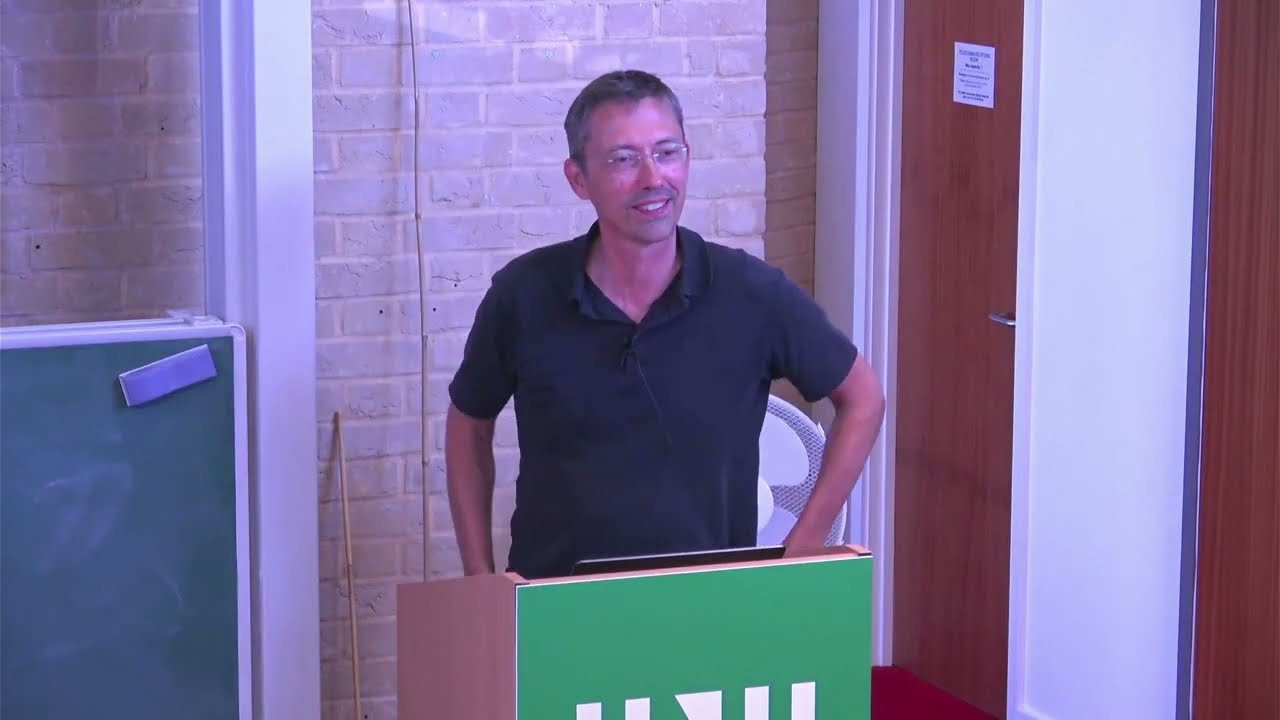
Prof. Oliver Junge | Entropic transfer operators - (Joint with FCP)
Keywords
Summary
176 words
Critical Evaluation
Value of the Information & Strength of the Argument
The talk presents a valuable contribution by proposing a new discretization technique that overcomes limitations of classical methods like Ulam’s in high-dimensional settings. The argumentation is solid, building on well-established concepts from transfer operator theory and optimal transport. The speaker clearly motivates the need for a self-adjoint approximation and demonstrates how entropic regularization provides a unique and smooth solution. The examples, though limited, effectively illustrate the method’s ability to recover spectral features. The discussion of parameter choice and the persistence of eigenvalues adds practical insight. Overall, the value lies in the novel combination of ideas and the potential for applications in complex dynamical systems.
Scientific Rigor, Source Quality, Title Accuracy
The presentation is scientifically rigorous, with clear definitions and derivations. The speaker references classical results (e.g., Poincaré recurrence, Birkhoff’s ergodic theorem) and mentions the work of colleagues, but does not provide specific citations or URLs during the talk. The title accurately reflects the content. The talk is part of a seminar at the Isaac Newton Institute, which adds credibility. However, the lack of explicit references in the talk itself limits the ability to verify all claims. The description provides links to the institute and the specific seminar page, which may contain further resources.
212 words
Title / Content Match
The title accurately reflects the content, which focuses on entropic transfer operators and their application to dynamical systems.
Quality & Reliability
8/10
Presentation of original research by a recognized expert, with clear mathematical derivations and references to classical results. The talk is technical and assumes prior knowledge, but the reasoning is rigorous and transparent.
Key Moments
Markers derived by PSI from the transcript: the creator did not define chapters.
- Introduction and motivation: goal to derive finite models of dynamical systems capturing macroscopic features.
- Review of transfer operators and their spectral properties, linking eigenvalues to metastability and cyclic behavior.
- Introduction of Ulam's method and its limitations in high-dimensional spaces.
- Core idea: using optimal transport to pull back measures from image point cloud to original point cloud.
- Discussion of entropic regularization and the resulting unique transport plan.
- Derivation of the integral operator approximation and its properties.
- Discussion on choosing the regularization parameter epsilon and its impact on the spectrum.
- Example: circle rotation, showing how the method recovers eigenvalues and macroscopic structures.
- Further examples and discussion of the method's advantages and potential extensions.
Cited Sources
- Isaac Newton Institute for Mathematical Sciences — Host institution for the seminar; provides general information about the institute.
- Seminar page: Operator methods for dynamical systems — Specific seminar page with details about the talk and possibly related resources.
Concurring Sources
- Isaac Newton Institute for Mathematical Sciences — The institute is a reputable research center, and the talk is part of a formal seminar series.
Contribution & Novelties
The talk introduces a novel approach to discretizing transfer operators by leveraging optimal transport with entropic regularization. This allows for a self-adjoint approximation that preserves invariant measures and captures macroscopic features more effectively than classical methods like Ulam’s, especially in high-dimensional settings. The method provides a principled way to handle point cloud data and yields a smooth kernel that can be tuned via the regularization parameter.
Pour aller plus loin :
- Transfer operator — Provides background on transfer operators and their applications.
- Optimal transport — Overview of optimal transport theory, including entropic regularization.
- Ulam’s method — Classical discretization method for transfer operators, contrasted with the presented approach.
107 words
Radar Profile
The radar profile shows high scores in technical level and information quality, indicating a specialized and rigorous presentation. The lower scores in quantity of information and global reliability reflect the limited number of examples and the lack of explicit citations during the talk, but the overall profile suggests a solid scientific contribution.