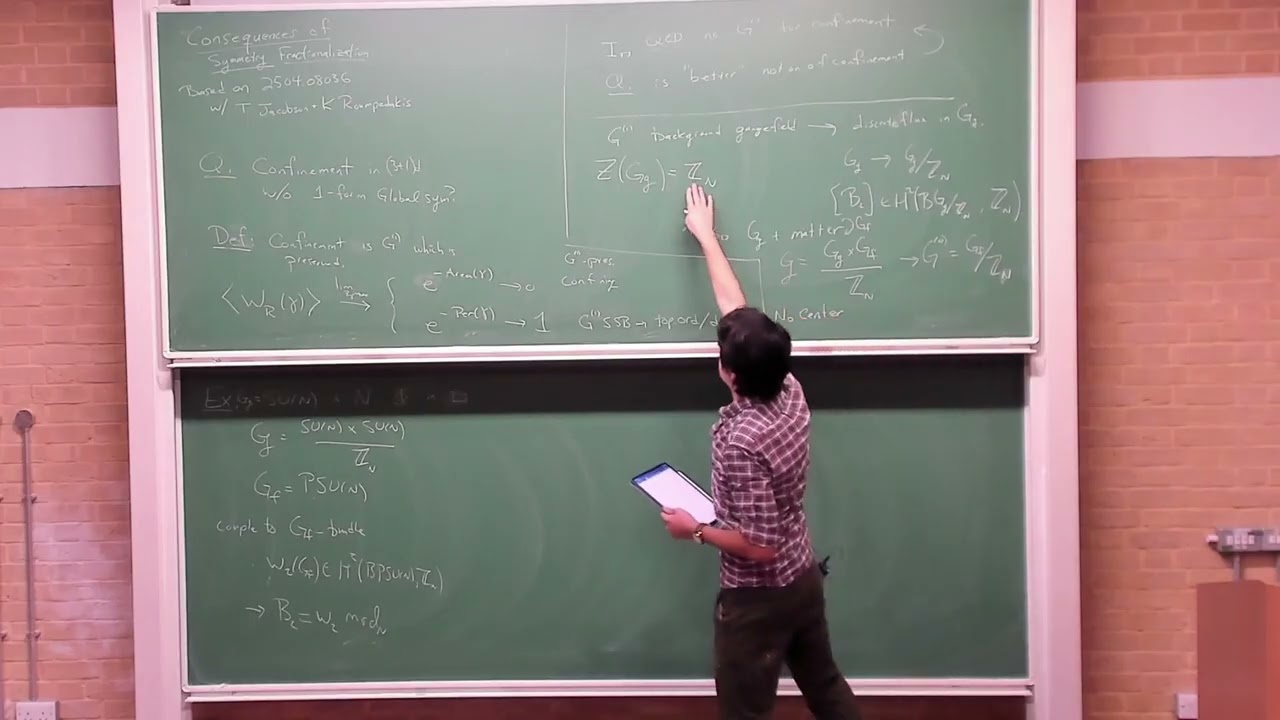
Consequences of Symmetry Fractionalization
Keywords
Summary
199 words
Critical Evaluation
Value of the Information & Strength of the Argument
The talk provides a novel framework for understanding confinement in gauge theories without one-form symmetries, which is a significant open problem. The argumentation is rigorous, building from established concepts to new insights. The speaker carefully explains the mathematical structure, including cohomology classes and projective representations, and supports his claims with explicit examples. The introduction of the disk operator is a useful computational tool that simplifies the analysis. The presentation is well-structured, with clear logical flow and appropriate level of detail for an expert audience.
Scientific Rigor, Source Quality, Title Accuracy
The scientific rigor is high, as expected from a research seminar at a prestigious institute. The speaker references his own paper and mentions related work, but the description lacks explicit citations, limiting immediate verification. The title accurately reflects the content, focusing on the consequences of symmetry fractionalization. The talk is consistent with current literature in theoretical physics, and the mathematical derivations appear sound. The lack of published references in the description is a minor weakness, but the content itself is credible.
180 words
Title / Content Match
The title accurately reflects the content, focusing on the consequences of symmetry fractionalization in gauge theories.
Quality & Reliability
8/10
The talk is a research seminar by an expert, presenting original work with mathematical rigor. The content is highly technical and consistent with current theoretical physics literature. The presentation is clear, but the lack of published references in the description limits immediate verification.
Key Moments
Markers derived by PSI from the transcript: the creator did not define chapters.
- Introduction to the problem of confinement without one-form symmetries.
- Review of one-form symmetry and its role in defining confinement.
- Discussion of discrete flux and its relation to flavor symmetries.
- Introduction to symmetry fractionalization and projective actions on line operators.
- Explanation of the disk operator and its utility.
- Derivation of selection rules in twisted sectors using symmetry fractionalization.
- Example with SU(N) gauge theory and fundamental scalars.
- Conclusion and summary of the main results.
Cited Sources
- INI Seminar Page — Event page for the seminar, providing details about the talk.
- Isaac Newton Institute — Official website of the Isaac Newton Institute, hosting the seminar.
Concurring Sources
- INI Seminar Page — Event page confirming the talk details.
External References
Contribution & Novelties
The talk presents a novel approach to confinement in gauge theories without one-form symmetries, using symmetry fractionalization. The introduction of the disk operator provides a new computational tool. The main contribution is the derivation of selection rules in twisted sectors, which offers a new way to probe confinement. This work extends previous studies on symmetry fractionalization and provides a framework applicable to real-world theories like QCD.
Pour aller plus loin :
- Symmetry fractionalization on Wikipedia — Overview of the concept.
- One-form symmetry on nLab — Technical definition and context.
- Confinement in quantum chromodynamics — Background on confinement in QCD.
99 words
Radar Profile
The radar profile shows high scores in all dimensions, indicating a technically rigorous and information-dense presentation. The talk is particularly strong in information quality and technical level, reflecting its research-level content. The lower score in quantity of information is due to the focused scope of the talk.