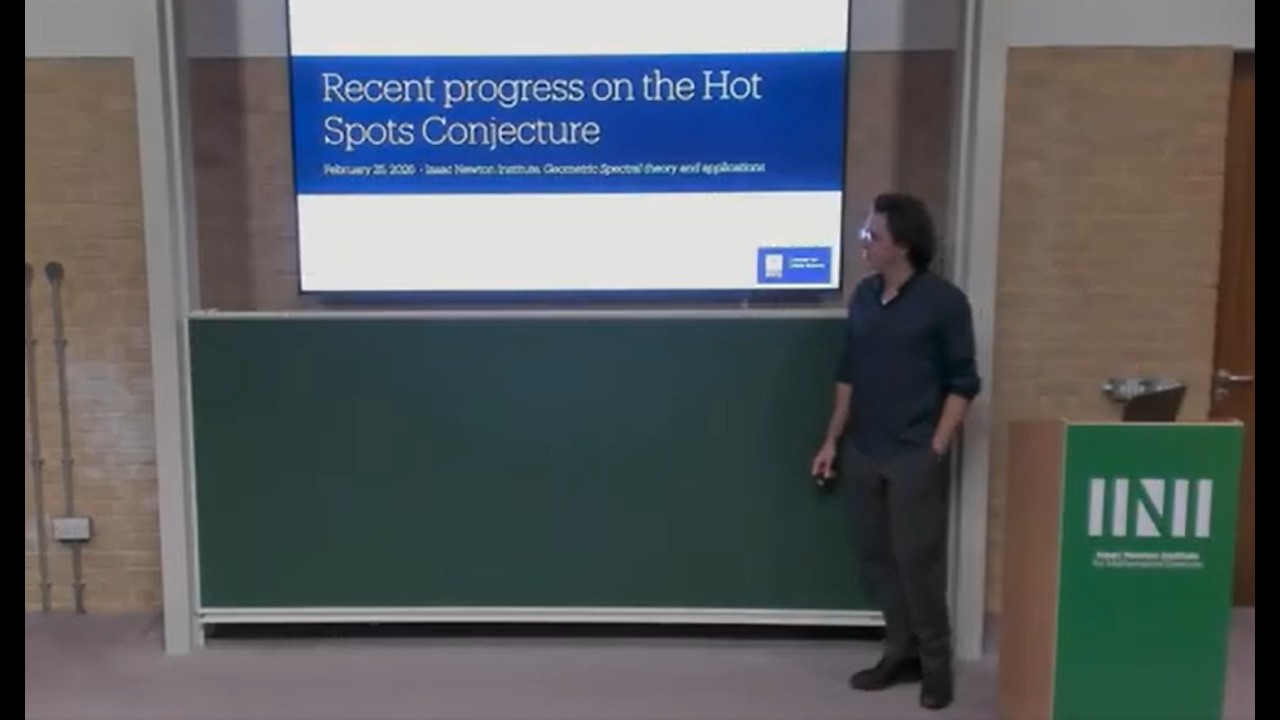
Recent Progress in the Hot Spots Conjecture
Keywords
Summary
178 words
Critical Evaluation
Value of the Information & Strength of the Argument
The talk provides valuable insights into the Hot Spots Conjecture, connecting it to broader themes in spectral theory and homogenization. The speaker’s argumentation is solid, building from classical results to recent developments. He emphasizes the importance of considering variable-coefficient generalizations, which is a novel perspective. The presentation is well-structured, with clear explanations of the physical intuition and mathematical techniques. The speaker also discusses counterexamples and open problems, giving a balanced view of the current state of the field.
Scientific Rigor, Source Quality, Title Accuracy
The talk is scientifically rigorous, with references to classical results (e.g., Payne’s conjecture, homogenization by Cioranescu and Murat) and recent work (e.g., counterexamples by Burdzy and Werner, and by other authors). The speaker is an expert in the field, and the content is presented at a high technical level. The title accurately reflects the content, focusing on recent progress on the Hot Spots Conjecture. The talk is part of a research program at the Isaac Newton Institute, which adds to its credibility.
175 words
Title / Content Match
The title accurately reflects the content, which focuses on recent developments in the Hot Spots Conjecture.
Quality & Reliability
8/10
The talk is a research seminar by a mathematician at ETH Zürich, presenting recent progress and open problems in spectral geometry. The content is rigorous, with references to known results and conjectures, and the speaker is an expert in the field. The presentation is clear and well-structured, though it assumes a high level of mathematical background.
Key Moments
Markers derived by PSI from the transcript: the creator did not define chapters.
- Introduction and motivation: Laplacian and its physical interpretations.
- Payne's conjecture and its Schrödinger operator version.
- Equivalence via homogenization and microscopic perforations.
- Counterexamples to Payne's conjecture with many holes and recent single-hole examples.
- Introduction to the Hot Spots Conjecture and physical intuition.
- Known results: intervals, triangles, convex sets with symmetry, and long domains.
- Counterexamples by Burdzy and Werner and the role of topology.
- Hot Spots ratio and upper bounds by Steinerberger and others.
- Open problems and the importance of variable-coefficient generalizations.
Cited Sources
- INI Seminar page — Event page for the talk, part of the Geometric spectral theory and applications programme.
- Isaac Newton Institute — Institute website, providing context for the research programme.
Concurring Sources
- Hot Spots Conjecture (Wikipedia) — General reference for the conjecture and known results.
External References
Contribution & Novelties
The talk presents recent progress on the Hot Spots Conjecture, including new counterexamples and improved bounds on the Hot Spots ratio. The speaker emphasizes the importance of considering variable-coefficient generalizations, which is a novel perspective that may guide future research. He also connects the Hot Spots Conjecture to the Payne conjecture and homogenization theory, providing a unified framework.
Pour aller plus loin :
- Hot Spots Conjecture (Wikipedia) — Overview of the conjecture and its history.
- Burdzy and Werner’s counterexample (arXiv) — Original paper presenting a counterexample.
- Steinerberger’s paper on Hot Spots ratio (arXiv) — Discusses the Hot Spots ratio and upper bounds.
102 words
Radar Profile
The radar profile shows high scores in quality of information and technical level, reflecting the advanced mathematical content. The quantity of information is also high, but the global reliability is slightly lower due to the speculative nature of some open problems. Overall, the talk is a valuable contribution to the field.
💬 No comments were provided for this video.