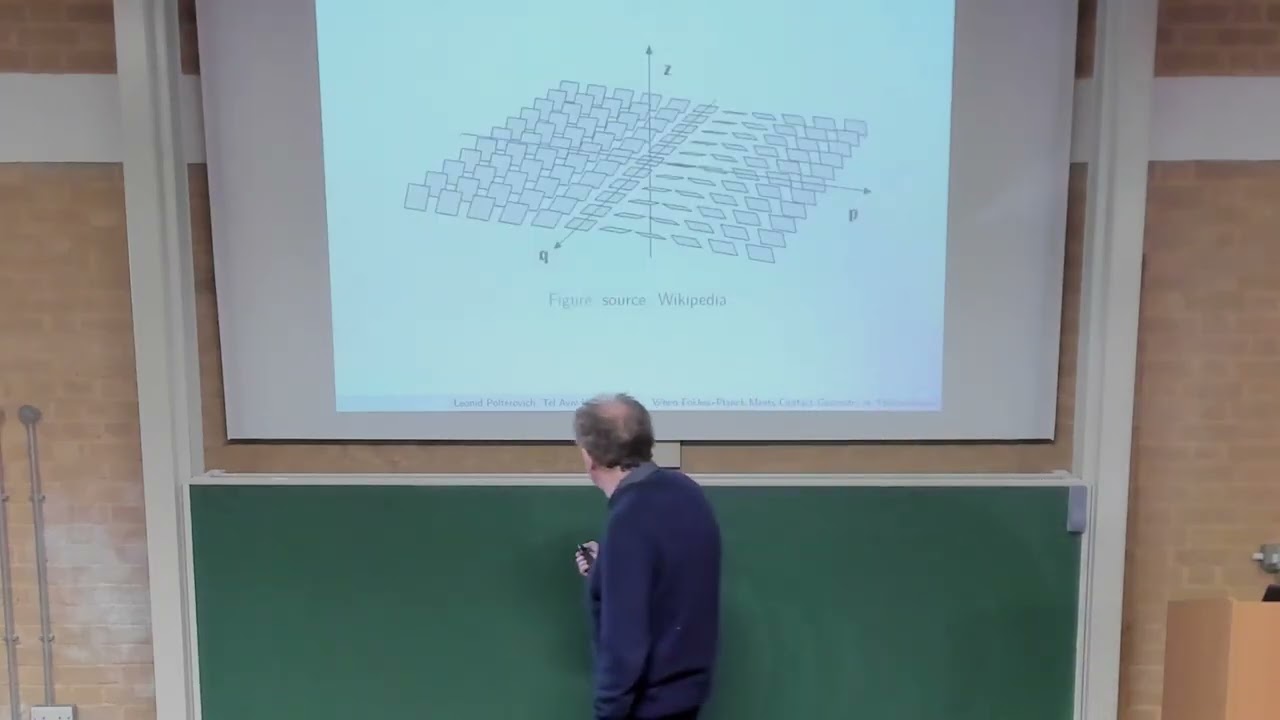
Prof. Leonid Polterovich | When Fokker–Planck Meets Contact Geometry in Thermodynamics
Keywords
Summary
143 words
Critical Evaluation
Value of the Information & Strength of the Argument
The talk provides a novel interdisciplinary perspective, linking abstract geometric structures (contact geometry) to concrete physical phenomena (metastability). The argumentation is rigorous, building from foundational definitions to advanced conjectures, with clear logical progression. The speaker acknowledges open problems and limitations, enhancing credibility. The value lies in offering a new geometric lens for understanding non-equilibrium thermodynamics, potentially inspiring further research.
Scientific Rigor, Source Quality, Title Accuracy
The presentation is scientifically rigorous, with precise mathematical definitions and derivations. The speaker references established concepts (Gibbs, Arrhenius, Wasserstein metric, Witten Laplacian) and mentions recent work by colleagues. The title accurately reflects the content. No external sources are cited in the video, but the description provides links to the Isaac Newton Institute and the specific seminar page, which are relevant for further context.
137 words
Title / Content Match
The title accurately reflects the content, which explores the intersection of Fokker-Planck equations and contact geometry in thermodynamics.
Quality & Reliability
9/10
Presentation by a leading mathematician at a prestigious institute, based on joint research, with rigorous mathematical derivations and references to established concepts.
Key Moments
Markers derived by PSI from the transcript: the creator did not define chapters.
- Introduction to the talk and the motto: geometry (contact) and Fokker-Planck equation coexist in non-equilibrium thermodynamics.
- Definition of the thermodynamic phase space and the Gibbs form, leading to Legendrian submanifolds.
- Introduction of the Curie-Weiss model and its equilibrium Legendrian.
- Discussion of the thermodynamic limit and the appearance of cusps and metastable branches.
- Transition to non-equilibrium: Fokker-Planck as gradient flow of free energy with respect to Wasserstein metric.
- Connection to Witten Laplacian and spectral gap, linking to metastability and Arrhenius law.
- Discussion of metastability in the Curie-Weiss model and comparison with Glauber dynamics.
- Open problems: boundary conditions and singularities in the Fokker-Planck equation on the segment.
- Geometric interpretation of temperature and field jumps, shifting the equilibrium Legendrian.
- Concluding remarks and outlook on the role of contact geometry in non-equilibrium thermodynamics.
Cited Sources
- Isaac Newton Institute Seminar Page — Event page for the talk, providing details on the seminar series.
- Isaac Newton Institute Website — General information about the institute and its research programs.
- Isaac Newton Institute LinkedIn — Professional network page for the institute.
Concurring Sources
- Isaac Newton Institute Seminar Page — Official event page confirming the talk's details.
Contribution & Novelties
The talk presents original research connecting contact geometry to Fokker-Planck dynamics, offering a new geometric perspective on metastability in thermodynamics. It introduces the concept of equilibrium Legendrians and their behavior in the thermodynamic limit, with implications for non-equilibrium processes.
Pour aller plus loin :
- Contact geometry — Foundational concept for the talk.
- Fokker-Planck equation — Central PDE discussed.
- Wasserstein metric — Key metric in the gradient flow formulation.
- Witten Laplacian — Operator related to spectral gap and metastability.
- Morse theory — Used to analyze critical points and spectral gaps.
89 words
Radar Profile
The radar profile shows high scores across all dimensions, indicating a technically deep, well-sourced, and original presentation. The balance between information quantity and quality is strong, with a slight emphasis on technical level, reflecting the advanced nature of the content.
💬 Sur les 0 commentaires analysés, aucune tendance n'est disponible.