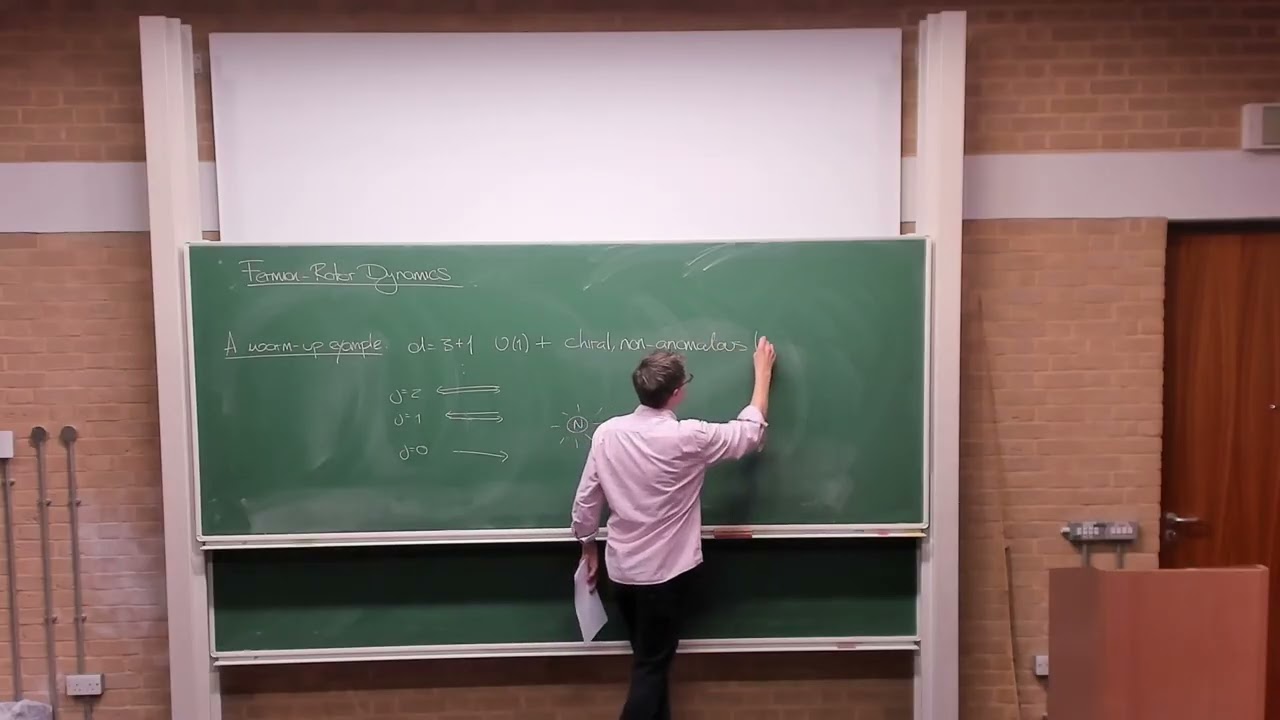
Prof. David Tong | The Fermion-Rotor Model
Keywords
Summary
168 words
Critical Evaluation
Value of the Information & Strength of the Argument
The talk provides valuable insights into a long-standing problem in quantum field theory, offering a concrete model that captures the essential physics. The argumentation is rigorous, building from the motivation to the specific model and its surprising consequences. Tong effectively uses analogies (e.g., graphene) and addresses questions from the audience, strengthening the presentation.
Scientific Rigor, Source Quality, Title Accuracy
The presentation is scientifically rigorous, with clear logical progression and references to established work (e.g., Callan, Cardy). The title accurately reflects the content. The talk is based on recent research by the speaker and collaborators, and while not peer-reviewed in this format, it is presented at a reputable institution. The description provides links to the institute and the specific seminar, but no direct references to papers are given.
136 words
Title / Content Match
The title accurately reflects the content, which focuses on the fermion-rotor model as a key example in the talk.
Quality & Reliability
8/10
Presentation by a leading physicist at a renowned institute, based on recent research and established literature, but not peer-reviewed in this format.
Key Moments
Markers derived by PSI from the transcript: the creator did not define chapters.
- Introduction and motivation: the puzzle of electron-monopole scattering.
- Setup of the chiral gauge theory and the reduction to 1+1 dimensions.
- Introduction of the 3450 model and the boundary condition problem.
- Discussion of Cardy states and the existence of symmetry-preserving boundary conditions.
- The scattering problem: what bounces back? The surprising answer involving twisted sectors.
- Interpretation of the result: the boundary as a portal to a twisted sector.
- Discussion of the implications for monopole physics and open questions.
- Further elaboration on the twisted sector and its properties.
- Conclusion and summary of key points.
Cited Sources
- Isaac Newton Institute for Mathematical Sciences — Official website of the institute hosting the seminar.
- Seminar page: Quantum field theory with boundaries, impurities, and defects — Event page for the seminar series where this talk was given.
Concurring Sources
- Callan-Rubakov effect — Describes the phenomenon of fermion-monopole scattering, which motivates the talk.
External References
Contribution & Novelties
The talk presents recent research by David Tong and collaborators on the fermion-rotor model, offering a concrete resolution to the puzzle of charge conservation in chiral boundary scattering. The key novelty is the demonstration that conformal boundary conditions can lead to scattering into twisted sectors of the Hilbert space, which are not visible in the perturbative Fock space. This provides a new perspective on the role of boundaries in quantum field theory and has implications for understanding monopole physics.
Pour aller plus loin :
- Callan-Rubakov effect — Related to monopole-induced baryon decay.
- Conformal field theory — Framework for boundary states.
- Twisted sector — Concept in orbifold theories, relevant to the twisted sectors discussed.
113 words
Radar Profile
The radar profile shows high scores in all dimensions, with a particularly strong emphasis on technical depth and information quality, reflecting the advanced nature of the talk.