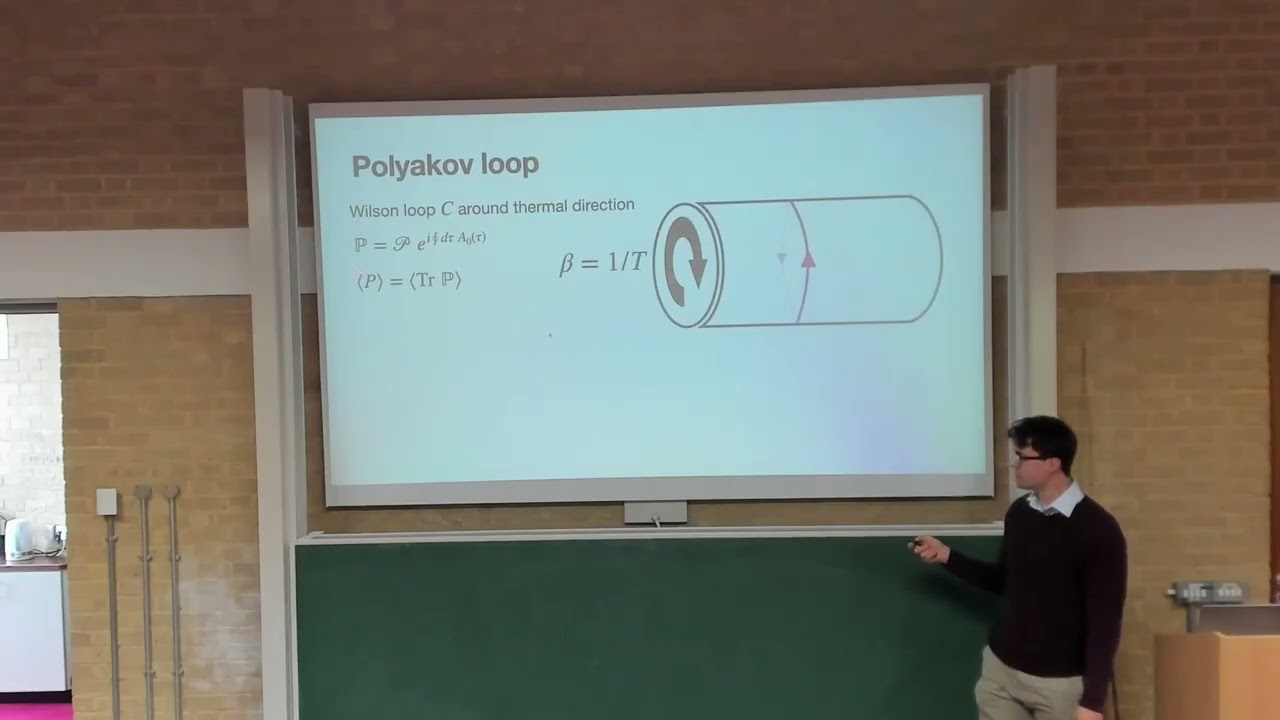
Dr. Jack Holden | BPS black holes, Instanton Condensation, and Partial Deconfinement
Keywords
Summary
221 words
Critical Evaluation
Value of the Information & Strength of the Argument
The talk provides a valuable overview of recent research connecting black hole physics, gauge theory, and matrix models. The argumentation is logically structured, starting from known phase diagrams and progressively introducing the superconformal index and matrix model techniques. The speaker clearly explains the paradox arising from the index calculation and proposes a resolution involving instanton condensation. The reasoning is supported by references to prior work, though the presentation is concise and assumes a high level of expertise.
Scientific Rigor, Source Quality, Title Accuracy
The talk demonstrates scientific rigor through the use of established concepts and references to literature, such as the Gross-Witten-Wadia transition and the work of Aharony et al. The sources cited are primarily from the description, including the Isaac Newton Institute website and seminar page. The title accurately reflects the content, which is a specialized research talk. The speaker does not provide a detailed bibliography, but the references mentioned are appropriate for the topic.
165 words
Title / Content Match
The title accurately reflects the content, which discusses BPS black holes, instanton condensation, and partial deconfinement.
Quality & Reliability
8/10
The talk is a research seminar by a physicist at Tsinghua University, presenting original work with mathematical derivations and references to established literature. The content is technical and appears rigorous, though not peer-reviewed in this format.
Key Moments
Markers derived by PSI from the transcript: the creator did not define chapters.
- Introduction to the holographic map and phase diagram of black holes in AdS5×S5.
- Discussion of the small black hole phase and proposal of partial deconfinement.
- Introduction of the Polyakov loop and its eigenvalue distribution as a tool.
- Explanation of the superconformal index and its invariance under RG flow.
- Matrix model approach and complex saddles for the index.
- Presentation of the index phase diagram and the paradox regarding partial deconfinement.
- Discussion of chemical potential effects and explicit breaking of gauge symmetry.
- Introduction of instanton condensation and its role in matrix models.
- Connection of instantons to wrapped D3-branes and implications for the paradox.
Cited Sources
- Isaac Newton Institute for Mathematical Sciences — The institute hosting the seminar and providing general information.
- Seminar page for the event — Details of the seminar where the talk was given.
- LinkedIn page of the Isaac Newton Institute — Social media presence of the institute.
Concurring Sources
- Isaac Newton Institute for Mathematical Sciences — The institute hosting the seminar and providing general information.
- Seminar page for the event — Details of the seminar where the talk was given.
Contribution & Novelties
The talk presents original research proposing a connection between BPS black holes, instanton condensation, and partial deconfinement. It offers a new perspective on the holographic dual of small black holes and suggests that instantons may resolve the paradox of missing entropy in the index calculation. The work builds on existing literature but provides new insights into the role of instantons in matrix models and their potential holographic interpretation.
Pour aller plus loin :
- Gross-Witten-Wadia transition — Key concept in matrix models and gauge theory.
- Superconformal index — Central tool used in the talk.
- AdS/CFT correspondence — Framework for the holographic map.
101 words
Radar Profile
The radar profile shows high scores in technical level and information quality, with slightly lower but still strong scores in quantity and reliability. This indicates a highly specialized and rigorous presentation, suitable for an expert audience.