Dr. Matthew Colbrook | Masterclass: spectral/computational operator methods II
Keywords
Summary
140 words
Critical Evaluation
Value of the Information & Strength of the Argument
The lecture provides significant value by addressing a key limitation of standard EDMD—the loss of unitarity—and offering a principled solution. The argumentation is rigorous, with clear mathematical definitions, theorems, and convergence results. The speaker supports claims with numerical experiments on both synthetic and real-world data, demonstrating the practical benefits. The discussion of spectral measures and their connection to correlations is insightful, and the convergence analysis in the Wasserstein metric is a strong contribution. The presentation is well-structured, building from basic concepts to advanced topics, and includes interactive Q&A that clarifies subtle points.
Scientific Rigor, Source Quality, Title Accuracy
The scientific rigor is high: the content is mathematically precise, and the speaker is an expert in the field. The talk references prior work (e.g., by Steve Brunton on physics-informed DMD) and mentions relevant literature (e.g., Dunford and Schwartz), though specific citations are not provided in the description. The title accurately reflects the content, focusing on spectral and computational operator methods. The lecture is part of a reputable Isaac Newton Institute program, adding credibility. However, the lack of explicit references in the description limits the ability to verify all claims independently.
198 words
Title / Content Match
The title accurately reflects the content: a masterclass on spectral and computational operator methods, focusing on unitary approximations and spectral measures.
Quality & Reliability
8/10
The lecture presents rigorous mathematical content with clear definitions, theorems, and convergence results. The speaker is an expert from the University of Cambridge, and the talk is part of an Isaac Newton Institute program, ensuring high academic standards. The presentation includes numerical examples and comparisons, but the lack of peer-reviewed references in the description slightly limits verifiability.
Key Moments
Markers derived by PSI from the transcript: the creator did not define chapters.
- Introduction and setup: measure-preserving dynamical systems, Koopman operator, and the goal of approximating the continuous spectrum.
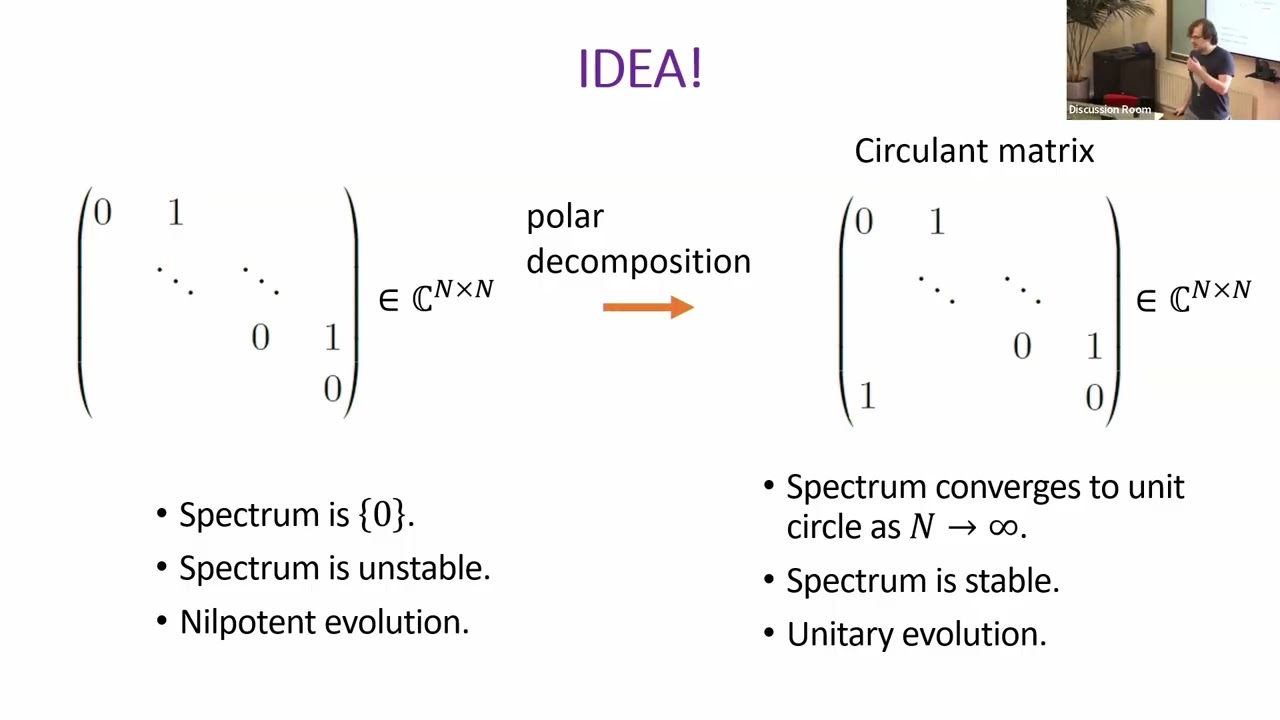
- Discussion of the shift operator example and the need for unitary approximations.
- Introduction to Measure-Preserving EDMD (MPEDMD) and its formulation as a constrained least-squares problem.
- Explanation of the polar decomposition and its role in obtaining unitary approximations.
- Definition of spectral measures and their physical interpretation in terms of correlations.
- Convergence theorem for spectral measures in the Wasserstein metric, with a rate for delay-embedding subspaces.
- Numerical example on the Lorenz system showing convergence of spectral measures.
- Application to turbulent jet data: comparison of MPEDMD, PiDMD, and EDMD in forecasting kinetic energy.
- Discussion of the importance of preserving the correct inner product and the limitations of PiDMD.
- Preview of generalized functions and Rigged DMD for approximating spectral measures and Koopman modes.
Cited Sources
- Isaac Newton Institute — The lecture is hosted by the Isaac Newton Institute for Mathematical Sciences.
- Event page for the seminar — Details of the seminar series 'Operator methods for dynamical systems'.
Concurring Sources
- Koopman operator — The lecture builds on the theory of Koopman operators.
- Dynamic mode decomposition — The lecture discusses EDMD and its variants.
Contribution & Novelties
The lecture presents a novel approach to approximating the continuous spectrum of Koopman operators by enforcing unitarity in EDMD, leading to stable and accurate spectral measures. The convergence analysis in the Wasserstein metric is a significant contribution, providing theoretical guarantees. The application to turbulent flows demonstrates practical relevance.
Pour aller plus loin :
- Koopman operator — Foundational concept for the lecture.
- Spectral measure — Mathematical background on spectral measures.
- Dynamic mode decomposition — Related method discussed in the lecture.
- Wasserstein metric — Metric used for convergence analysis.
87 words
Radar Profile
The radar profile shows high scores in information quantity, quality, and technical level, reflecting a dense and rigorous lecture. The global reliability is also high, though slightly lower due to limited external references. The overall note of 4 stars indicates an excellent presentation with minor limitations in verifiability.