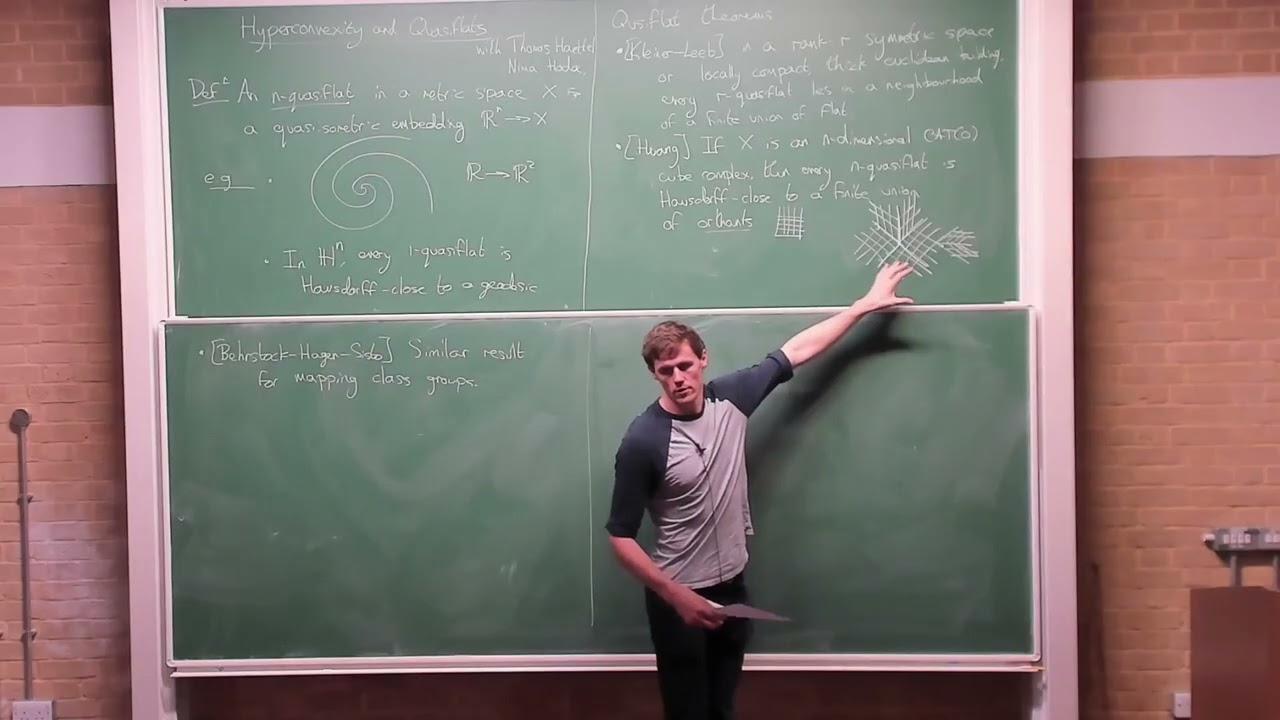
Hyperconvexity and quasiflats
Keywords
Summary
175 words
Critical Evaluation
Value of the Information & Strength of the Argument
The talk provides a valuable overview of quasiflat rigidity theorems and hyperconvex spaces, connecting them to recent research. The argumentation is clear and well-structured, with concrete examples and motivations. The speaker explains why top-dimensional quasiflats are the right objects to study and how hyperconvexity relates to geometric group theory. The presentation is rigorous, with references to key results and open questions.
Scientific Rigor, Source Quality, Title Accuracy
The talk is scientifically rigorous, presenting established theorems and recent results. The speaker cites specific researchers and results, though no formal references are given in the video. The title accurately reflects the content. The talk is part of a research seminar at the Isaac Newton Institute, indicating a high level of expertise. The description provides links to the institute and the specific seminar page, which may contain further details.
145 words
Title / Content Match
The title accurately reflects the content, which focuses on hyperconvexity and quasiflats.
Quality & Reliability
8/10
Talk by a researcher at a recognized institute (INI), presenting established results and recent work in geometric group theory. The content is technical and appears accurate, but as a seminar talk it may not have undergone peer review.
Key Moments
Markers derived by PSI from the transcript: the creator did not define chapters.
- Introduction to quasiflats and examples of bad quasiflats
- Discussion of top-dimensional quasiflats and rigidity theorems
- Review of Kleiner-Leeb and Huang results
- Motivations: quasi-isometric rigidity and obstructions
- Introduction to hyperconvex spaces and examples
- Non-examples and the four-ball criterion
- Isbell's theorem and hyperconvex hulls
- Dress's construction of the hull
- Applications to groups acting on hyperconvex spaces
Cited Sources
- Isaac Newton Institute seminar page — Official page for the seminar, providing details and possibly slides.
- Isaac Newton Institute website — General information about the institute and its research programmes.
- LinkedIn page of the Isaac Newton Institute — Social media presence of the institute.
Concurring Sources
- Kleiner and Leeb, 'Rigidity of quasi-isometries for symmetric spaces and Euclidean buildings' — Cited in the talk as an early quasiflat theorem.
- Huang, 'Quasi-flats in CAT(0) cube complexes' — Cited as a result for CAT(0) cube complexes.
- Behrstock, Hagen, and Sisto, 'Quasiflats in hierarchically hyperbolic spaces' — Cited for mapping class groups and hierarchically hyperbolic spaces.
Contribution & Novelties
The talk synthesizes recent results on quasiflat rigidity and hyperconvex spaces, highlighting connections between them. It provides a clear exposition of the state of the art, including open questions. The speaker’s perspective on hyperconvex spaces as L-infinity analogues of CAT(0) cube complexes is insightful.
Pour aller plus loin :
- Quasiflats in CAT(0) spaces — Background on CAT(0) spaces.
- Injective metric spaces — Overview of injective spaces.
- Geometric group theory — Context for the talk.
74 words
Radar Profile
The radar profile shows high scores in technical level and information quality, with slightly lower but still strong scores in quantity and reliability. This indicates a technically dense and reliable seminar talk, suitable for an expert audience.