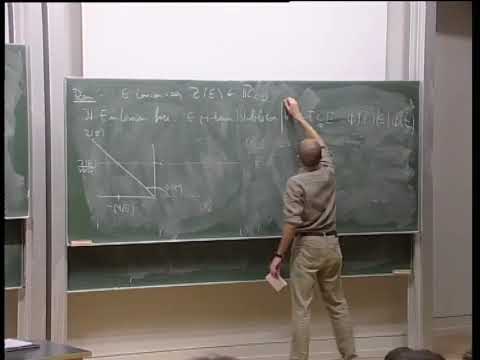
Prof. Daniel Huybrechts | Introduction to derived categories and stability conditions - I
Keywords
Summary
136 words
Critical Evaluation
Value of the Information & Strength of the Argument
The lecture provides a solid foundation for understanding stability conditions by revisiting classical slope stability and abstracting it to the notion of torsion theories. The argumentation is rigorous and well-motivated, with clear explanations of why certain definitions are natural. Huybrechts effectively uses the example of curves to illustrate concepts and then points out the limitations when generalizing to surfaces, motivating the need for more sophisticated tools. The presentation is logical and builds progressively, making it valuable for both newcomers and those seeking a refresher.
Scientific Rigor, Source Quality, Title Accuracy
The lecture is scientifically rigorous, with the speaker citing relevant literature such as the works of Dickson, Gabriel, HRS, and Banica-Wron. The title accurately reflects the content, as it is indeed an introduction to derived categories and stability conditions. The lecture is part of a formal school, and the speaker is a recognized expert, adding to its credibility. The sources mentioned are appropriate and well-known in the field.
167 words
Title / Content Match
The title accurately reflects the content: an introductory lecture on derived categories and stability conditions, focusing on torsion theories and t-structures.
Quality & Reliability
9/10
Lecture by a leading expert in algebraic geometry, part of a formal school at the Isaac Newton Institute. Content is mathematically rigorous, well-structured, and historically grounded, with references to classical and recent literature.
Key Moments
Markers derived by PSI from the transcript: the creator did not define chapters.
- Introduction and overview of the lecture series
- Definition of slope stability for sheaves on curves
- Introduction of the stability function Z and phase
- Harder-Narasimhan and Jordan-Hölder filtrations
- Discussion of slices and subcategories P(φ)
- Torsion theories: definition and examples
- Generalization to surfaces and limitations
- Conclusion and outlook for next lectures
Cited Sources
- School on moduli spaces — Event page for the lecture series
Concurring Sources
- Stability conditions on triangulated categories — Bridgeland's foundational paper on stability conditions, which the lecture builds towards.
Contribution & Novelties
This lecture provides a clear and accessible introduction to the concepts of derived categories and stability conditions, emphasizing the importance of torsion theories and t-structures. It bridges classical slope stability with modern stability conditions, offering a pedagogical perspective that is valuable for learners. The lecture also highlights the limitations of naive generalizations to higher dimensions, motivating the need for more sophisticated approaches.
Pour aller plus loin :
- Derived category — Wikipedia article providing an overview of derived categories.
- Stability condition — Wikipedia article on Bridgeland stability conditions, a central concept in the field.
- Torsion theory — Wikipedia article on torsion theories in abelian categories.
- Harder–Narasimhan filtration — Wikipedia article on the Harder–Narasimhan filtration, a key concept in the lecture.
119 words
Radar Profile
The radar profile shows high scores in quantity and quality of information, with a slightly lower but still strong score in technical level, reflecting the advanced nature of the content. The overall reliability is high, consistent with the expert presentation.
💬 No comments were provided for analysis.