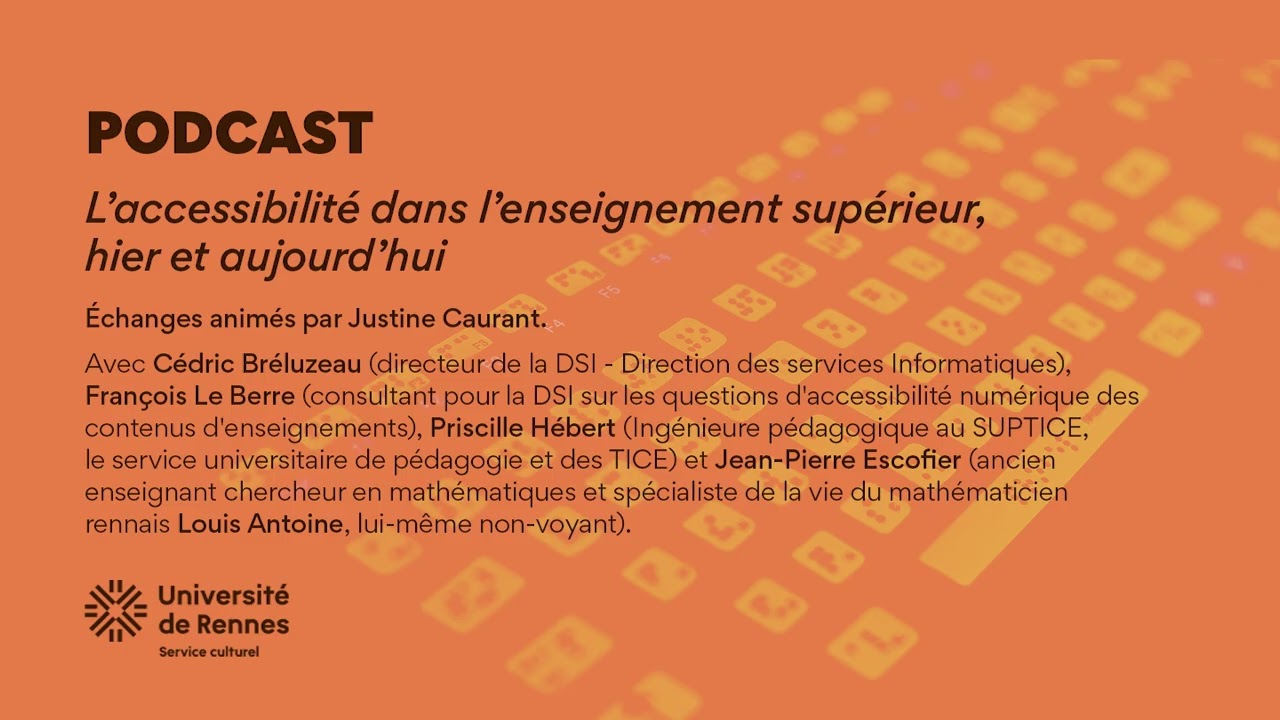
Podcast “L’accessibilité dans l’enseignement supérieur, hier et aujourd’hui”
Keywords
Summary
148 words
Critical Evaluation
Value of the Information & Strength of the Argument
The podcast provides valuable insights into both historical and contemporary aspects of accessibility in higher education. The historical segment on Louis Antoine is well-researched and offers a compelling narrative about a pioneering figure. The contemporary discussion is grounded in real-world experiences, particularly François Le Berre’s personal testimony, which effectively illustrates the challenges faced by students with visual impairments. The argumentation is coherent, with speakers building on each other’s points to emphasize the need for systemic change. However, the discussion is largely anecdotal and lacks empirical data or references to broader research on accessibility.
Scientific Rigor, Source Quality, Title Accuracy
The podcast demonstrates a reasonable level of scientific rigor, with speakers who are experts in their fields. The historical information about Louis Antoine is based on documented research, and the contemporary discussion reflects current practices and regulations. However, the podcast does not cite specific sources or studies, and the reliance on personal testimony may limit its generalizability. The title accurately reflects the content, and the discussion stays on topic throughout.
178 words
Title / Content Match
The title accurately reflects the content, which compares historical and contemporary accessibility in higher education.
Quality & Reliability
7/10
The podcast features expert speakers with direct experience in accessibility, including a blind consultant and a historian. The content is well-structured and grounded in personal testimony and historical facts. However, it lacks formal citations or references to scientific studies, and the discussion is largely anecdotal.
Key Moments
Markers derived by PSI from the transcript: the creator did not define chapters.
- Introduction to Louis Antoine and his significance.
- Jean-Pierre Escofier discusses Louis Antoine's career and the invention of Braille mathematics.
- François Le Berre shares his experience as a blind student in the digital age.
- Discussion on the challenges of PDF documents and the need for accessible formats.
- Cédric Bréluzeau explains the university's approach to digital accessibility.
- Priscille Hébert discusses universal design for learning and the variety of student needs.
- The panel discusses the importance of training and awareness for teachers.
- Conclusion and call to action for improving accessibility.
Cited Sources
- Référentiel Général d'Amélioration de l'Accessibilité (RGAA) — Mentioned as the French accessibility standard for digital services.
- NVDA screen reader — François Le Berre mentions using NVDA, a free open-source screen reader.
- Moodle — The learning management system used by the university for course materials.
Concurring Sources
Contribution & Novelties
The podcast offers a unique perspective by connecting historical and contemporary accessibility issues in higher education. It highlights the often-overlooked contributions of Louis Antoine and provides a personal account of the challenges faced by a blind student today. The discussion emphasizes the importance of user expertise and universal design, which are valuable insights for educational institutions.
Pour aller plus loin :
- Universal Design for Learning (UDL) — A framework for designing educational materials that are accessible to all students.
- Web Content Accessibility Guidelines (WCAG) — International standards for web accessibility, relevant to digital course materials.
- Louis Antoine (mathematician) — More information about the historical figure discussed in the podcast.
109 words
Radar Profile
The radar profile shows high scores in information quantity and quality, reflecting the podcast's rich content and expert insights. The technical level is moderate, as the discussion is accessible to a general audience. The overall reliability is good, though the lack of formal citations slightly reduces the score.
💬 No comments were provided for analysis.