African Studies Global Virtual Forum: Decoloniality & Southern Epistemologies - Peter Mose
Keywords
Summary
170 words
Critical Evaluation
Value of the Information & Strength of the Argument
The talk provides valuable insights into the historical and contemporary challenges of language policy in Africa, particularly Kenya. Mose’s argument is well-structured, moving from historical context to current practices and future directions. He supports his claims with references to key scholars like Ngũgĩ wa Thiong’o and Neville Alexander, as well as official reports (Ominde Commission, UNESCO). However, the argumentation is largely anecdotal and relies on personal observations and selected evidence, lacking systematic empirical data. The speaker’s passion and personal experience add authenticity but also introduce potential bias. The call for intellectualizing African languages is compelling and aligns with broader decolonial scholarship, but the practical implementation remains underexplored.
Scientific Rigor, Source Quality, Title Accuracy
The speaker demonstrates academic rigor by referencing established scholars and official documents, such as Ngũgĩ’s ‘Decolonizing the Mind’ and the 1953 UNESCO report. However, some references are mentioned without full citations, and the talk is not a peer-reviewed presentation. The title accurately reflects the content, focusing on decoloniality and Southern epistemologies. The speaker’s credentials lend credibility, but the lack of a formal methodology and the reliance on personal anecdotes limit the scientific rigor. The talk is more of an expert opinion than a systematic study.
207 words
Title / Content Match
The title accurately reflects the content: a forum on decoloniality and Southern epistemologies, focusing on the intellectualization of African languages.
Quality & Reliability
7/10
The speaker is a senior lecturer with a PhD in African languages, and the talk is grounded in academic references (Ngũgĩ, Alexander, UNESCO, etc.). However, it is primarily an opinion/expert talk with limited empirical data and no systematic methodology.
Key Moments
Markers derived by PSI from the transcript: the creator did not define chapters.
- Introduction of Dr. Peter Mose by the host, highlighting his academic background.
- Mose begins his talk, sharing his personal language background (Ekegusii) and the use of code-switching in Kenyan classrooms.
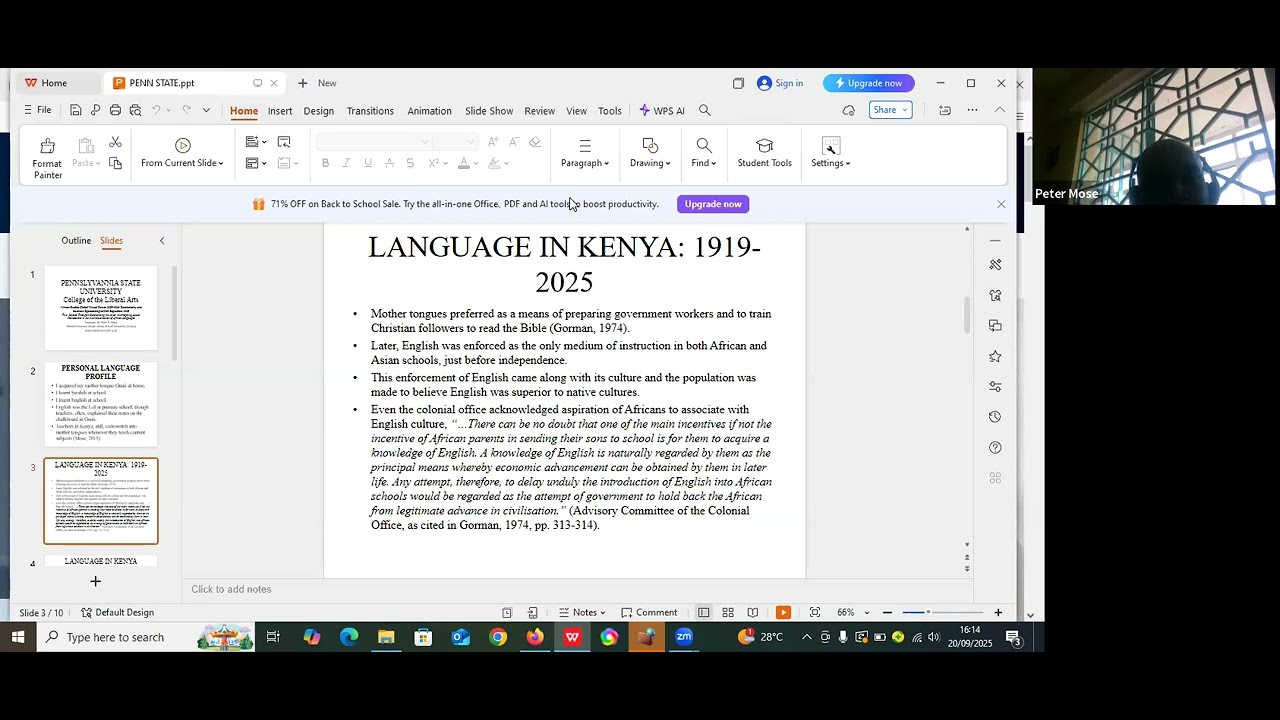
- Discussion of colonial language policies from 1919, including missionary and colonial decisions, and the shift to English-only instruction.
- Quotes from the colonial advisory committee and the Ominde Commission (1963) recommending English as the medium of instruction.
- Mose discusses the cultural bomb concept from Ngũgĩ wa Thiong'o and its impact on African self-perception.
- Examples of current practices: students punished for speaking mother tongues, and the lack of African language curricula.
- Mose highlights the role of media in promoting African languages and the need for intellectualization through use as languages of instruction.
- Discussion of the absence of African language textbooks that incorporate indigenous knowledge systems, and the need to decolonize curricula.
- Mose concludes with a call to foreground African realities and heritages in education, and to adopt critical literacy pedagogies.
Cited Sources
- Decolonizing the Mind: The Politics of Language in African Literature — Referenced by Mose to explain the concept of the 'cultural bomb' and its effects on African identity.
- UNESCO 1953 report on the use of vernacular languages in education — Cited to support the argument for mother-tongue instruction.
- Ominde Commission (1963) report on education in Kenya — Referenced as the commission that recommended English as the medium of instruction from grade one.
- Neville Alexander's work on language policy in South Africa — Quoted on the 'unassailable but unattainable' nature of English and the lip service paid to multilingualism.
Concurring Sources
- UNESCO 1953 report on the use of vernacular languages in education — Supports the argument for mother-tongue instruction.
- Ngũgĩ wa Thiong'o - Decolonizing the Mind — Provides theoretical framework for the cultural bomb and language decolonization.
Dissenting Sources
- Ominde Commission (1963) report — The commission recommended English as the medium of instruction, contradicting the speaker's advocacy for mother-tongue education.
Contribution & Novelties
The talk offers a personal and scholarly perspective on the decolonization of African languages, emphasizing the need to intellectualize them through use as languages of instruction. It highlights the gap between policy and practice in Kenya and other African countries, and calls for a radical rethinking of curricula to include indigenous knowledge systems. The speaker’s own research on scientific vocabulary in African languages adds a novel dimension.
Pour aller plus loin :
- Ngũgĩ wa Thiong’o - Decolonizing the Mind — Foundational text on language and decolonization.
- UNESCO - Mother tongue instruction — Policy background on language of instruction.
- Neville Alexander - Language policy — Key scholar on multilingualism in South Africa.
111 words
Radar Profile
The radar profile shows high scores in information quantity and quality, reflecting the speaker's expertise and the depth of the discussion. The technical level is moderate, suitable for an academic audience but accessible. The overall reliability is good, though the talk is opinion-based rather than empirical.
💬 No comments were provided for analysis.