AFR Global Virtual Forum: Decoloniality & Southern Epistemologies - Philomena Ama Okyeso Yeboah
Keywords
Summary
198 words
Critical Evaluation
Value of the Information & Strength of the Argument
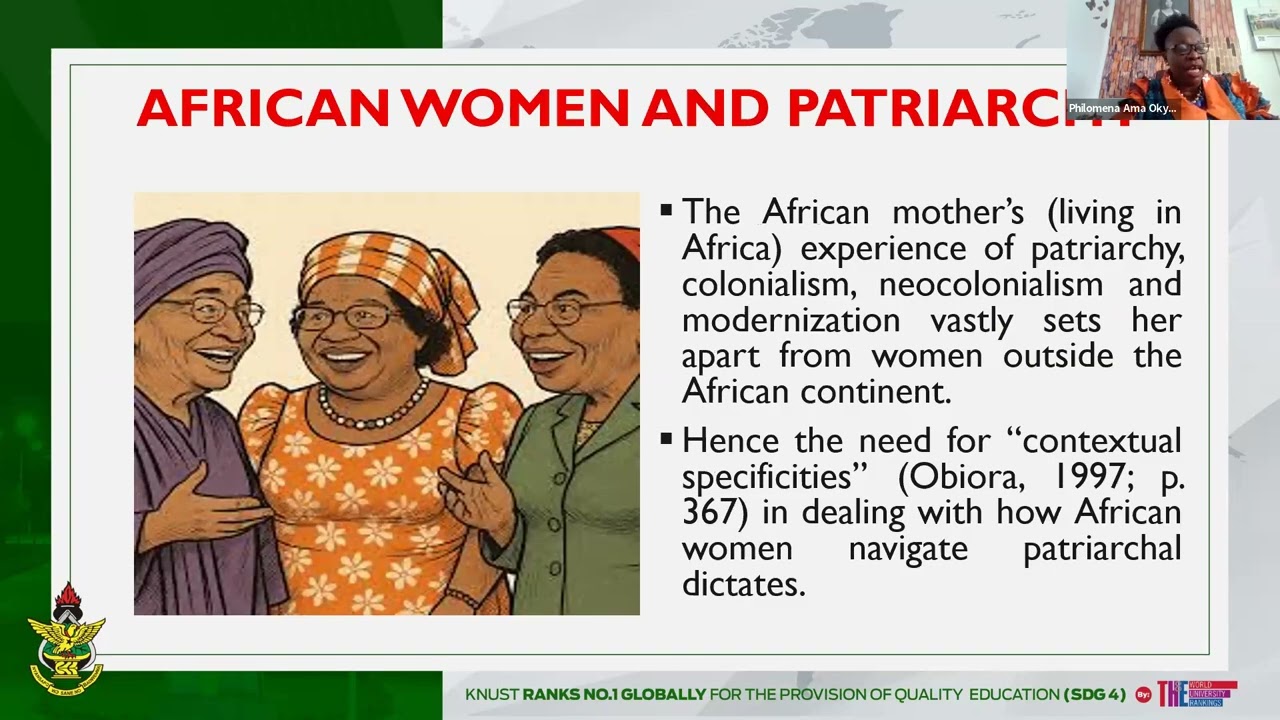
The presentation offers valuable insights into African feminist theories and their application to literary analysis. Dr. Yeboah effectively argues that African mothers are not passive victims but active agents who negotiate their spaces within patriarchal structures. She supports her argument with a range of literary examples and theoretical frameworks, demonstrating a deep understanding of the subject. However, the argumentation could be strengthened by more direct engagement with counterarguments and a clearer distinction between her personal opinions and established scholarly positions.
Scientific Rigor, Source Quality, Title Accuracy
The talk demonstrates a strong grounding in African feminist scholarship, referencing key theorists such as Molara Ogundipe, Chikwenye Okonjo Ogunyemi, Mary Modupe Kolawole, Catherine Acholonu, and Akachi Adimora-Ezeigbo. The literary texts analyzed are well-known and relevant. However, the presentation is an expert opinion rather than a systematic review, and some claims lack explicit citations. The title accurately reflects the content, which focuses on decoloniality and Southern epistemologies through the lens of African motherhood and feminist theory.
171 words
Title / Content Match
The title accurately reflects the content, which focuses on decoloniality and Southern epistemologies through the lens of African motherhood and feminist theory.
Quality & Reliability
7/10
The presentation is grounded in established African feminist theories and literary analysis, with clear references to key scholars and texts. However, it is an opinion/expert talk rather than a peer-reviewed study, and some claims lack direct citations.
Key Moments
Markers derived by PSI from the transcript: the creator did not define chapters.
- Introduction: Dr. Yeboah shares her personal journey as an African mother and career woman, highlighting the tensions between expectations and reality.
- Overview of African feminist theories: womanism, stiwanism, motherism, snail-sense feminism, and negofeminism.
- Discussion of motherism as the theoretical lens, with reference to Catherine Acholonu's work.
- Critique of early African male writers' portrayal of women, and the emergence of female writers who rewrite these narratives.
- Analysis of Mariama Bâ's 'So Long a Letter' and the strategies of negotiation used by the female characters.
- Analysis of Amma Darko's 'Faceless' and the contrasting portrayals of mothers, highlighting the role of education and activism.
- Analysis of Alice Walker's 'Possessing the Secret of Joy' and the complexities of motherhood and resistance.
- Analysis of Chimamanda Ngozi Adichie's 'Purple Hibiscus' and the theme of escape through education and art.
- Conclusion: The bane of African mothers' progress is the patriarchal system, but they can strategically negotiate their spaces to achieve freedom and self-actualization.
Cited Sources
- Daughters of Anoa: African Women and Patriarchy — Referenced as a key text analyzing African women's lives and the myth of Anoa.
- Womanism and African Consciousness — Referenced as a foundational work by Mary Modupe Kolawole on womanism.
- Motherism: The Afrocentric Alternative to Feminism — Referenced as the theoretical lens by Catherine Acholonu.
- So Long a Letter — Analyzed as a novel by Mariama Bâ depicting women's negotiation of patriarchal structures.
- Faceless — Analyzed as a novel by Amma Darko depicting the struggles of mothers and the role of an NGO worker.
- Possessing the Secret of Joy — Analyzed as a novel by Alice Walker (though the speaker attributes it to 'Chika Inigu' - likely a mispronunciation) exploring themes of motherhood and resistance.
- Purple Hibiscus — Analyzed as a novel by Chimamanda Ngozi Adichie depicting a young woman's escape from patriarchal oppression.
Concurring Sources
- African feminism — Provides background on African feminist theories and movements.
- Womanism — Explains the concept of womanism, which is central to the talk.
- Motherism — Defines motherism, the theoretical lens used in the presentation.
Dissenting Sources
- Critiques of snail-sense feminism — The speaker acknowledges that snail-sense feminism has been criticized for being too slow or passive in achieving emancipation.
Contribution & Novelties
The talk provides a comprehensive overview of African feminist theories and applies them to literary analysis, offering a nuanced perspective on how African mothers negotiate patriarchal structures. It highlights the importance of motherism as a theoretical lens and emphasizes the role of literature in rewriting women’s narratives. The speaker’s personal experience adds a unique dimension to the discussion.
Pour aller plus loin :
- African feminism — Overview of African feminist movements and theories.
- Womanism — Definition and history of womanism as a feminist framework.
- Motherism — Explanation of motherism as an Afrocentric feminist theory.
- Chimamanda Ngozi Adichie — Author of ‘Purple Hibiscus’ and prominent feminist voice.
- Mariama Bâ — Author of ‘So Long a Letter’ and Senegalese feminist writer.
119 words
Radar Profile
The radar profile shows high scores in quantity and quality of information, reflecting the speaker's extensive knowledge and use of literary examples. The technical level is moderate, suitable for an academic audience but not overly specialized. Overall reliability is good, though the presentation is an expert opinion rather than a peer-reviewed study.
💬 Sur les 0 commentaires analysés, aucune tendance n'a pu être dégagée.