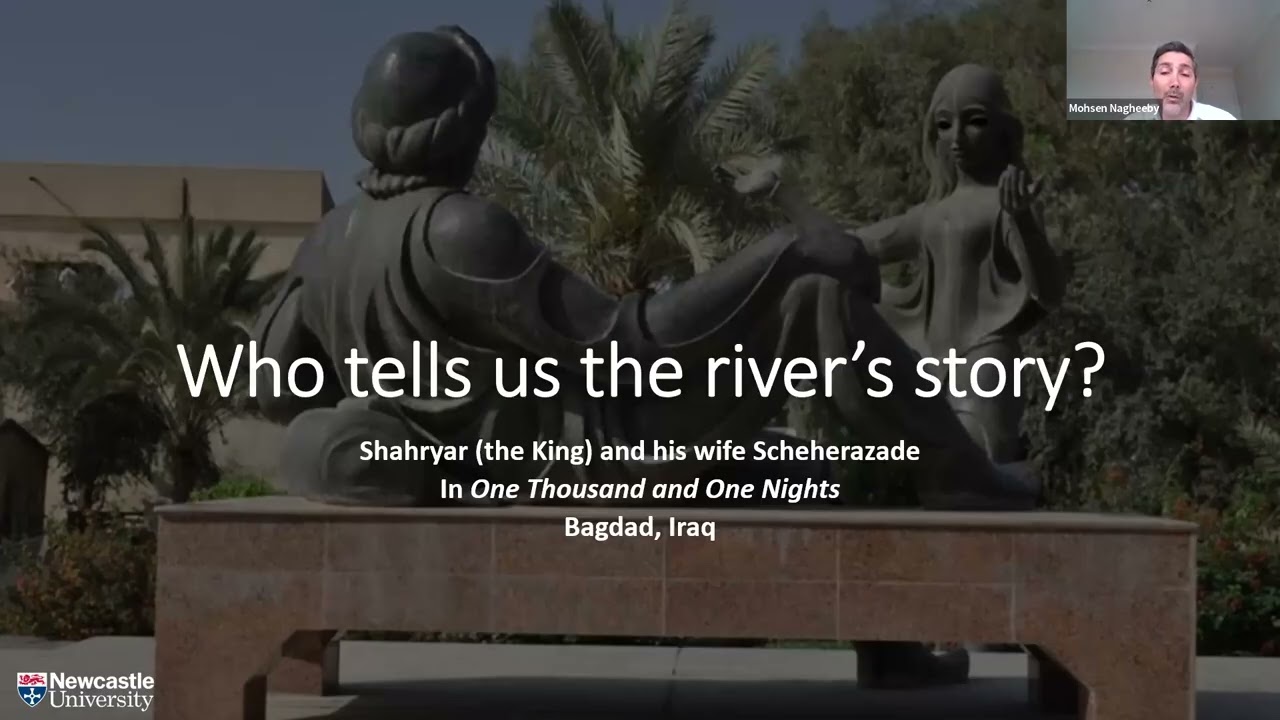
African Studies Global Virtual Forum: Decoloniality & Southern Epistemologies – Mohsen Nagheeby
Keywords
Summary
195 words
Critical Evaluation
Value of the Information & Strength of the Argument
The talk provides a valuable critical perspective on water diplomacy, challenging the dominant security-peace paradigm and introducing the concept of hydro-decolonisation. The argument is well-structured, moving from a critique of existing paradigms to a proposal for a new one. Nagheeby effectively uses metaphors (Tintin’s gaze, capitalist black hole) to illustrate complex ideas. However, the argument is primarily theoretical and lacks concrete case studies or empirical evidence. The presentation is persuasive but could benefit from more specific examples of how hydro-decolonisation would be implemented in practice.
Scientific Rigor, Source Quality, Title Accuracy
The speaker demonstrates scientific rigor by grounding his argument in critical hydropolitics and decolonial theory, referencing his own published work and that of others. However, the talk does not provide a comprehensive list of sources, and some claims are made without direct citations. The title accurately reflects the content, which is a forum on decoloniality and southern epistemologies. The talk is well-aligned with the forum’s theme.
166 words
Title / Content Match
The title accurately reflects the content: a forum on decoloniality and southern epistemologies, with the speaker presenting his concept of hydro-decolonisation.
Quality & Reliability
8/10
The speaker is an interdisciplinary scholar at Newcastle University Centre for Water, with publications in leading journals. The talk is well-structured, theoretically grounded, and draws on critical hydropolitics and decolonial thought. However, it is an opinion/expert talk rather than a peer-reviewed study, and some claims lack direct citations.
Key Moments
Markers derived by PSI from the transcript: the creator did not define chapters.
- Introduction: Dr. Nagheeby introduces the topic and poses the question 'whose peace?'
- Discussion of the three dominant paradigms in water politics: water war, water peace, and critical hydropolitics.
- Critique of the materialist bias in water diplomacy.
- Discussion of representational asymmetry and how the global south is narrated as unstable.
- Introduction of the 'capitalist black hole' concept and its implications for water governance.
- Placement of rivers within colonial and imperial histories, using examples from the Middle East and India.
- Discussion of the distinction between peace and pacification, and the role of narratives.
- Conclusion: Call for a radical epistemological shift in water diplomacy, moving from security-peace to equity-identity.
Cited Sources
- Decolonizing water diplomacy — Mentioned as recent work by the speaker and colleagues.
- Capitalist black hole in water governance — Concept introduced in the talk, based on five years of collaboration.
Concurring Sources
- Critical hydropolitics — The talk builds on critical hydropolitics literature, which is consistent with the speaker's argument.
Dissenting Sources
- Water war paradigm — The speaker critiques the water war paradigm, which is a contrasting view that emphasizes scarcity leading to conflict.
Contribution & Novelties
The talk offers a novel contribution by proposing ‘hydro-decolonisation’ as a new paradigm for water diplomacy, shifting the focus from security and peace to equity and identity. It critiques the dominant security-peace framing and introduces the ‘capitalist black hole’ metaphor to explain how capital and power shape water governance. The talk also emphasizes the importance of narratives and epistemology in water diplomacy, challenging the Eurocentric foundations of the field.
Pour aller plus loin :
- Decoloniality — Foundational concept for understanding the critique of Eurocentrism.
- Hydro-hegemony — Related concept in critical hydropolitics.
- Water diplomacy — Overview of the field and its challenges.
101 words
Radar Profile
The radar profile shows high scores in quality of information and reliability, reflecting the speaker's expertise and structured argument. The lower score in quantity of information may be due to the theoretical nature of the talk, which lacks extensive empirical data. Overall, the talk is strong in conceptual depth but could benefit from more concrete examples.
💬 No comments were provided for analysis.