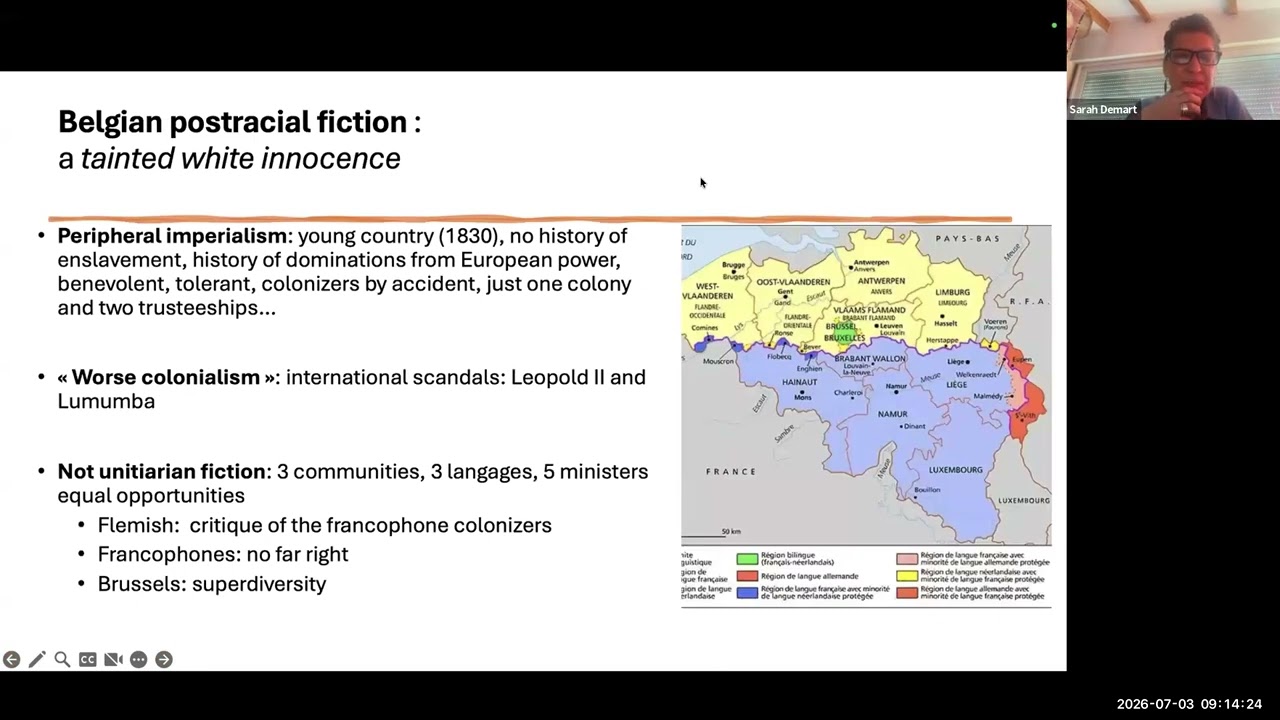
Africana Studies Global Virtual Forum: Decoloniality & Southern Epistemologies - Sarah Demart
Keywords
Summary
231 words
Critical Evaluation
Value of the Information & Strength of the Argument
The presentation offers valuable insights into the Belgian context of race and anti-racism, which is often overlooked in international discussions. Demart provides a nuanced analysis of how postracial ideologies operate in Belgium, drawing on her extensive fieldwork and engagement with activist communities. Her argument is well-structured, moving from a theoretical framework to concrete examples at different levels of negotiation. She effectively demonstrates how the Belgian postracial fiction is maintained through institutional practices, funding mechanisms, and legal frameworks. The argumentation is solid, though it is primarily based on her own research and interpretations rather than a systematic review of literature. The presentation would benefit from more explicit references to specific studies or data, but the overall reasoning is coherent and compelling.
Scientific Rigor, Source Quality, Title Accuracy
The presentation demonstrates a strong engagement with decolonial and critical race scholarship, referencing key thinkers such as Grada Kilomba, David Theo Goldberg, and Sarah Ahmed. However, specific citations are not systematically provided, and the presentation relies heavily on the speaker’s own research and observations. The title accurately reflects the content, focusing on decoloniality and Southern epistemologies within the context of Belgian postracial fiction. The video description is minimal, providing only a brief title, but the content aligns with the stated theme. The speaker’s positionality is clearly articulated, which enhances the credibility of the analysis. Overall, the scientific rigor is high, but the lack of explicit source citations in the presentation limits the verifiability of some claims.
251 words
Title / Content Match
The title accurately reflects the content: a forum presentation on decoloniality and Southern epistemologies, focusing on the Belgian postracial fiction.
Quality & Reliability
8/10
The presentation is grounded in long-term ethnographic research and draws on established decolonial and critical race scholarship. The speaker is a senior researcher in sociology with relevant publications. The argument is coherent and well-supported, though it is primarily an expert opinion rather than a systematic review or original study.
Key Moments
Markers derived by PSI from the transcript: the creator did not define chapters.
- Introduction and speaker's background
- Discussion of Belgium's absence from global race discourse
- Explanation of postracial ideologies and Belgian 'tainted white innocence'
- Analysis of macrosocial level: how Belgium defines racism and anti-racism
- Discussion of mesosocial level: implementation of anti-racism in civil society
- Examination of microsocial level: experiences of black African organizations
- Legal framework and impossibility to penalize blackface
- Conclusion: Afrodescendant anti-racism challenges narrow framework
Cited Sources
- Le territoire postcolonial — Mentioned as the author's book
- Créolité, vidans, belong — Edited with Dia Abasa, mentioned in introduction
- Laïcité postraciale, bel anti-racisme, afroféminisme et aspir colonial — Recent publication mentioned in introduction
Concurring Sources
- Decoloniality and Southern Epistemologies — The presentation aligns with broader decolonial scholarship that critiques Eurocentric knowledge production.
Dissenting Sources
- Postracial fiction in other national contexts — The presentation focuses specifically on Belgium, and while it draws parallels with other countries, it does not engage with potential counterarguments or alternative perspectives on postracialism.
Contribution & Novelties
The presentation offers a novel analysis of the Belgian postracial fiction, a concept that is rarely addressed in international scholarship. Demart’s long-term ethnographic engagement with Congolese diaspora communities and activist collectives provides unique insights into the mechanisms of racial silencing and the conditions for Afrodescendant anti-racism. She highlights the specificities of the Belgian context, such as the fragmented state structure and the ’tainted white innocence’ narrative, which contribute to the invisibility of race. The presentation also contributes to the understanding of how postracial ideologies operate in a European context, beyond the more commonly discussed cases of France, the Netherlands, or the United States.
Pour aller plus loin :
- Decoloniality — Provides an overview of decolonial thought and its key proponents.
- Post-racial society — Discusses the concept of post-racialism and its critiques.
- Critical race theory — Offers a framework for understanding race and racism in society.
145 words
Radar Profile
The radar profile shows high scores in quantity and quality of information, indicating a well-informed and detailed presentation. The technical level is also high, reflecting the academic nature of the talk. The overall reliability is strong, though the reliance on the speaker's own research and the lack of explicit citations slightly reduce the score. The profile suggests a content that is rich in insights but may require some background knowledge to fully appreciate.