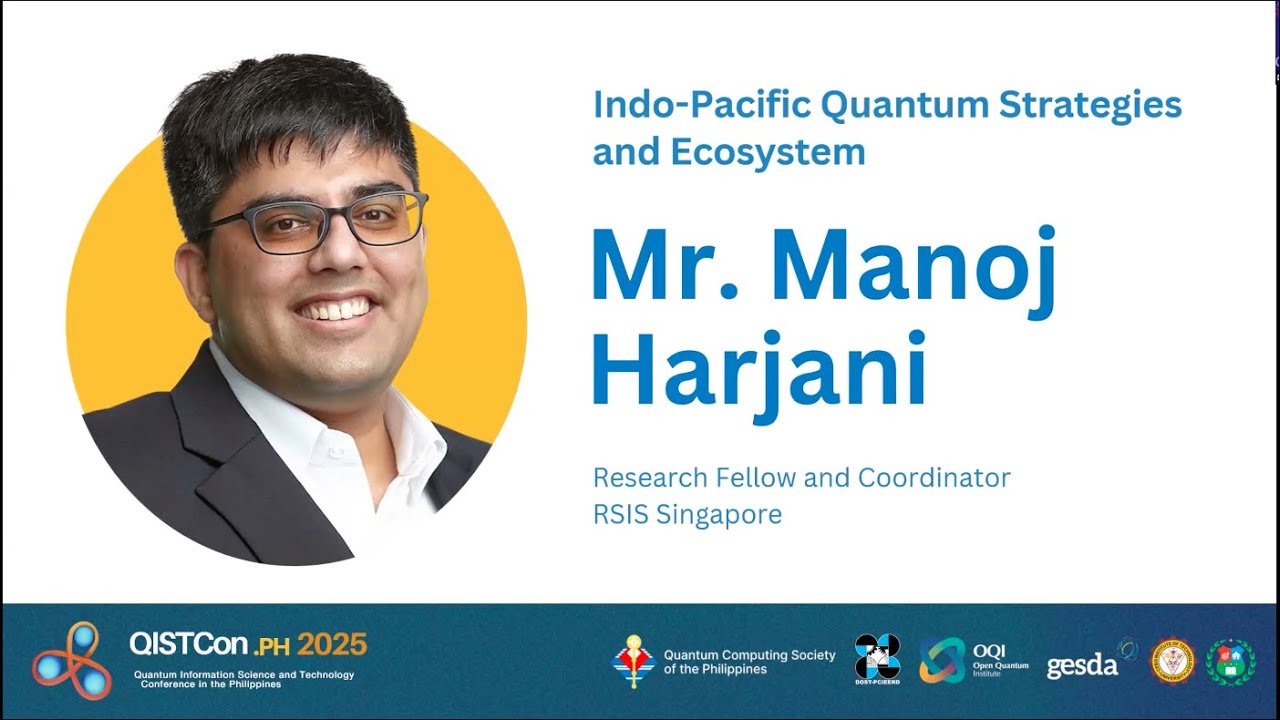
Indo-Pacific Quantum Strategies and Ecosystem
Keywords
Summary
192 words
Critical Evaluation
Value of the Information & Strength of the Argument
The talk provides valuable insights into Singapore’s quantum strategy, offering specific details on funding, programs, and institutional structures. The argumentation is coherent and well-structured, with a clear progression from history to strategy to challenges and opportunities. Harjani supports his points with references to other countries’ approaches, which strengthens the analysis. However, the talk is primarily descriptive and lacks deep critical evaluation of the strategy’s effectiveness. The speaker’s perspective is that of an insider, which adds credibility but also potential bias.
Scientific Rigor, Source Quality, Title Accuracy
The speaker references his own written piece (via QR code) and mentions specific programs and initiatives, but does not cite external sources in detail. The information appears accurate based on public knowledge of Singapore’s quantum efforts. The title is appropriate, though the focus is more on Singapore than the entire Indo-Pacific. The talk is an expert opinion rather than a peer-reviewed study, so the scientific rigor is moderate.
163 words
Title / Content Match
The title accurately reflects the content, which focuses on quantum strategies in the Indo-Pacific region, with a detailed case study of Singapore.
Quality & Reliability
7/10
The speaker is a research fellow at RSIS with expertise in emerging technologies, and the talk is based on a written piece. The content is well-structured and provides specific details about Singapore's quantum strategy, but it is primarily an opinion/analysis rather than peer-reviewed research.
Key Moments
Markers derived by PSI from the transcript: the creator did not define chapters.
- Introduction and overview of the talk
- History of quantum research in Singapore
- Launch of national quantum strategy and funding
- Strategic thrusts: scientific excellence and engineering capabilities
- Innovation and enterprise partnerships, talent development
- Challenges: lack of milestones, talent dependency, ethical implications
- Opportunities: regional standards, market capture
- Look ahead: strategy refresh and future priorities
- Q&A: attracting talent and collaboration with Philippines
Cited Sources
- Singapore's National Quantum Strategy (piece by Manoj Harjani) — Referenced via QR code on screen; not directly available in description.
Concurring Sources
- Singapore's National Quantum Strategy — Official government source confirming the strategy and its initiatives.
- Centre for Quantum Technologies — Official CQT website, corroborating the research center's role and achievements.
Contribution & Novelties
The talk provides a concise and up-to-date overview of Singapore’s national quantum strategy, highlighting its four pillars and specific initiatives. It offers a critical perspective on challenges, such as the lack of measurable targets and the need for alternative talent pathways, and suggests lessons from other countries. This is valuable for policymakers and researchers in the region.
Pour aller plus loin :
- Singapore’s National Quantum Strategy — Official page of the National Quantum Office, providing details on the strategy and initiatives.
- Centre for Quantum Technologies — Official website of CQT, with information on research and spin-offs.
- Quantum Engineering Programme — Official site of the Quantum Engineering Programme, detailing its projects and funding.
- UK National Quantum Strategy — UK government document, referenced for comparison on quantitative targets.
- Quantum for Society — Website of the Netherlands’ Centre for Quantum and Society, mentioned for ethical frameworks.
143 words
Radar Profile
The radar profile shows high scores in quality of information and reliability, with moderate scores in quantity and technical level. This indicates a well-informed expert talk that is accessible to a general audience but lacks deep technical detail.
💬 No comments were provided for analysis.