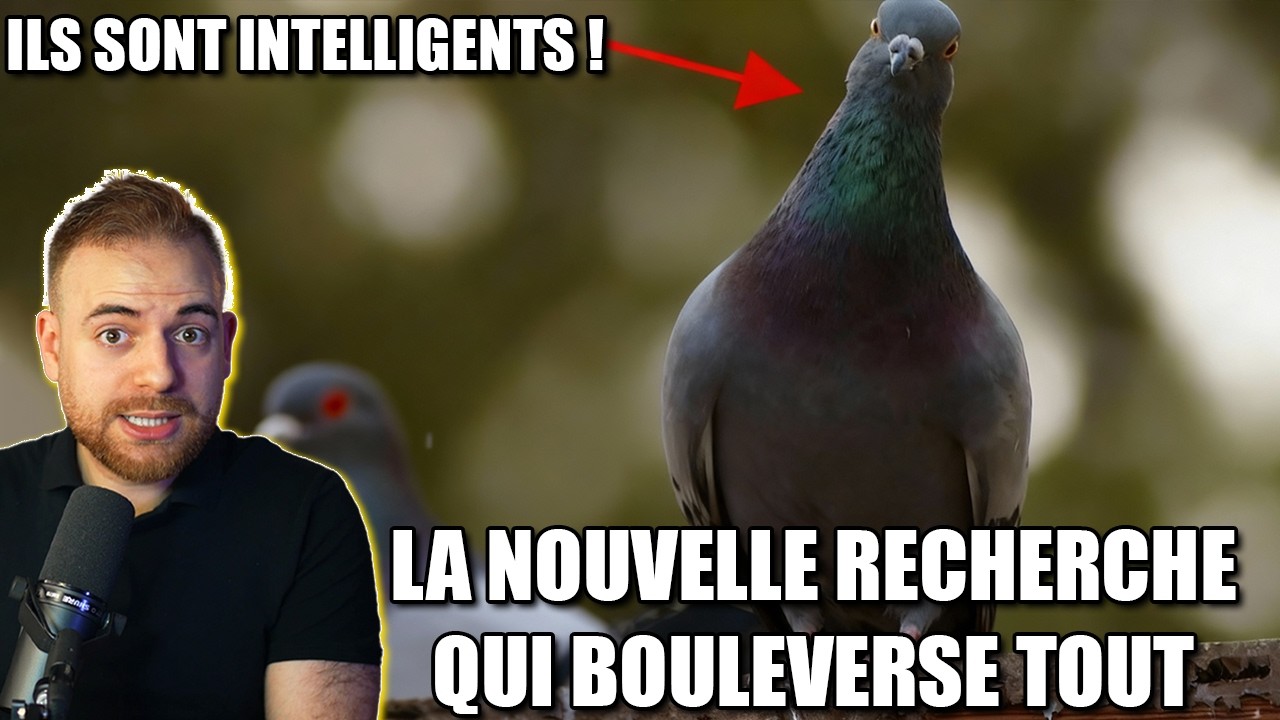
Les pigeons sont CONSCIENTS ? Cette découverte scientifique change tout
Keywords
Summary
184 words
Critical Evaluation
The video provides a compelling overview of recent research on avian consciousness, effectively communicating complex scientific concepts to a general audience. It correctly identifies key studies, such as those from Ruhr University Bochum and the University of Tübingen, and places them within the broader context of animal consciousness research. The discussion of the NCL and its functional equivalence to the prefrontal cortex is accurate and well-explained. The video also appropriately highlights the significance of the New York Declaration on Animal Consciousness, which represents a major shift in scientific consensus. However, the video lacks specific citations for many claims, relying on general references to ‘researchers’ and ‘studies’ without providing publication details or links. This reduces its utility for viewers seeking to verify the information. Additionally, the video includes a promotional segment for an AI training program, which, while not affecting the scientific content, may be seen as a conflict of interest. The title is somewhat sensationalist, but the content is generally accurate and well-structured. The video could benefit from more detailed explanations of the experimental methods and the limitations of the studies. Overall, it is a valuable resource for those interested in animal cognition, but viewers should seek primary sources for deeper understanding.
202 words
Title / Content Match
The title is somewhat sensationalist but accurately reflects the content's focus on avian consciousness.
Quality & Reliability
7/10
The video presents recent scientific findings on avian consciousness, referencing specific studies and declarations. However, it lacks detailed citations and includes promotional content, which slightly reduces its reliability.
Key Moments
Markers derived by PSI from the transcript: the creator did not define chapters.
- Introduction: corvid solving puzzle and counting, setting the stage for avian intelligence.
- Definition of phenomenal consciousness and introduction to the question of animal consciousness.
- Discussion of the historical view that consciousness requires a neocortex, and the avian brain's different structure.
- Introduction of the nidopallium caudolaterale (NCL) and its functional similarity to the prefrontal cortex.
- Explanation of convergent evolution and how different brain architectures can produce similar cognitive abilities.
- Methods to test consciousness: mirror test and its adaptations for birds, including pigeons and roosters.
- Study from University of Tübingen (May 2024) showing ravens can count vocally, with planning abilities.
- Mention of the Cambridge Declaration (2012) and the New York Declaration (2024) on animal consciousness.
- Three major theories of consciousness and evidence that bird brains meet their criteria.
- Evolutionary model of consciousness (alarm, vigilance, reflective) and examples of complex bird behaviors.
- Parallels with AI consciousness, quoting philosopher Tom McClelland and neuroscientist Anil Seth.
- Implications for animal welfare and understanding intelligence; conclusion and promotional segment.
Cited Sources
- Newsletter Vision IA — Promotional link for the channel's newsletter, not directly related to the scientific content.
- Formation IA — Promotional link for an AI training program, not a scientific source.
Concurring Sources
- New York Declaration on Animal Consciousness — The video references this declaration, which supports the possibility of consciousness in many animals.
- Cambridge Declaration on Consciousness — The video mentions this earlier declaration, which also supports animal consciousness.
Dissenting Sources
- No discordant sources found — The video does not present any conflicting sources or viewpoints.
Contribution & Novelties
The video synthesizes recent research on avian consciousness, highlighting convergent evolution and the possibility of consciousness in non-mammalian species. It provides a clear explanation of the neural basis and behavioral evidence, making the topic accessible to a broad audience.
Pour aller plus loin :
- New York Declaration on Animal Consciousness — The declaration itself, signed by over 500 scientists, outlining the scientific support for animal consciousness.
- Cambridge Declaration on Consciousness — The 2012 declaration signed by prominent neuroscientists, asserting the presence of consciousness in non-human animals.
- Theory of Integrated Information — A leading theory of consciousness that the video discusses, relevant to understanding how consciousness might arise in different systems.
110 words
Radar Profile
The radar profile shows high scores in quantity and quality of information, moderate technical level, and good reliability. This indicates a well-balanced video that provides substantial information with reasonable accuracy, suitable for a general audience interested in animal cognition.
💬 No comments were provided for analysis.