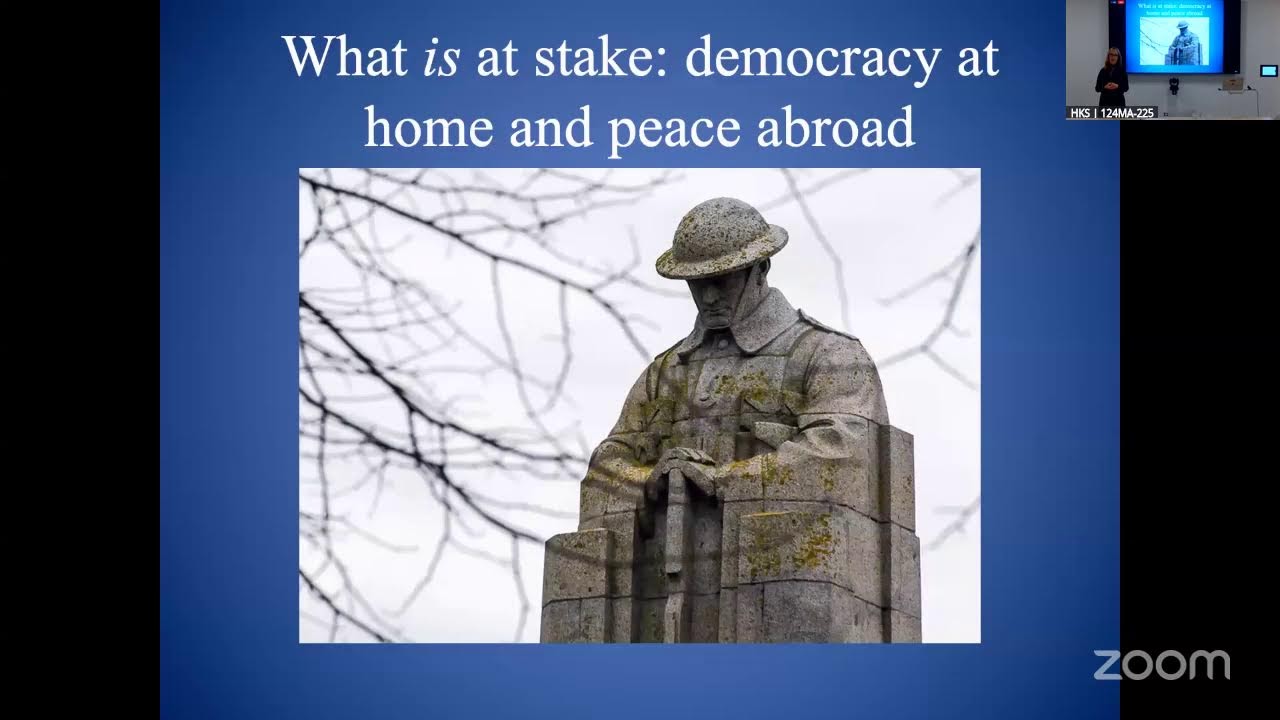
Democratic Backsliding: Why Is It Happening? What Can Stop It?
Keywords
Summary
159 words
Critical Evaluation
Value of the Information & Strength of the Argument
The talk provides a comprehensive overview of democratic backsliding, synthesizing a large body of research. Stokes presents a clear conceptual framework and supports her claims with empirical evidence, including statistical correlations and illustrative examples from various countries. The argumentation is logically structured, moving from definition to causes to strategies and potential remedies. She acknowledges nuances, such as the distinction between normal executive overreach and genuine erosion, and the role of both left- and right-wing leaders. The discussion of income inequality as a key driver is compelling and backed by robust statistical analysis. The talk also offers practical insights into how backsliding can be countered, making it valuable for both scholars and practitioners.
Scientific Rigor, Source Quality, Title Accuracy
Stokes demonstrates high scientific rigor, referencing her own book and the work of other scholars, such as Meliss Leybens and Larry Bartels. She uses data from the Varieties of Democracy project and presents statistical findings transparently. The title accurately reflects the content, which addresses both the causes and potential solutions to democratic backsliding. The talk is well-sourced, though it does not provide a formal bibliography; however, the references are credible and relevant. The discussion is balanced, considering multiple perspectives and acknowledging uncertainties.
209 words
Title / Content Match
The title accurately reflects the content, which covers causes and potential remedies for democratic backsliding.
Quality & Reliability
9/10
The speaker is a distinguished professor of political science, director of a democracy research center, and president of the American Political Science Association. The talk is based on her book and draws on extensive empirical research, including cross-national statistical analysis and case studies. The argument is well-structured and supported by references to academic work.
Key Moments
Markers derived by PSI from the transcript: the creator did not define chapters.
- Introduction of Susan Stokes and her credentials.
- Definition of democratic erosion and its characteristics.
- Wave of democratic erosion since the late 1990s, displacing coups.
- Two ideological variants: right-wing ethnonationalists and left-wing populists.
- Playbook of backsliding leaders: targeting press, courts, elections, etc.
- Causes: income inequality as a robust predictor, based on statistical analysis.
- Mechanisms linking inequality to backsliding: grievances and polarization.
- Strategies to maintain support: polarization and 'trash talking' democracy.
- Discussion on how to stop or slow democratic erosion.
- Implications for international relations and conflict.
Cited Sources
- Stokes, S. (2023). Democratic Backsliding: Why Leaders Undermine Their Own Democracies — The talk is based on her book, which she references throughout.
- Varieties of Democracy (V-Dem) Project — Used for expert coding and measures of democratic erosion.
- Leybens, M. (work on democratic backsliding) — Mentioned for her conceptualization of backsliding as decline in vertical and horizontal accountability.
- Bartels, L. (work on public opinion and democracy) — Referenced for evidence that support for democracy has not declined significantly.
Concurring Sources
- Varieties of Democracy (V-Dem) Project — Provides empirical data consistent with the speaker's claims about democratic erosion.
- Freedom House — Reports on democratic decline in various countries, supporting the global trend.
Dissenting Sources
- Some scholars argue that income inequality is not a primary driver of democratic backsliding — Alternative explanations focus on cultural factors, elite actions, or international influences.
Contribution & Novelties
The talk provides a comprehensive synthesis of current research on democratic backsliding, emphasizing the role of income inequality as a key structural driver. It offers a clear framework for understanding the phenomenon and discusses strategies for resistance. The speaker’s expertise and the breadth of examples make it a valuable resource for scholars and policymakers.
Pour aller plus loin :
- Varieties of Democracy (V-Dem) Project — Provides data and indices on democratic erosion.
- The International Institute for Democracy and Electoral Assistance (IDEA) — Offers resources on democracy and democratic backsliding.
- Freedom House — Reports on political rights and civil liberties, useful for tracking democratic decline.
- The Journal of Democracy — Publishes articles on democratic erosion and related topics.
117 words
Radar Profile
The radar profile shows high scores in information quantity, quality, and reliability, with a moderate technical level. This indicates a well-researched and credible presentation that is accessible to a broad audience while maintaining academic rigor.
💬 No comments were provided for analysis.