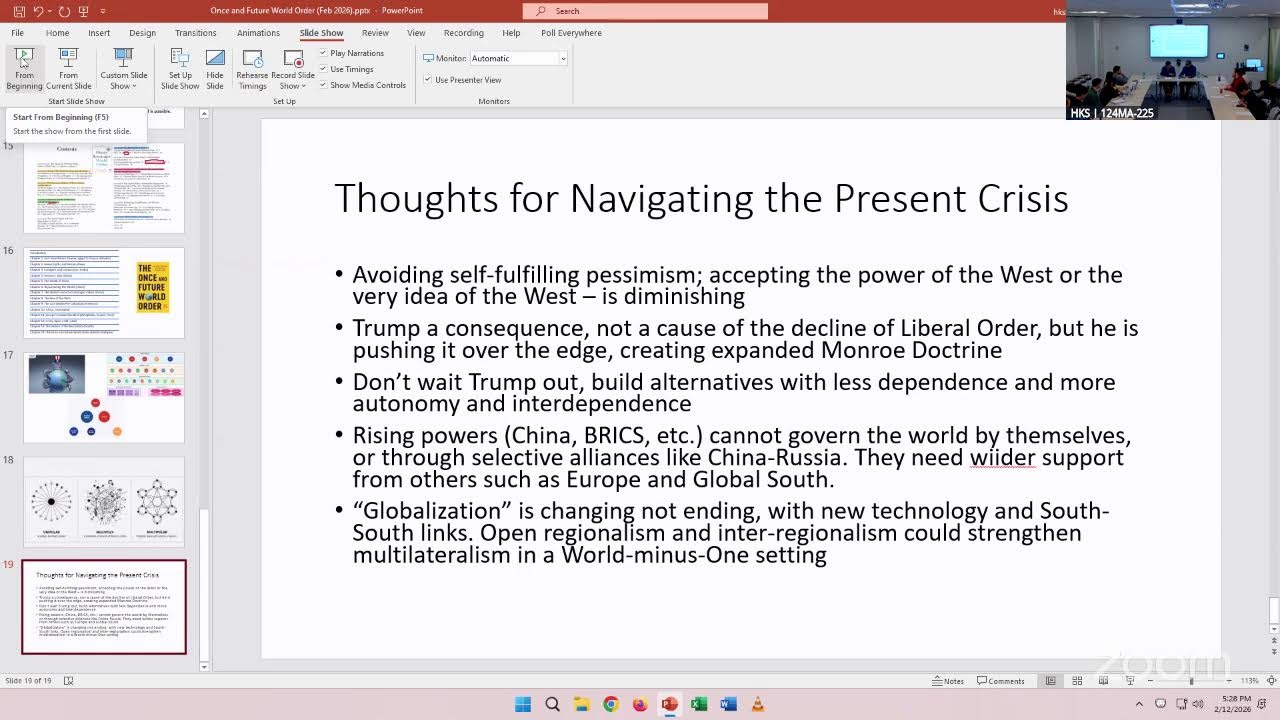
The Once and Future World Order: Why Global Civilization Will Survive the Decline of the West
Keywords
Summary
150 words
Critical Evaluation
Value of the Information & Strength of the Argument
The value of the information lies in its comprehensive historical perspective that challenges conventional Eurocentric narratives. Acharya provides numerous concrete examples, such as the Treaty of Kadesh, the Maritime Laws of Malacca, and the Manden Charter, to substantiate his claims. His argument is well-structured and logically presented, moving from specific historical cases to broader theoretical implications. He acknowledges counterarguments and nuances, such as the role of diffusion and the imperfections of early systems, which strengthens his credibility. However, some interpretations are contested, and the presentation is more of an overview than a detailed analysis, which may limit its depth for specialists.
Scientific Rigor, Source Quality, Title Accuracy
Acharya demonstrates scholarly rigor by referencing historical documents and scholarly works, though he does not provide explicit citations during the talk. The sources he mentions, such as the Amarna letters and the Kouroukan Fuoga, are credible and verifiable. The title accurately reflects the content, and the talk is well-organized. The discussion is based on the speaker’s own book, which is a legitimate source, but the lack of external references in the presentation reduces the ability to cross-check claims. Overall, the scientific quality is high, but the reliance on the speaker’s own work and the absence of direct citations in the talk are minor weaknesses.
220 words
Title / Content Match
The title accurately reflects the content, which discusses the historical origins of world order and argues that global civilization will survive the decline of the West.
Quality & Reliability
8/10
The speaker is a distinguished professor of international relations with extensive academic credentials. The arguments are based on historical evidence and scholarly sources, though some interpretations are contested. The presentation is well-structured and balanced, but the lack of direct citations in the talk and the reliance on the speaker's own book reduce the verifiability.
Key Moments
Markers derived by PSI from the transcript: the creator did not define chapters.
- Introduction and land acknowledgment
- Amitav Acharya begins his talk, introducing the book and its key argument
- Definition of world order and its normative purpose
- Thesis: world order is a shared creation, not a Western monopoly
- Examples of independent innovation: state system, great power cooperation, etc.
- Treaty of Kadesh and the Amarna system as early examples of international order
- Freedom of the seas: Grotius and the Maritime Laws of Malacca
- Humanitarian values: Code of Manu and Geneva Conventions
- Property rights: Magna Carta and the Manden Charter
- The role of Islam in preserving and transmitting Greek knowledge
Cited Sources
- The Once and Future World Order — The book being discussed, which presents the main arguments.
- The End of American World Order — A previous book by the author, mentioned in the introduction.
- Constructing Global Order — Another book by the author, referenced in the introduction.
- The Making of Global International Relations — Co-authored book, mentioned in the introduction.
Concurring Sources
- The Rise and Fall of the Great Powers — Paul Kennedy's work discusses the rise and decline of great powers, which aligns with the theme of Western decline.
- The Clash of Civilizations — Samuel Huntington's thesis on civilizational conflicts, which Acharya's argument implicitly challenges by emphasizing shared creation.
Dissenting Sources
- The End of History and the Last Man — Francis Fukuyama's argument that liberal democracy represents the endpoint of ideological evolution, which contrasts with Acharya's emphasis on multiple civilizational contributions.
Contribution & Novelties
The talk offers a fresh perspective on the origins of world order, arguing that it is a shared creation of multiple civilizations rather than a Western invention. This challenges Eurocentric narratives and provides a more inclusive understanding of global history. The book synthesizes a wide range of historical examples to support this thesis.
Pour aller plus loin :
- Global History — Provides context on the field of global history, which examines historical connections across civilizations.
- International Relations Theory — Offers an overview of theoretical frameworks in IR, including those that challenge Western-centric views.
- Eurocentrism — Discusses the concept of Eurocentrism and its critiques, relevant to Acharya’s argument.
- Amitav Acharya — Provides biographical information and a list of his works.
119 words
Radar Profile
The radar profile shows high scores in quantity and quality of information, reflecting the speaker's expertise and the depth of historical examples. The level of technicality is moderate, making it accessible to a general audience. The overall reliability is high, though the reliance on the speaker's own book and the lack of direct citations in the talk slightly reduce the score.