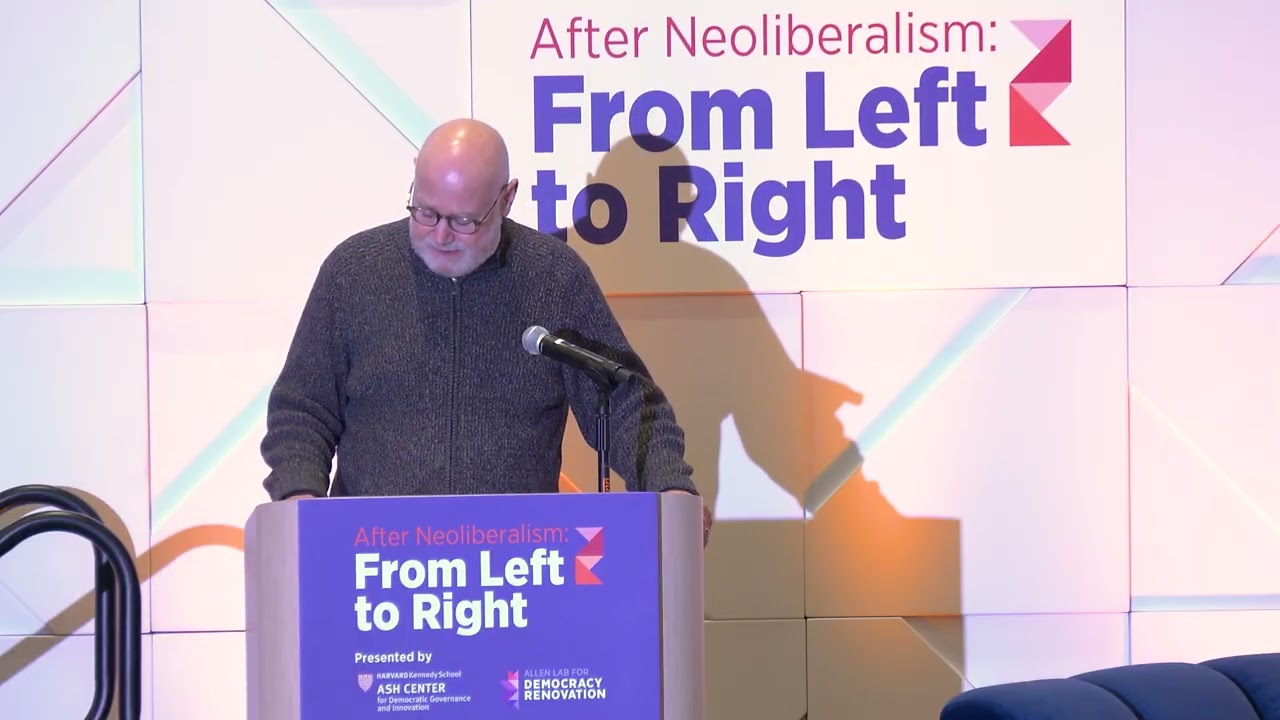
Closing Remarks with Yochai Benkler
Keywords
Summary
184 words
Critical Evaluation
Value of the Information & Strength of the Argument
The talk provides a valuable synthesis of diverse expert perspectives, offering a coherent framework for rethinking capitalism. Benkler’s argumentation is logically structured, moving from critique to concrete proposals. He effectively uses empirical references (e.g., Great Gatsby curve, robotics studies) to support his claims, though some assertions are presented without detailed evidence. The value lies in its integrative approach, connecting themes like work, decommodification, and technology policy into a unified vision.
Scientific Rigor, Source Quality, Title Accuracy
Benkler demonstrates scientific rigor by referencing multiple experts and empirical studies, but he does not provide specific citations or data. The sources are mentioned in passing, and the talk is more of an opinion piece than a rigorous academic review. The title accurately reflects the content, as it is indeed closing remarks. The talk’s strength is its breadth, but it lacks depth in verifying claims.
150 words
Title / Content Match
The title accurately reflects the content, as Benkler delivers closing remarks summarizing the day's discussions.
Quality & Reliability
7/10
Benkler provides a synthesis of a conference, drawing on multiple expert perspectives and empirical references (e.g., Great Gatsby curve, robotics studies). However, the talk is an opinion piece without detailed citations or data verification, and some claims are presented without direct evidence.
Key Moments
Markers derived by PSI from the transcript: the creator did not define chapters.
- Benkler opens with thanks and introduces the challenge that academics have not led in developing new economic theories.
- Discussion of markets concentrating power and the trade-off between growing and grabbing the pie.
- Focus on work as a source of meaning and the need for dignified work, with references to Oren Cass and Rebecca Henderson.
- Highlighting the loss of a meaningful politics of class and the emergence of subparties across the political spectrum.
- Discussion of high road capitalism and institutional frameworks to make exploitation less profitable.
- Critique of profit-driven instrumentalization of life, with references to Graham Barnett and the iPhone example.
- Emphasis on decommodifying basic needs to provide freedom from market dependence, with examples from care, healthcare, and energy.
- Introduction of the Great Gatsby curve to argue that equality and productivity are not in conflict.
- Call for socializing labor markets, credit, and infrastructure, and discussion of technology steering with examples from robotics and clean energy.
- Conclusion: need for a new theory of capitalism that centers power and harnesses profit's productive effects.
Contribution & Novelties
The talk synthesizes multiple expert perspectives into a coherent call for a new theory of capitalism, emphasizing decommodification and socialization of key sectors. It offers a unique integration of ideas from diverse political and academic backgrounds.
Pour aller plus loin :
- Great Gatsby Curve — A concept referenced to illustrate the relationship between inequality and social mobility.
- High Road Capitalism — A term used by Rebecca Henderson to describe a business model that prioritizes stakeholder value.
- Decommodification — A concept central to the talk, referring to reducing reliance on market mechanisms for basic needs.
94 words
Radar Profile
The radar profile shows moderate scores across all dimensions, indicating a balanced but not exceptional presentation. The talk is informative and well-argued but lacks deep technical detail and rigorous sourcing.