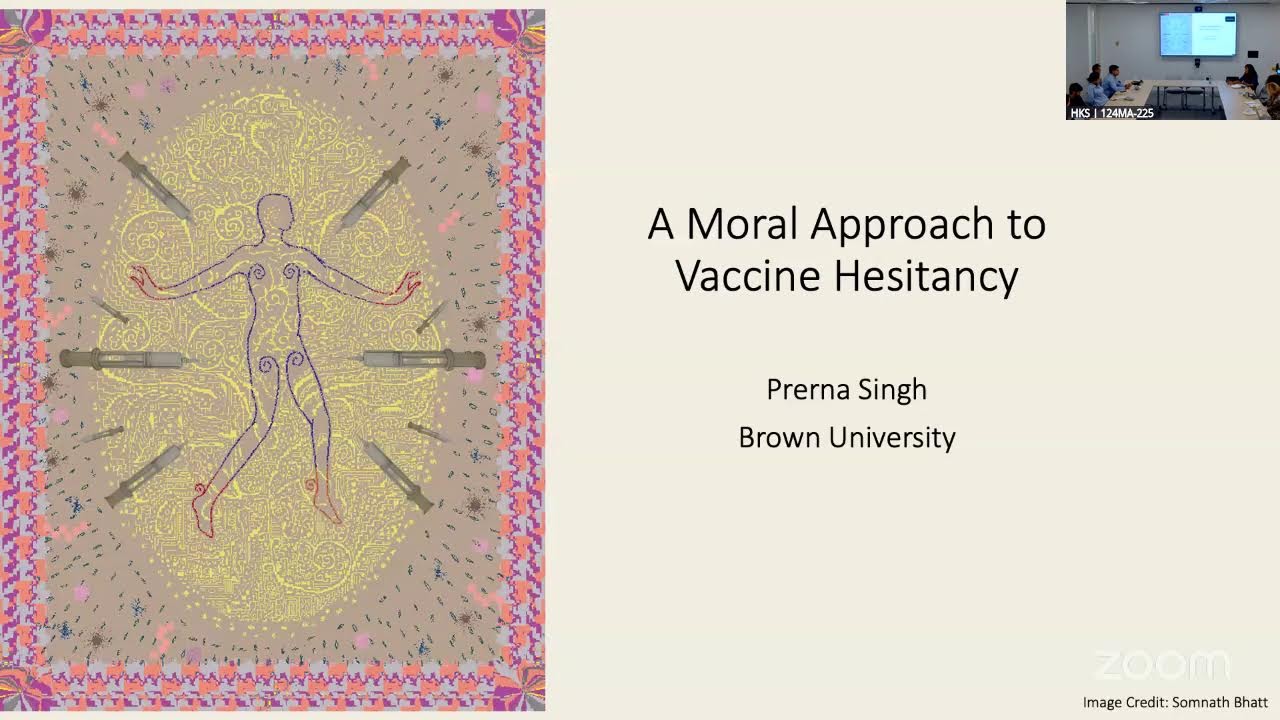
Moral Vaccination: Ideas and Institutions in the Control of Contagion in China and India
Keywords
Summary
145 words
Critical Evaluation
Value of the Information & Strength of the Argument
The talk offers a valuable theoretical contribution by challenging dominant rational choice explanations in political science and public health. Singh’s concept of moral relationality provides a nuanced framework for understanding state-society dynamics in health interventions. The argument is well-structured, drawing on classical theory (Durkheim, Locke) and contemporary psychology (Festinger, Damasio). However, the empirical evidence presented is selective and primarily illustrative; the full book project will need to systematically test the theory. The argumentation is persuasive but relies heavily on historical interpretation, which may be contested.
Scientific Rigor, Source Quality, Title Accuracy
The speaker demonstrates scholarly rigor by referencing her own publications (Annual Review of Political Science, The Lancet) and classical works. The talk is based on archival research and comparative historical analysis, but the presentation does not provide detailed citations for all claims. The title accurately reflects the content, focusing on the role of moral ideas in vaccination. The talk is part of a university seminar series, indicating academic credibility. No comments were provided for analysis.
175 words
Title / Content Match
The title accurately reflects the content, focusing on the role of moral ideas in vaccination uptake in China and India.
Quality & Reliability
8/10
The speaker is a recognized academic (Brown University) with a strong publication record. The talk presents a theoretical framework and historical evidence, but as a seminar presentation, it lacks full methodological detail and peer review. The argument is plausible and grounded in literature, but the evidence is selectively presented.
Key Moments
Markers derived by PSI from the transcript: the creator did not define chapters.
- Introduction to the importance of infectious diseases and the puzzle of differential control.
- Presentation of the research question and the concept of moral relationality.
- Critique of rational actor models and introduction of moral relationality as an alternative.
- Explanation of the book's research design: smallpox, China and India, and sub-national comparisons.
- Comparison of Calcutta and Canton: epidemiological similarity and colonial context.
- Discussion of Confucianism and colonial modernity as ideas of rule shaping state commitment.
- Analysis of societal cooperation and the moral embeddedness of vaccination.
- Evidence from Canton: higher vaccination rates due to Confucian welfare ethos.
- Contrast with Calcutta: colonial state's lack of moral legitimacy and lower vaccination rates.
- Conclusion and implications for contemporary public health and vaccine hesitancy.
Cited Sources
- How Solidarity Works for Welfare: Subnationalism and Social Development in India — Singh's first book, mentioned as related to state commitment and ideas of rule.
- Annual Review of Political Science article on vaccination — Mentioned as situating vaccination among broader cases of collective action.
- The Lancet article on vaccination — Mentioned as situating vaccination among broader cases of collective action.
- Acemoglu, Johnson, and Robinson paper on settler mortality — Referenced for the long-run institutional consequences of infectious disease.
Concurring Sources
- WHO on vaccine hesitancy — Supports the claim that vaccine hesitancy is a major global health threat.
Dissenting Sources
- Rational choice theory in political science — The talk explicitly critiques rational actor models, which are a dominant paradigm in political science.
Contribution & Novelties
The talk offers a novel theoretical framework—moral relationality—that integrates ideational factors into the study of public health compliance, moving beyond rational actor models. It provides a historical comparative analysis of vaccination in China and India, highlighting the role of state legitimacy and cultural norms. The book project promises to contribute to political science, public health, and historical sociology.
Pour aller plus loin :
- Vaccination — Overview of vaccination history and mechanisms.
- Smallpox — Detailed history of the disease and its eradication.
- Confucianism — Core tenets and influence on governance in China.
- Durkheim’s theory of social solidarity — Relevant to the concept of moral relationality.
104 words
Radar Profile
The radar profile shows high scores in quantity and quality of information, with a strong technical level, indicating a well-informed and detailed presentation. The reliability is also high, reflecting the academic background of the speaker. The overall profile suggests a rigorous and insightful talk.