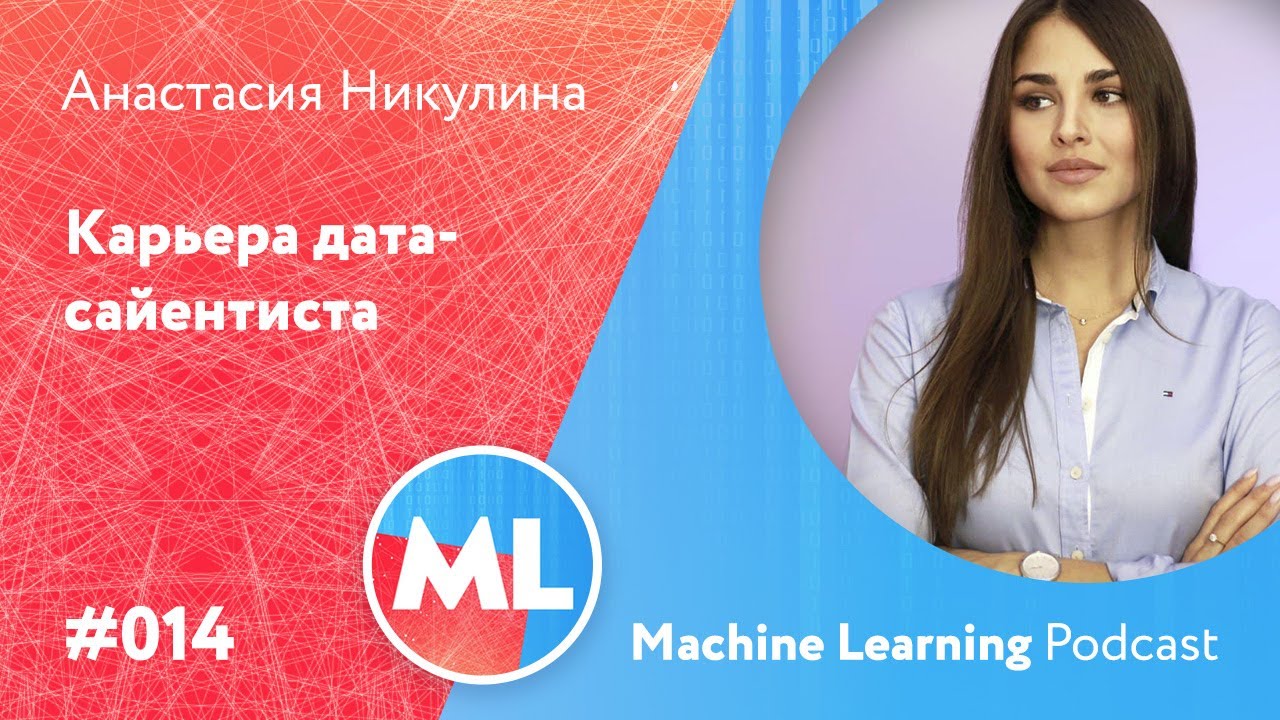
#014 ML Анастасия Никулина. Карьера дата-сайентиста
#014 ML Anastasia Nikulina. Career of a data scientist
Keywords
Summary
212 words
Critical Evaluation
Value of the Information & Strength of the Argument
The informational value of this episode lies in its concrete, stage-by-stage breakdown of what a data scientist career actually entails — something rarely articulated in formal training programs. The guest provides an honest account of the gap between university education and industry demands, particularly the importance of data cleaning, business context, and communication skills. Her argumentation is built almost entirely on personal experience and illustrates claims with vivid analogies, such as comparing a machine learning model to a car engine where a mechanic without fundamental knowledge wastes time and money on unnecessary repairs. The reasoning is coherent and persuasive: she insists on the necessity of mathematical foundations even for junior positions, and defends this claim by describing real interview scenarios where theoretical questions were asked and by explaining how an understanding of model internals (e.g., gradient descent) prevents using inappropriate methods. The discussion is pragmatic rather than academic, and the guest’s willingness to admit uncertainty (e.g., about confidentiality and salary ranges) enhances credibility. However, the argumentation relies on a single testimony and does not triangulate with external data or literature, which limits the strength of the broader claims.
Scientific Rigor, Source Quality, Title Accuracy
Scientifically, this episode does not present original research or rigorous evidence — it is a career narrative and expert opinion. The only external work referenced is Sebastian Raschka’s ‘Python and Machine Learning’ book, recommended for beginners, and the guest’s own educational YouTube videos on calculus and linear algebra for data science. These are appropriate practical recommendations but do not constitute academic rigor. The description provides links to the guest’s LinkedIn profile, her YouTube channel, the book page, and podcast platforms (Anchor, Apple Podcasts, Google Podcasts, Yandex Music, VK), which support traceability of the people and materials discussed. The title and content align well: the video genuinely delivers an overview of the data scientist career path, as announced. No misleading framing was detected. No public comments were provided, so audience reception could not be analyzed.
337 words
Title / Content Match
The title accurately reflects the content: an ML podcast featuring Anastasia Nikulina discussing the data scientist career path from junior to senior levels. No mismatch.
Quality & Reliability
7/10
The podcast is a career-oriented interview based on the guest's personal professional journey, not a peer-reviewed or data-backed scientific study. The claims are anecdotal but coherent, realistic, and grounded in concrete experience at prominent companies (MTS, Rosbank). The guest demonstrates honesty about gaps in her knowledge and openly discusses soft-skill challenges. No formal sources or empirical studies are cited, which limits reliability for generalizable conclusions, but the content is internally consistent and aligns with widely documented industry practices (e.g., data cleaning dominance).
Key Moments
Markers derived by PSI from the transcript: the creator did not define chapters.
- Introduction and guest presentation — Anastasia Nikulina, Senior Data Scientist at Rosbank
- Education background: studying robotics and automation at Bauman University, discovering math passion
- How she entered data science — manager asked her to process data with Python, starting at nights and weekends
- Discussion of telemedicine project (chatbot for medical advice) and legal limits of remote diagnoses
- Junior data scientist role — data collection, cleaning, and preparation taking up to 80% of project time
- Mid-level role at an advertising company — clustering customers, social network data analysis for targeted ads
- Senior role at Rosbank; need to revisit mathematical fundamentals during interviews
- Why calculus and linear algebra matter — selecting correct algorithms, gradient descent, understanding model internals
- Soft skills and career advice — punctuality, presentations, responsibility, and women in data science
Cited Sources
- Python и машинное обучение (Python and Machine Learning) by Sebastian Raschka — book page — Recommended by guest as a starting point for machine learning beginners.
- Anastasia Nikulina — LinkedIn profile — Guest's professional profile mentioned in the description.
- Nastya's YouTube channel (miracl6) — Educational videos on calculus and linear algebra for data science.
- Матан для Data Science (Calculus for Data Science) — video — One of the guest's top-3 videos, referenced during discussion of math fundamentals.
- Линал для Data Science (Linear Algebra for Data Science) — video — Second recommended video covering linear algebra essentials.
- Резюме IT-специалиста (IT Specialist CV) — video — Video on resume writing for IT professionals, relevant to junior career advice.
- Episode 014 on Anchor.fm — Podcast episode hosted on Anchor.fm platform.
- Telegram channel 'Стать специалистом по машинному обучению' — Channel for machine learning specialists, linked in description.
- Podcast on Apple Podcasts — Episode available via Apple Podcasts platform.
- Podcast on Google Podcasts — Feed link for Google Podcasts.
- Podcast on Yandex Music — Episode available on Yandex Music.
- Podcast VK group — Community page for the podcast on VK.
- All podcast episodes on Anchor.fm — Hub for all episodes of the podcast.
Concurring Sources
- Data science — Wikipedia — The episode's description of data cleaning as the dominant time-consuming task aligns with widely documented industry reports summarized in Wikipedia.
- CRISP-DM — Wikipedia — The data preparation phase (cleaning, transformation) is described in this standard as a major workstream, corroborating the guest's assertion.
Contribution & Novelties
The original contribution of this episode is a detailed, practitioner-driven mapping of the data scientist career ladder, clarifying what actually differentiates junior, middle, and senior roles in terms of both hard and soft skills. Nikulina offers a nuanced defense of foundational mathematics — arguing that understanding gradients and model mechanisms directly impacts model selection quality — which is illustrated with an original analogy comparing ignorant model usage to a car owner overpaying at a repair shop. The episode also offers an honest, firsthand account of the gender dimension in data science from the perspective of a woman who reached a senior position.
Pour aller plus loin :
- Data science — Wikipedia — Overview of the discipline, its history, and core methods, useful for contextualizing the career advice.
- Machine learning — Wikipedia — Foundational concepts and algorithm families referenced throughout the discussion.
- Sebastian Raschka — Python Machine Learning (book page on pythonworld.ru) — The recommended starter book for ML practitioners.
- Gradient descent — Wikipedia — Directly relevant to the episode’s point about why understanding calculus matters in model training.
- CRISP-DM — Cross-industry standard process for data mining — A process model contextualizing the data preparation and cleaning phases mentioned in the discussion.
- Kaggle — Online platform where data scientists practice skills; mentioned by the guest as a way to build practical experience. No URL provided to avoid risking an inaccurate address.
230 words
Radar Profile
The radar profile shows a balanced shape with quantity of information (8) and technical level (6) higher than fiabilite_globale (7) and qualite_information (7). This reflects an episode that is rich in conversational detail and topic coverage but limited in scientific rigor and verifiable external evidence, consistent with a practitioner interview rather than a research presentation.