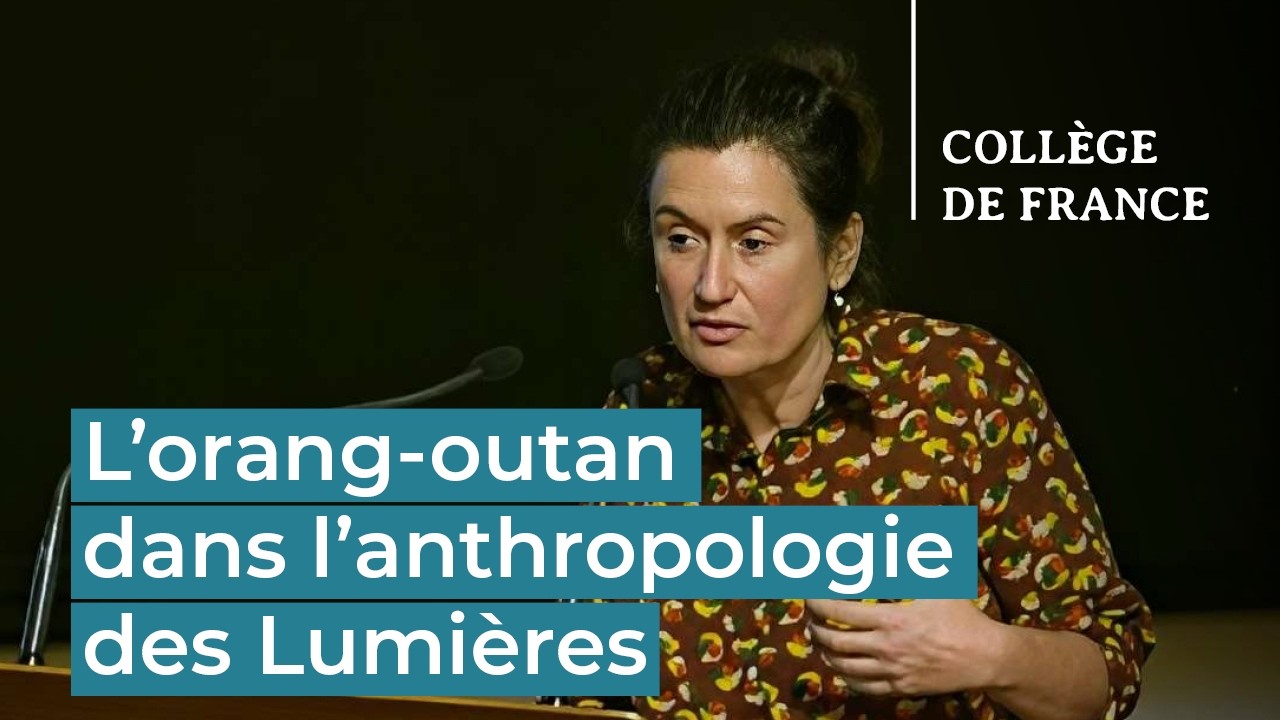
L’orang-outan dans l’anthropologie des Lumières - 2026-2027 (5)
The orangutan in Enlightenment anthropology - 2026-2027 (5)
Keywords
Summary
156 words
Critical Evaluation
Value of the Information & Strength of the Argument
The lecture offers a detailed, well-documented analysis supported by primary sources and recent historiography. The argument that the orangutan served as a pivotal figure in redefining racial hierarchies is persuasive, evidenced by specific examples from anatomical treatises, newspaper accounts, and colonial records. Sebastiani skillfully connects the scientific discourse with economic and imperial contexts, demonstrating how the animal’s presence in European cities was intertwined with the slave trade. The speaker also acknowledges the limitations of historical recovery, particularly the challenge of accessing the animal’s perspective, which adds intellectual honesty. The reasoning is coherent and builds progressively from the arrival of the specimens to the broader implications for the science of man, making a compelling case for the centrality of the orangutan in Enlightenment anthropology.
Scientific Rigor, Source Quality, Title Accuracy
The scientific rigor is high: Sebastiani draws on archival research, contemporary publications (e.g., Tulp, Tyson, Buffon), and modern scholarship, citing specific routes and ships to ground her claims. The description links to institutional resources at the Collège de France, ensuring reliable context. The title accurately reflects the content—it is indeed about the orangutan in Enlightenment anthropology, not a broader survey of animal studies. The talk is well-structured and matches expectations set by the abstract. No significant discrepancies between title and content were noted. The institutional framework of the Collège de France further enhances credibility, and the speaker’s authority as a specialist in Enlightenment Scottish thought and race is evident.
247 words
Title / Content Match
The title accurately reflects the content, focusing on the orangutan within Enlightenment anthropology.
Quality & Reliability
9/10
The lecture is delivered by a recognized historian at a prestigious institution, uses primary sources, and presents a nuanced argument about the role of orangutans in Enlightenment debates on race and humanity.
Key Moments
Markers derived by PSI from the transcript: the creator did not define chapters.
Cited Sources
- Collège de France - L'animal (Colloque de rentrée 2026) — Page du colloque où la conférence est présentée.
- Collège de France — Institution de recherche fondamentale.
- Fondation du Collège de France — Support institutionnel.
External References
Contribution & Novelties
The lecture provides an original contribution by intertwining the history of science with colonial trade and racial thought, moving beyond a simple narrative of ‘discovery’ to reveal the orangutan as an active agent in shaping Enlightenment categories. Sebastiani’s emphasis on the material circuits—slave ships, menageries, coffee houses—underscores how scientific knowledge was embedded in imperial economies. This approach offers a fresh perspective on the ‘animal turn’ in history, challenging historians to consider non-human actors more seriously. The speaker’s own admission of methodological difficulties in recovering the animal’s experience is a valuable reflexive contribution.
Pour aller plus loin :
- Orangutan — A modern biological perspective on the species discussed in the lecture, providing context on their behavior and classification.
- Edward Tyson — The anatomist whose 1699 work was pivotal in comparative anatomy and shaped later Enlightenment ideas.
- Great Chain of Being — The intellectual framework underlying hierarchical classifications of nature, relevant to understanding the orangutan’s place in Enlightenment taxonomy.
157 words
Radar Profile
The radar profile suggests a strong balance between information quantity, quality, and reliability, with slightly lower technical complexity for a general audience. The high reliability underscores the academic rigor, while the moderate technical level indicates accessible yet scholarly content.