Soutenance de Thèse - Virgin Durepaire
Title history
- Soutenance de Thèse - Virgin Durepaire — observed on 20261112-0406 UTC (YouTube)
Keywords
Summary
136 words
Critical Evaluation
Value of the Information & Strength of the Argument
The video provides a thorough presentation of original research with clear motivation and methodology. The argumentation is solid, based on established theoretical frameworks and computational results. The speaker clearly explains the physical mechanisms and justifies the choices made. The work extends previous studies by incorporating additional physical effects, such as non-axisymmetric modes and stratification, providing a more general understanding.
Scientific Rigor, Source Quality, Title Accuracy
The presentation demonstrates scientific rigor through careful descriptions of the equations, assumptions, and numerical methods. Multiple references are mentioned throughout, including works by Mosser (2012), Devel, Griffiths (2022), and earlier authors like Kiriloff and Child. The title accurately reflects the content, as it is a formal thesis defense. However, the sources are only mentioned by name without explicit citations, and no external links are provided in the description.
142 words
Title / Content Match
The title accurately reflects the content: a formal thesis defense presentation by Virgin Durepaire.
Quality & Reliability
8/10
A thorough and technically detailed presentation of original research, with clear methodology and references to prior work, though external verification is limited.
Key Moments
Markers derived by PSI from the transcript: the creator did not define chapters.
- Introduction of jury and setting of the thesis defense.
- Motivation for studying stars and connection to exoplanets and galactic evolution.
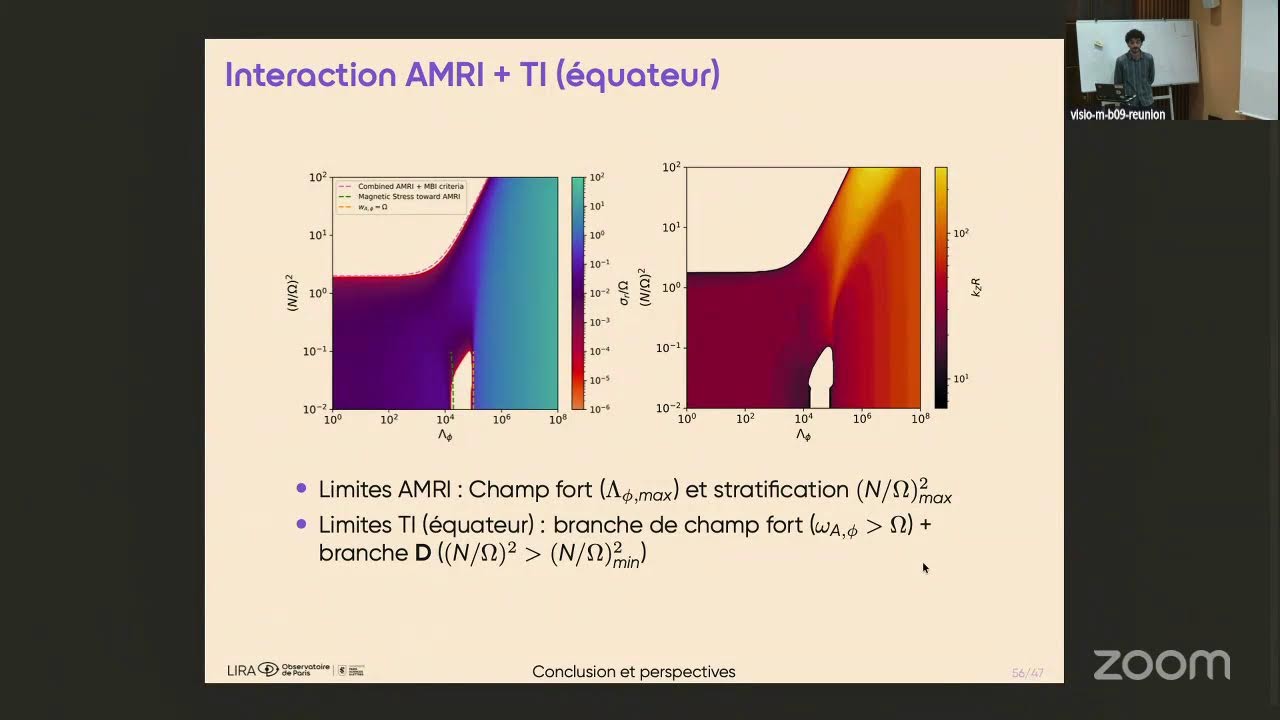
- Introduction to the three MHD instabilities: MRI, GSF, and Tayler.
- Explanation of linear analysis methods: local and global approaches.
- Results and stability criteria for MRI and GSF instabilities.
- Nonlinear results and conclusions, including applications to stellar models.
Cited Sources
- Mosser et al. (2012) - Rotation of red giants — Asteroseismology observations showing core rotation slowing.
- Devel et al. - Catalogue of 71 red giants with strong magnetic fields — Magnetic field measurements in red giant cores.
- Griffice et al. (2022) - Rotation profiles from simulations — Comparisons of rotation profiles with different instabilities.
- Kiriloff and Child - Local and global MHD analysis — Previous linear analysis approaches.
- Reiner Orp - Code provider — Adapted global code for solving eigenproblems.
Contribution & Novelties
The thesis provides a more general theoretical framework for MHD instabilities in stellar radiative zones, incorporating non-axisymmetric modes, stratification, and combined axial/azimuthal fields, and comparing local and global analyses. It establishes stability criteria and growth rates applicable to realistic stellar profiles.
Pour aller plus loin :
- Magnetorotational instability — Core concept of one of the studied instabilities.
- Tayler instability — Another key instability studied in the thesis.
- Goldreich-Schubert-Fricke instability — A related centrifugal instability; no URL provided due to uncertainty.
- Asteroseismology — Observational technique used to infer stellar interior rotation.
90 words
Radar Profile
The scores indicate a high technical level with strong quantitative information, but moderate reliability due to the lack of verifiable external sources.