William Troiani: Solomonoff Induction and Singular Integrals
Title history
- William Troiani: Solomonoff Induction and Singular Integrals — observed on 20261029-1051 UTC (YouTube)
Keywords
Summary
200 words
Critical Evaluation
Value of the Information & Strength of the Argument
The value of this work lies in establishing a formal bridge between two fundamental but historically separate simplicity measures in machine learning. The argumentation is logically coherent: after defining the Solomonoff distribution and the local learning coefficient, the speaker clearly states the main theorem and then walks through the key steps of the proof, focusing on the construction of a universal Turing machine that uniformly approximates the Bayesian evidence. The reliance on black-boxed singular learning theory hypotheses is transparent, and the speaker acknowledges the technical challenges, such as ensuring uniformity across all n. The demonstration of the sampling algorithm provides intuitive support. Overall, the reasoning is rigorous and the presentation effectively communicates both the result and the proof strategy, though non-experts may find it demanding.
Scientific Rigor, Source Quality, Title Accuracy
The talk is grounded in a specific preprint (arXiv:2609.01666), which is the primary source and is explicitly referenced. The speaker does not cite external sources in the video, but the mathematical exposition appears consistent with established literature in algorithmic information theory and singular learning theory. The title is faithful to the content; the speaker indeed discusses Solomonoff induction and its connection to singular learning theory. No comments were available to gauge audience reception, so no public trends are analysed.
219 words
Title / Content Match
The title accurately reflects the content, which directly addresses Solomonoff induction and its relation to singular integrals (via the local learning coefficient).
Quality & Reliability
8/10
The talk presents original research with a rigorous mathematical proof sketch. The presenter demonstrates deep familiarity with both algorithmic information theory and singular learning theory, and the claims are backed by a formal theorem and a published arXiv paper. The technical hypotheses are explicitly acknowledged as black-boxed, indicating transparency. However, the video is a single seminar talk with no external verification, and the low view count prevents community validation.
Key Moments
Markers derived by PSI from the transcript: the creator did not define chapters.
- Introduction and overview of the talk, mentioning the collaboration and the goal to relate two notions of simplicity.
- Definition of the Solomonoff distribution and explanation of how it formalises Ockham's razor and Epicurus's principle.
- Introduction to Bayesian learning and the definition of the local learning coefficient via the free energy expansion.
- Statement of the main theorem relating the negative log of the Solomonoff distribution to the learning coefficient.
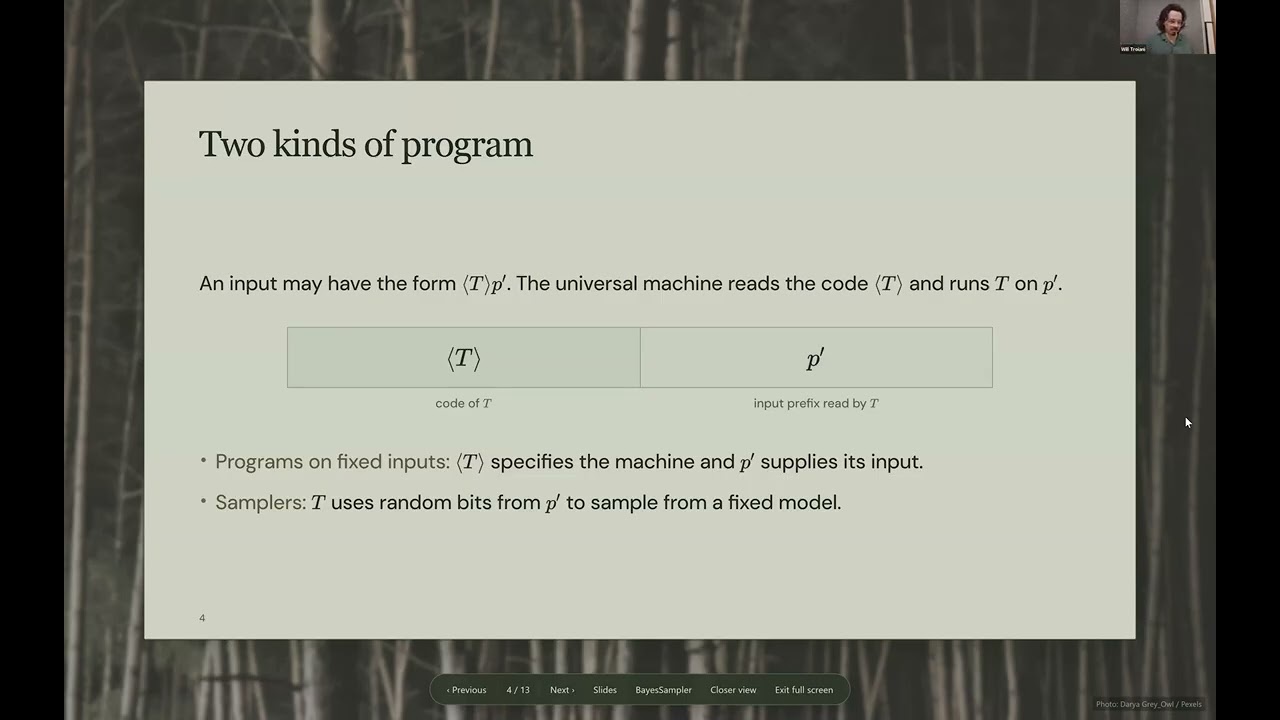
- Construction of the monotone Turing machine that approximates the Bayesian evidence using the Hamming hash interval algorithm.
Cited Sources
- Solomonoff Induction and Singular Integrals — The paper presented in the talk, authored by William Troiani and Daniel Murph, containing the full theorem and proof.
Contribution & Novelties
The primary novelty is the explicit quantitative connection between Solomonoff induction and the local learning coefficient, providing a bridge between algorithmic information theory and singular learning theory. The proof demonstrates that the Solomonoff distribution can generically encode Bayesian learning with a single fixed universal Turing machine, which is a non-trivial uniform approximation result. This opens avenues for using singular learning theory techniques to analyse properties of universal induction and for interpreting the learning coefficient in terms of program simplicity.
Pour aller plus loin :
- Solomonoff induction — Background on the theoretical framework of universal induction.
- Kolmogorov complexity — Core concept underlying the Solomonoff prior’s weighting.
- Bayesian inference — Fundamental methodology used in the Bayesian part of the paper.
- Minimum description length — Related principle linking simplicity and compression.
128 words
Radar Profile
The radar profile shows high technical depth (10) and good reliability (8), with moderate information quantity (8). This indicates a specialised, mathematically rigorous talk suited for an expert audience, where the focus is on the precision of the argument rather than breadth of coverage.