Richard Cornelius Suwandi: Kernel Autoresearch for Open-Ended Model Discovery
Keywords
Summary
159 words
Critical Evaluation
Value of the Information & Strength of the Argument
The work presents a significant contribution by addressing the validity guarantee in LLM-based kernel generation, an issue often overlooked. The argumentation is solid: the authors demonstrate a 22-58% failure rate for naively generated kernels, motivating their construction contract approach. The use of a quality-diversity archive and novelty fingerprinting is well-integrated, and the experimental design with meta-evolution phases (training, validation, meta-test) convincingly shows transferability. The discussion of related work positions the approach clearly, and the conclusion that human-refined kernels improve performance underscores the practical utility. The claims are supported by concrete numerical results, though full replication is not possible from the talk alone.
Scientific Rigor, Source Quality, Title Accuracy
The scientific rigor is high: the method is based on well-founded mathematical principles (kernel validity, positive semi-definiteness) and the stress tests quantify failure modes. The sources cited (Duvenaud et al., Wilson and Adams, Wilson et al., FunSearch) are well-known and relevant, though no direct links are provided in the description. The title is perfectly aligned with the content, and the presentation follows a logical structure from motivation to method to results. The use of metrics like CRPS for calibration and regret AUC for optimization is appropriate. The quality of sources is good, but the lack of accessible references in the description limits immediate verification.
221 words
Title / Content Match
The title precisely matches the content, which presents the Kernel Autoresearch system for discovering reusable kernel programs in an open-ended manner.
Quality & Reliability
8/10
The talk presents a well-structured research method with theoretical guarantees and empirical validation, though external verification is limited without checked sources.
Key Moments
Markers derived by PSI from the transcript: the creator did not define chapters.
- Motivating example on inductive bias and kernel selection.
- Review of related work on kernel grammars and spectral mixture kernels.
- Introduction of Kernel Autoresearch architecture with construction contracts.
- Explanation of quality-diversity archive and novelty screening.
- Meta-evolution framework and experimental setup.
- Results on black-box optimization and enzyme kinetics.
- Discussion on human refinement and interpretability.
Cited Sources
- Duvenaud et al. (2013) - Kernel grammar for covariance functions — Introduced kernel grammar composing base kernels with addition and multiplication.
- Shin et al. (2018) - Network for kernel composition — Extended kernel grammar into a differentiable network.
- Wilson and Adams (2013) - Spectral mixture kernels — Learned kernels via spectral density mixture.
- Wilson et al. (2016) - Deep kernel learning — Combined spectral mixture kernels with deep architectures.
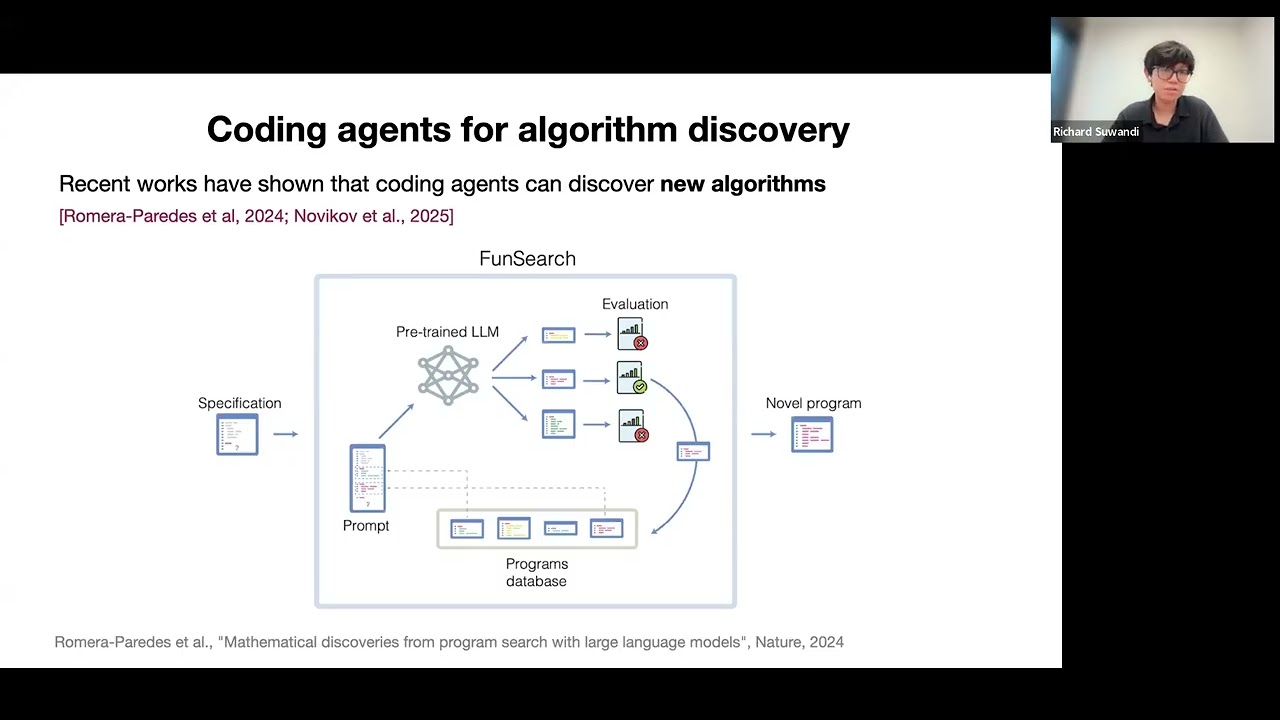
- FunSearch (Google DeepMind) - Functional search — Inspired the use of coding agents for program discovery.
- ICML 2026 meta-evolution paper — Framework for meta-learning with evolution phases.
Contribution & Novelties
The primary novelty is the combination of LLM-based program generation with formal construction contracts that guarantee kernel validity, overcoming the undecidability of validity for arbitrary programs. The quality-diversity archive and fingerprint-based novelty screening promote diverse and non-redundant discoveries, and the demonstration of transferable kernels across unseen tasks is particularly valuable. The paper also introduces two application domains: black-box optimization and enzyme kinetics, showing broad applicability.
Pour aller plus loin :
- Kernel method — Foundational concept for kernel-based learning.
- Gaussian process — Core probabilistic model where kernels define the prior.
- Quality diversity — Optimization paradigm used in the archive.
- FunSearch (Google DeepMind) — Related approach using LLM programs for scientific discovery.
110 words
Radar Profile
The radar profile shows high scores in technical level and quantity of information, balanced by solid but slightly lower quality and reliability due to limited external verification. The method is rigorous but specialized, positioned for expert audiences.