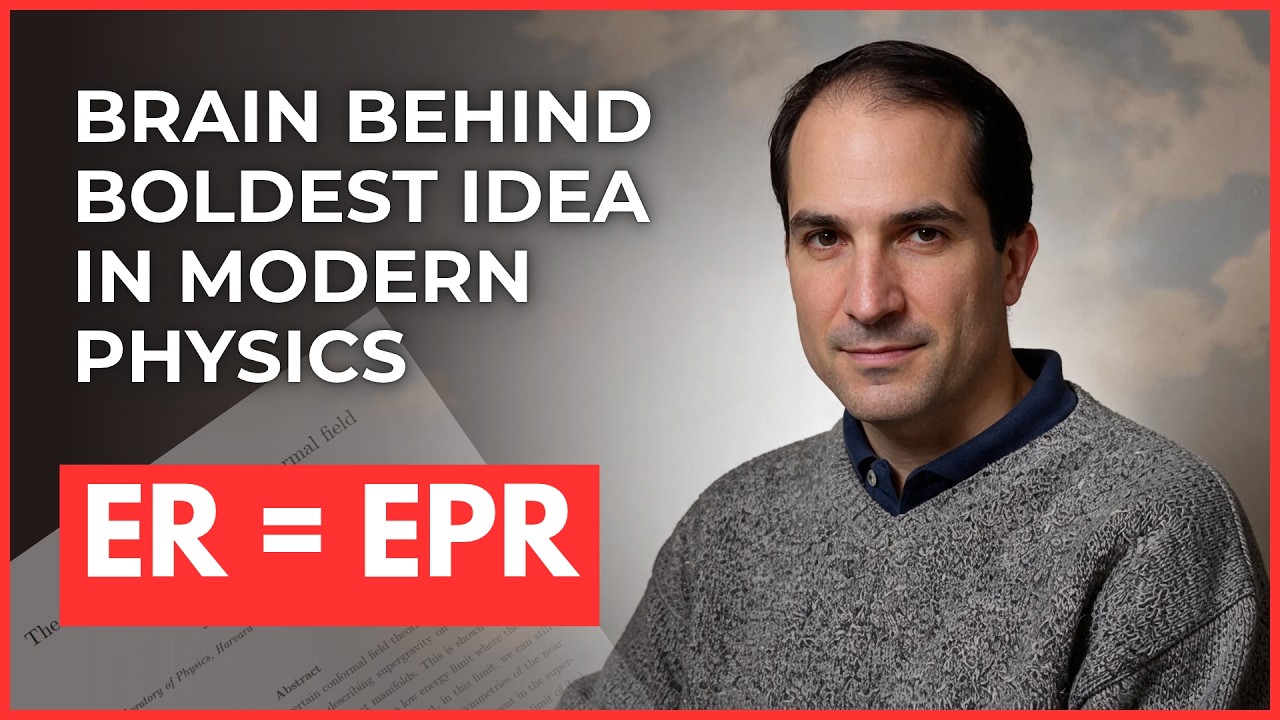
Meet Juan Maldacena, Legend Amongst Legends
Keywords
Summary
263 words
Critical Evaluation
Value of the Information & Strength of the Argument
The informational value rests on a well-chosen explanatory spine rather than on any new material: the video is a synthesis, and it earns its keep by making a genuinely difficult correspondence intelligible without equations. The argument is built as a problem-solution chain and holds together. It first establishes why the two pillars of twentieth-century physics cannot be combined — the equations diverge precisely where an object is both massive and small, at a black hole singularity or at the origin of the universe — then shows why the extra dimensions of string theory were a liability as much as an asset, and finally presents Maldacena’s inversion of the move: instead of adding dimensions to make the mathematics work, reduce them and let the gravitational description emerge from a lower-dimensional, gravity-free boundary theory. The hologram analogy is deployed correctly for once, since the point of a hologram is that the information for a volume is encoded on its surface, and the video explicitly draws the consequence that a spatial dimension can be emergent rather than fundamental. The information-paradox detour is the strongest part of the reasoning chain: by stating that the conformal field theory side is unitary and therefore cannot destroy information, the video shows why the duality dissolves the paradox rather than merely restating it, and it identifies the practical payoff — translating an intractable strongly coupled calculation into a tractable gravitational one — with two concrete applications, quark-gluon plasma viscosity and high-temperature superconductivity. The weaknesses are ones of calibration rather than of fact. The ER=EPR section is presented with the same declarative confidence as AdS/CFT, whereas it is a conjecture with a much thinner evidentiary base, and the text never signals that difference; the phrase ’the way space is connected and the way particles are entangled are actually the same’ is a hypothesis stated as an identity. Similarly, the claim that ‘without entanglement, space itself would break apart’ is a research programme, not an established result. The citation figure of 29,000 is given without a retrieval date beyond ‘by 2026’ and the paper is never named, so the viewer cannot check it. Finally, the closing material on faith and the Pontifical Academy is accurate but sits loose from the physics, functioning as colour rather than as argument. There is a short promotional interlude of roughly half a minute in the middle of the video.
Scientific Rigor, Source Quality, Title Accuracy
RIGOROUS SCIENTIFIC QUALITY, QUALITY OF SOURCES, TITLE/CONTENT MATCH. On sourcing, the video is thin in a specific and diagnosable way: the description lists no paper, no arXiv identifier and no interview, only the publisher’s own store, app, audiobook and podcast links, preceded by a list of five institutions — Perimeter Institute, the Institute for Advanced Study, the University of Michigan, the International Centre for Theoretical Physics and IHES — with no indication of which one supports which claim. Institution names are not references; a viewer cannot trace the citation counts, the prize chronology or the quoted remarks by Susskind (‘perhaps the greatest physicist of his generation’) and Klebanov (‘stone-cold genius’) back to any document. The quoted first-person material (‘as a child I was mostly interested in technology’, ‘any quiet place with no visual or auditory distractions would work’) is evidently drawn from interviews, but no interview is identified. This is a sourcing failure of traceability rather than of accuracy: the substantive claims about the 1997 paper, the 2012 Breakthrough Prize, the 2007 Heineman Prize, the 2008 Dirac Medal, the 2019 Galileo Galilei Medal, the 2013 Pontifical Academy appointment and the 2005 Scientific American article ‘The Illusion of Gravity’ are all consistent with the public record as far as they go, and the physics exposition contains no error that a specialist would flag. The one place where the popularisation outruns the evidence is the treatment of ER=EPR, described as though it were an established result. On title and content, the mismatch is minor: the title announces a portrait and the video is precisely a portrait, with ‘Legend Amongst Legends’ supplying the only note of hype.
684 words
Title / Content Match
The title promises a portrait of a person, and the video delivers exactly that: a chronological biography running from Buenos Aires and the Instituto Balseiro to Princeton, Harvard and the Institute for Advanced Study, anchored on the 1997 paper. Only the subtitle register ('Legend Amongst Legends') is promotional, which is a matter of tone rather than of content mismatch.
Quality & Reliability
6/10
The physics content (the incompatibility of general relativity and quantum mechanics, the reason string theory adds dimensions, the AdS/CFT dictionary, the black hole information paradox, the ER=EPR proposal) is presented accurately and in a form a specialist would not find misleading. The biographical and prize facts are specific and checkable (1997 arXiv preprint, Breakthrough Prize in Fundamental Physics 2012, Dirac Medal 2008, Heineman Prize 2007, Pontifical Academy membership in 2013, IAS professorship in 2001), yet none is referenced in the description, which lists only the publisher's own commercial links plus a bare list of institutions without a single pointer to a paper. The ER=EPR conjecture is described with almost the same degree of assurance as the well-established AdS/CFT correspondence, and the rhetorical framing ('broke physics', 'rewrote reality') overshoots what a duality conjecture establishes. Solid popularisation, but unverifiable as delivered.
Chapters
Cited Sources
- Maldacena, 'The Large N Limit of Superconformal Field Theories and Supergravity' (arXiv, November 1997) — the AdS/CFT paper — The central subject of the video; posted to arXiv in November 1997 and described as the most-cited paper in the history of high-energy physics, with over 29,000 citations.
- Maldacena & Susskind, 'Cool horizons for entangled black holes' (ER=EPR) — The 2013 paper presented as proposing that Einstein-Rosen bridges and Einstein-Podolsky-Rosen entanglement are the same phenomenon.
- Strominger & Vafa (1996), microstate counting of black holes using D-branes — Cited as the prior result that motivated Maldacena's focus on black holes and the information paradox.
- Hawking radiation and the black hole information paradox — The 1970s result attributed to Stephen Hawking, presented as the conflict between gravitational and quantum descriptions that the video treats as the setup for AdS/CFT. No reference given in the description.
- Einstein & Rosen (1935), wormhole paper; Einstein, Podolsky & Rosen (1935), entanglement paper — Both 1935 papers invoked to explain the two halves of the ER=EPR equation and Einstein's 'spooky action at a distance'. No reference given in the description.
- Maldacena, 'The Illusion of Gravity', Scientific American (2005) — Cited as the author's own equation-free explanation of the holographic universe. No link provided in the description.
- Perimeter Institute for Theoretical Physics; Institute for Advanced Study; University of Michigan; International Centre for Theoretical Physics; Institut des Hautes Études Scientifiques (IHES) — Listed in the description under 'Sources', without a link or an indication of which claim each institution supports.
Concurring Sources
- Maldacena, 'The Large N Limit of Superconformal Field Theories and Supergravity' — The primary source for the central claim of the video; consistent with the account given of the duality between anti-de Sitter gravity and a boundary conformal field theory.
- AdS/CFT correspondence — Wikipedia — Independent summary corroborating the video's description of the duality, its citation impact and its applications to strongly coupled systems.
- Black hole information paradox — Wikipedia — Corroborates the framing of Hawking radiation and information loss as the problem that AdS/CFT is used to address.
Dissenting Sources
- Critical literature on the ER=EPR conjecture — The video states as fact that wormholes and entanglement are the same thing and that spacetime is held together by entanglement. In the literature ER=EPR is a conjecture, and the step from an entangled pair to a geometric connection is not established; the video gives no indication of this gap.
External References
Contribution & Novelties
The video contributes no new research and does not claim to; its value is editorial. It assembles a single continuous narrative in which the biographical trajectory (a childhood spent dismantling appliances, a military school that supplied discipline, the deliberately isolated Instituto Balseiro in Patagonia, a Princeton PhD under Curtis Callan) is made to converge on one November 1997 paper, and it pairs that narrative with a correct and unusually patient explanation of what the duality actually asserts — including the often-skipped point that Maldacena’s move was to reduce dimensions rather than add them, and that the unitarity of the boundary theory is what saves the information. The reconstruction of the reception (the immediate uptake by Witten, Klebanov, Gubser and Polyakov, the Strings ‘98 banquet) gives a texture that a textbook account would not, and the treatment of ER=EPR as a later, distinct line of work rather than as a corollary is a useful structural choice. What it does not do is distinguish established results from conjecture, and it supplies no traceable reference for any of its figures.
Pour aller plus loin :
- AdS/CFT correspondence — Wikipedia — Background article covering the duality explained here, with the original references.
- Maldacena, ‘The Large N Limit of Superconformal Field Theories and Supergravity’ (arXiv:hep-th/9711200) — The 1997 paper itself, the primary source the video never links.
- Black hole information paradox — Wikipedia — Frames the Hawking problem and the competing resolutions, of which AdS/CFT is one.
- Holographic principle — Wikipedia — The broader idea behind the hologram analogy used in the video.
- ER=EPR conjecture — The 2013 Maldacena-Susskind proposal that wormholes and entanglement are the same thing; worth reading alongside critiques that treat it as a conjecture rather than a result.
287 words
Radar Profile
The profile is broad rather than deep: strong on informational quantity and on the coherence of the explanatory narrative, moderate on technical density, since the mathematics is described in words rather than performed, and weakest on sourcing, where the absence of any referenced paper or document caps the reliability score. This is the signature of competent science popularisation built on secondary synthesis rather than on direct engagement with the primary literature.