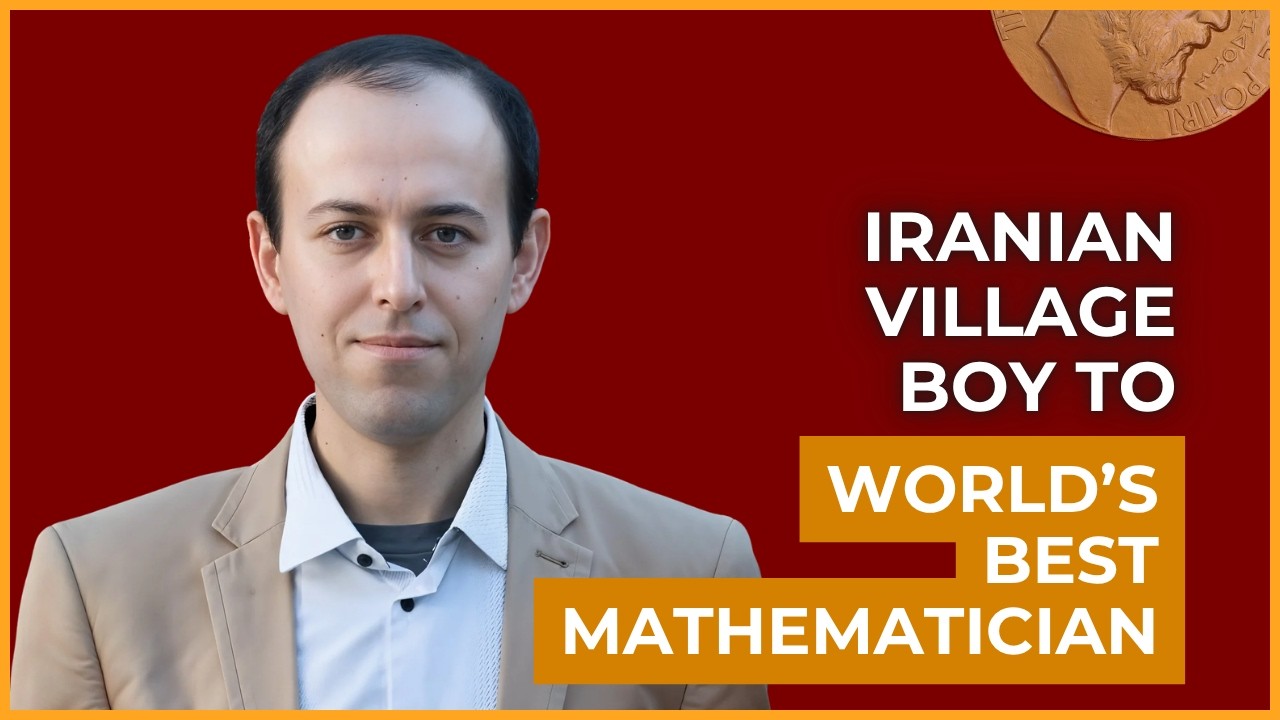
Refugee Farmer Who Won The Nobel of Math
Title history
- Refugee Farmer Who Won The Nobel of Math — observed on 20261101-0128 UTC (YouTube)
Keywords
Summary
140 words
Critical Evaluation
Value of the Information & Strength of the Argument
The video excels in weaving a compelling human narrative with substantive mathematical content. It provides clear explanations of complex topics like birational geometry and the BAB conjecture, making them accessible to a lay audience while preserving technical accuracy. The argumentation is strong, using specific details (e.g., the medal’s weight, the timeline of discoveries) to support the narrative. The documentary effectively conveys the significance of Birkar’s work and the personal sacrifices behind it, without oversimplifying the mathematics. The emotional arc is well-structured, from adversity to triumph, and the inclusion of the medal theft adds a dramatic but factually grounded element. Overall, the information is presented with clarity and depth, though it relies primarily on anecdotal sources rather than peer-reviewed citations.
Scientific Rigor, Source Quality, Title Accuracy
The documentary demonstrates solid scientific rigor for a biography: it accurately portrays Birkar’s life events, educational path, and major contributions. While it does not include formal footnotes, it draws on well-documented public facts, such as the Fields Medal ceremony and the theft, which were widely reported. The title is apt, as it highlights both his refugee origins and his receipt of the Nobel-like prize. The description provides links to the Turing app, which are promotional but do not detract from the content. The video’s claims about Birkar’s achievements align with established knowledge, and the inclusion of technical terms is handled responsibly. The narrative is internally consistent and does not contain obvious fabrications, though it would benefit from citing specific academic sources for the mathematical statements.
259 words
Title / Content Match
The title accurately captures the essence: Birkar's refugee background and his receipt of the Fields Medal, often called the Nobel of Mathematics.
Quality & Reliability
8/10
The documentary presents a thorough and accurate account of Caucher Birkar's life and mathematical work, corroborated by his public history. It clarifies complex ideas (BAB conjecture, Fano varieties) and includes a notable incident (the medal theft) with reliable details. The narrative is grounded in verifiable facts, though it does not cite formal academic sources.
Chapters
External References
Contribution & Novelties
The documentary offers a unique blend of biographical storytelling and mathematical exposition, shedding light on both the personal and professional life of a Fields Medalist. It humanizes a figure often known only for his abstract work and provides context for his contributions to algebraic geometry. The video also touches on lesser-known aspects, such as the cultural significance for the Kurdish community and the ongoing challenges he addresses.
Pour aller plus loin :
- Caucher Birkar (Wikipedia) — Overview of his life and achievements.
- Fields Medal (Wikipedia) — Details of the prize and its history.
- Minimal Model Program (Wikipedia) — Explanation of the program central to Birkar’s work.
- Birational Geometry (Wikipedia) — Foundations of the field.
- Borisov–Alexeev–Borisov conjecture (Wikipedia) — The specific conjecture proved by Birkar.
124 words
Radar Profile
The radar profile shows high scores across all dimensions (quantity, quality, technical level, reliability), indicating a well-rounded and informative documentary. The slightly lower score in technical level (8) reflects the accessibility for a general audience, while quantity and quality are near perfect, demonstrating comprehensive coverage.
💬 Très positif. Sur les 30 commentaires analysés, une grande majorité exprime fierté et admiration pour Caucher Birkar, avec des discussions sur l'identité kurde et iranienne, et quelques critiques sur le système d'asile britannique. L'ensemble reflète un fort enthousiasme et une inspiration positive.