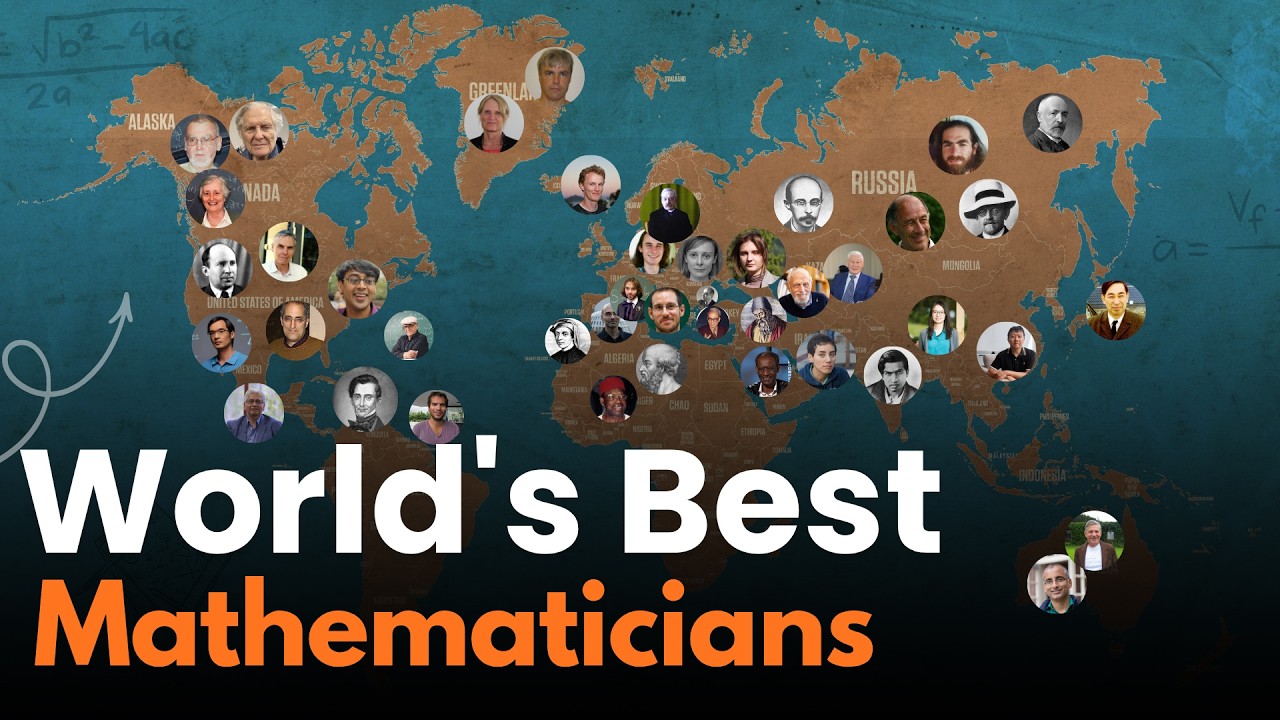
Which Country Has World's Best Mathematicians?
Title history
- Which Country Has World's Best Mathematicians? — observed on 20261101-0057 UTC (YouTube)
Keywords
Summary
138 words
Critical Evaluation
Value of the Information & Strength of the Argument
The video demonstrates strong value by offering a transparent, multi-metric framework for a complex, subjective question. It weighs research output, elite awards, young talent, origin, and per-capita efficiency, providing a nuanced view beyond simple medal counts. The argumentation is solid for a general audience, with historical anecdotes and specific examples (e.g., Terence Tao, June Huh) illustrating each country’s profile. However, the weights are chosen arbitrarily and not backed by peer-reviewed justification, which introduces inherent subjectivity. The inclusion of honorary mentions and the discussion of brain drain add depth, but the lack of explicit citations for specific data points (e.g., IMO medal counts, publication rankings) weakens the verification of claims.
Scientific Rigor, Source Quality, Title Accuracy
The video’s scientific rigor is moderate: it references credible institutions like the International Mathematical Union and prestigious universities, but does not provide direct links or footnotes for its statistics. The data seems plausible, and the methodology is explained clearly, but the absence of transparent sourcing is a limitation. The title accurately reflects the content—a data-driven ranking—and the content remains focused on that premise. The video does not engage with or refute alternative methodologies, which would have strengthened its credibility. The title-contenu match is excellent, and the presentation is professionally structured, though the lack of a final revealed top-5 (due to transcript cut) leaves the core question partially unanswered.
232 words
Title / Content Match
The title directly matches the content, which provides a data-driven ranking of countries according to mathematical excellence.
Quality & Reliability
7/10
The video presents a balanced multi-criteria framework but lacks explicit citations for many data points; however, it references reputable institutions and appears data-driven.
Chapters
External References
- apps.apple.com
- books.apple.com
- open.spotify.com
- open.spotify.com
- open.spotify.com
- open.spotify.com
- open.spotify.com
- open.spotify.com
- open.spotify.com
- open.spotify.com
- open.spotify.com
- open.spotify.com
- open.spotify.com
- open.spotify.com
- play.google.com
- podcasts.apple.com
- podcasts.apple.com
- podcasts.apple.com
- podcasts.apple.com
- podcasts.apple.com
- podcasts.apple.com
- podcasts.apple.com
- podcasts.apple.com
- podcasts.apple.com
- podcasts.apple.com
Contribution & Novelties
The video’s original contribution lies in its balanced, five-part scoring framework that combines quantitative metrics with contextual factors like origin and per-capita efficiency, offering a more holistic view than simple medal tallies. It also brings attention to smaller nations and honorary mentions, enriching the global perspective. However, the overall approach is reminiscent of various existing rankings, and the novelty is limited to the specific weighting and country lineup.
Pour aller plus loin :
- Fields Medal — The most prestigious award in mathematics, central to the video’s elite distinction criterion.
- International Mathematical Olympiad — Key source of the talent pipeline metric, with historical results for many countries.
- Poincaré conjecture — Grigori Perelman’s solved problem and his refusal of awards, illustrating the complexity of ranking and individual choices.
126 words
Radar Profile
The radar profile shows a well-balanced content with high quantity of information (8), moderate quality and reliability (7 and 6), and a moderate technical depth (6), indicating a comprehensive but accessible presentation. The lower reliability score reflects the lack of explicit citations, while the quantity and quality sustain viewer interest.
💬 Balanced — out of 30 comments analyzed, many viewers appreciated the detailed analysis but pointed out notable omissions such as Germany and Romania, and some historical corrections.