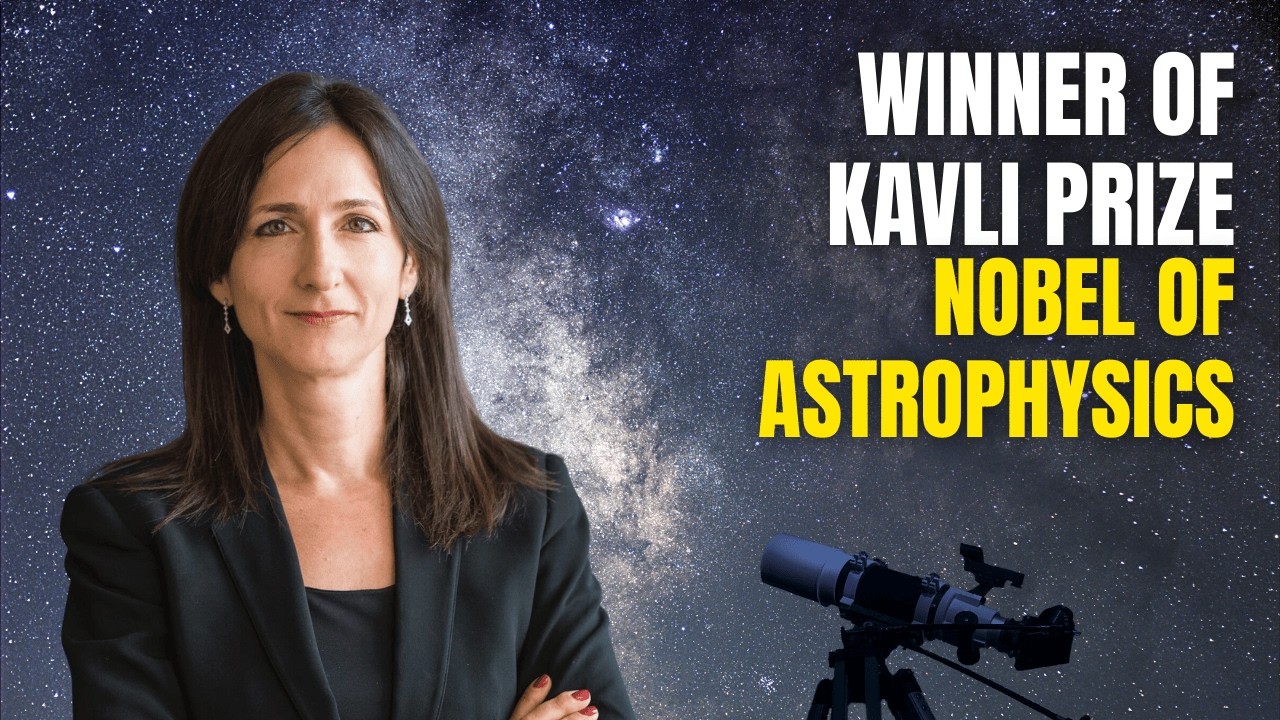
The Youngest Woman to Win Nobel of Astrophysics
Title history
- The Youngest Woman to Win Nobel of Astrophysics — observed on 20261101-0156 UTC (YouTube)
Keywords
Summary
150 words
Critical Evaluation
Value of the Information & Strength of the Argument
The video offers significant value by synthesizing Sara Seager’s contributions into a coherent narrative, making complex astrophysical concepts accessible. It demonstrates the progression of exoplanet science from detection to characterization, and explains the physical principles behind transmission spectroscopy with clear analogies. The argumentation is solid: it traces Seager’s early skepticism from her peers, her theoretical predictions, and their later experimental confirmation, thereby establishing a cause-and-effect relationship. The inclusion of her personal perseverance strengthens the narrative without undermining scientific rigor. However, the video could benefit from more explicit references to primary sources and peer-reviewed papers, as some claims about her being the ‘best expert’ are subjective. Overall, the information is valuable and the reasoning is sound, though not exhaustive.
Scientific Rigor, Source Quality, Title Accuracy
The scientific rigor is generally high: the methods described (radial velocity, transit photometry, transmission spectroscopy) are accurately presented, and the historical milestones (e.g., 2002 sodium detection) are correctly attributed. The video references real awards, institutions, and Seager’s textbooks and memoir, which are verifiable. However, the description only provides a link to the Turing app, not to any academic sources, so direct citations are limited. The title’s claim of ‘Nobel of Astrophysics’ is a common but unofficial designation for the Kavli Prize, and ‘Youngest Woman’ is not addressed or validated in the content. The title is catchy but could mislead viewers. Despite minor sensationalism, the core content is reliable and well-structured.
243 words
Title / Content Match
The title claims she won a Nobel, but it refers to the Kavli Prize, often called the 'Nobel of Astrophysics'. The 'youngest woman' aspect is not supported by the video content. The title is catchy but slightly misleading.
Quality & Reliability
8/10
The video provides an accurate and well-researched account of Sara Seager's life and scientific contributions, based on publicly known facts. Minor sensationalism in the title, but content is reliable.
Chapters
Cited Sources
- Turing App — Link to the Turing app, which provides STEM audio shows; mentioned in the video description as a resource.
Concurring Sources
- Sara Seager - Wikipedia — Wikipedia article providing biographical details consistent with the video.
- NASA Exoplanet Exploration — NASA's official exoplanet program, corroborating detection methods and missions.
Contribution & Novelties
The video presents a comprehensive biographical account of Sara Seager, highlighting her unique role in developing transmission spectroscopy and her leadership in exoplanet mission concepts. It successfully bridges her personal resilience with her scientific achievements, offering inspiration to aspiring scientists. While it does not present new research, it compiles existing knowledge into an accessible documentary, emphasizing the significance of her work. For deeper exploration, the following resources are recommended.
Pour aller plus loin :
- Exoplanet — Overview of planets outside our solar system and detection methods.
- Transmission spectroscopy — Technical details on how atmospheric absorption lines reveal composition.
- Kavli Prize — Information about the prize considered the ‘Nobel of Astrophysics’.
- Starshade — Concept of a spacecraft designed to block starlight for direct imaging.
123 words
Radar Profile
The radar profile shows a well-rounded video with high scores in information quantity and quality, but a slightly lower technical level, indicating it is accessible to a general audience while preserving scientific accuracy.