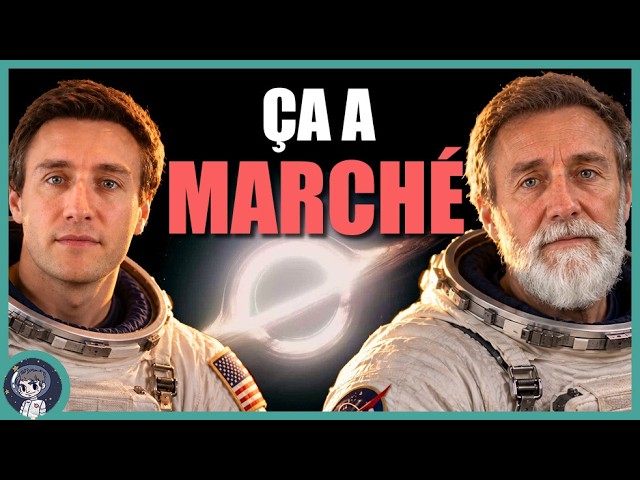
La première EXPÉRIENCE de VOYAGE dans le TEMPS a RÉUSSI ! - On Se l'Demande #215 - Le JDE
The first TIME TRAVEL EXPERIMENT was a SUCCESS! - We Wonder #215 - Le JDE
Title history
- La première EXPÉRIENCE de VOYAGE dans le TEMPS a RÉUSSI ! - On Se l'Demande #215 - Le JDE — observed on 20261025-1149 UTC (YouTube)
Keywords
Summary
170 words
Critical Evaluation
Value of the Information & Strength of the Argument
The video excels at making complex physics understandable without sacrificing accuracy. The use of cinematic references (Interstellar, Planet of the Apes) serves as memorable mental anchors, while the step-by-step diagrammatic explanation of the twin paradox is pedagogically effective. The argumentation follows a logical progression: from sci-fi scenario to theoretical framework (space-time diagrams, equivalence principle) to empirical validation. The host carefully distinguishes between theoretical predictions and experimental measurements, and he acknowledges the limits of current technology. The inclusion of the Galileo satellite incident adds a compelling modern example, showing how unintended events can provide unique scientific opportunities. Overall, the reasoning is coherent, well-supported, and persuasive, making a strong case for the reality of time dilation.
Scientific Rigor, Source Quality, Title Accuracy
The scientific rigour is high: the video references well-established experiments (Frisch muons, Hafele-Keating, Galileo) and correctly explains the underlying principles. However, it does not provide specific citations or direct links to the original papers, but this is typical for a popular science channel. The title is catchy but slightly overstates the content, as it implies an actual time travel feat rather than a confirmation of time dilation. Still, the core message is scientifically accurate. The video’s structure is clear, and the host explicitly mentions additional resources (like Science Étonnante) for deeper exploration, which adds credibility. The comments (30 provided) are overwhelmingly positive, with viewers praising the clarity and educational value, indicating a well-received piece of science communication.
246 words
Title / Content Match
The title is somewhat sensationalist ('first TIME TRAVEL EXPERIMENT SUCCEEDED') but the video actually discusses experimental confirmations of time dilation, which is a legitimate precursor to time travel into the future. The content largely matches the promise, though the phrasing could be more precise.
Quality & Reliability
9/10
The video presents a rigorous, well-structured explanation of time dilation and gravitational time dilation, backed by concrete experimental evidence (muon decay, Hafele-Keating, Galileo satellites). The host explains complex concepts clearly, using intuitive diagrams and cinematic examples, while acknowledging theoretical limits. The scientific content is accurate and up-to-date, with no obvious errors or misleading claims.
Chapters
- La planète Miller dans Interstellar
- Pourquoi le temps ralentit-il près d'un trou noir ?
- Le paradoxe temporel de La Planète des singes
- Comprendre l'espace-temps et le diagramme de Minkowski
- La vitesse de la lumière et la désynchronisation temporelle
- Pourquoi le voyageur vieillit-il moins vite ? (Accélération et référentiels)
- Gravité et accélération : le principe d'équivalence
- Ce qui arrive réellement sur la planète Miller
- Première preuve expérimentale : les muons du mont Washington
- L'expérience des horloges atomiques en avion (Hafele-Keating)
- Le test parfait : l'accident des satellites Galileo 5 et 6
- Le voyage dans le temps est possible...mais que dans un sens
Cited Sources
- Journal de l'Espace - Blog — Official website of the channel, providing articles and space news.
- Épisode sur le voyage supraluminique — Mentioned as a complement for the Minkowski diagram and superluminal travel paradoxes.
- Forum de la conquête spatiale — Listed as a general source for space discussions.
Concurring Sources
- Hafele-Keating experiment — Confirms the time dilation observed with atomic clocks in aircraft.
- Gravitational time dilation — Supports the explanation of time passing slower near massive objects.
- Galileo satellite navigation system — Background on the satellites that were accidentally put into elliptical orbits and used to measure time dilation.
External References
Contribution & Novelties
The video brings a fresh angle by linking a celebrated Hollywood scene to concrete experimental physics, making the concept of time dilation tangible and accessible. It also highlights the Galileo satellite accident as an accidental but perfectly designed test of general relativity, which is not widely known. The pedagogical use of Minkowski diagrams and the equivalence principle is well executed. This content adds value by awakening curiosity and providing a solid foundation for understanding relativistic time effects.
Pour aller plus loin :
- Hafele–Keating experiment — Direct reference to the atomic clock experiment discussed in the video.
- Gravitational time dilation — Theoretical background and examples.
- Muon decay and time dilation — Explanation of the muon experiment.
- Twin paradox — Detailed analysis of the paradox and its resolution.
126 words
Radar Profile
The radar profile shows a well-rounded video with high scores in information quality and reliability, slightly lower in technical depth but still suitable for a general audience. The strong balance between entertainment and education makes it an effective science communication piece.
💬 The climate is very positive. Sur les 30 commentaires analysés, tous expriment un enthousiasme marqué : les téléspectateurs louent la clarté de la vulgarisation, l'usage ingénieux des films de science-fiction et la qualité pédagogique de l'épisode. Aucune critique négative n'est relevée.