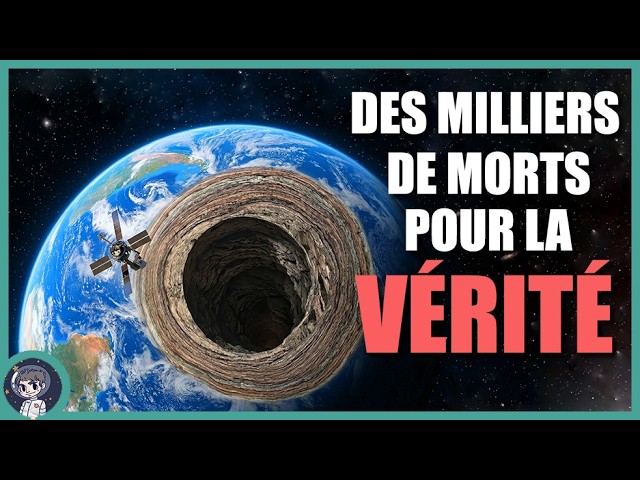
Ce qu'on a VRAIMENT TROUVÉ au CENTRE de la TERRE - On Se l'Demande #213 - Le JDE
What we REALLY FOUND at the CENTER of the EARTH - On Se l'Demande #213 - Le JDE
Keywords
Summary
185 words
Critical Evaluation
Value of the Information & Strength of the Argument
The video’s value lies in its clear and engaging presentation of the history and science of Earth’s interior. It effectively uses the narrative of incorrect theories to illustrate the evolution of scientific thought and the importance of empirical evidence. The argumentation is logically structured: it first establishes the historical context, then presents the fictional and pseudoscientific ideas, and finally shows how seismology provided decisive proof. Solid reasoning is used to explain why the hollow Earth idea was implausible and how seismic wave behavior led to the current model. The explanations are accessible yet accurate, and the visual aids (animations and diagrams) reinforce the arguments.
Scientific Rigor, Source Quality, Title Accuracy
The video demonstrates strong scientific rigor by accurately depicting historical figures and their theories, and by correctly explaining the physical principles behind seismology. While the video does not cite specific papers, it refers to well-known scientific milestones (e.g., Oldham’s 1906 discovery, Lehmann’s 1936 identification of the inner core) that are consistent with established geophysical literature. The title accurately reflects the content, and the video’s internal structure (chapters) logically unfolds from myth to science. No significant discrepancies or unsupported claims were noted. The comments section shows unanimous appreciation for the pedagogical and historical approach, with viewers praising the clarity and the reminder of the importance of understanding how scientific knowledge is built.
230 words
Title / Content Match
The title accurately reflects the content: it discusses what we now know about the Earth's interior and the historical journey of discovery, matching the video's focus and promise.
Quality & Reliability
8/10
The video presents a historically and scientifically accurate overview of the hollow Earth theory and its debunking through seismology. It clearly distinguishes speculation from evidence, and correctly explains the propagation of seismic waves and the resulting model of Earth's internal structure. While it does not cite specific primary sources within the video itself, the explanations align with well-established scientific knowledge.
Chapters
- Le mythe du Maelström polaire
- Les mystères des profondeurs terrestres
- Légendes et fantasmes des pôles
- La Terre creuse selon Edmond Halley
- Deux soleils intérieurs : l'hypothèse de John Leslie
- Les gouffres géants de John Symmes
- Pourquoi l'idée de cavités a persisté
- La révolution de la sismologie (ondes P et S)
- La découverte du noyau terrestre
- La structure interne de la Terre aujourd’hui
- Sonder l'intérieur de la Lune et de Mars
Cited Sources
- Journal de l'Espace Blog — Official website of the channel, providing additional articles and references.
- Forum de la conquête spatiale — French space exploration forum cited as a general source in the video description.
- NASA Goddard YouTube Channel — Listed among sources for images and animations, representing authoritative space agency content.
- Scott Buckley Music — Music composer credited in the video, not a scientific source but a listed link.
- Utho Riley — Music composer credited in the video, not a scientific source but a listed link.
Concurring Sources
- Oldham's 1906 paper on Earth's core — The video refers to Richard Dixon Oldham's discovery of the liquid outer core using seismic data from a Guatemala earthquake; though not linked, this is a well-documented historical scientific claim.
External References
Contribution & Novelties
The video’s original contribution lies in synthesizing the historical hollow Earth theories with the modern seismological evidence in an engaging and didactic manner. It effectively illustrates how scientific knowledge corrects pseudoscientific beliefs and emphasizes the role of indirect observation. The historical anecdotes (Halley, Leslie, Symmes) are presented with enough detail to captivate, while the explanation of seismic wave behavior is clear enough for a general audience.
Pour aller plus loin :
- Seismic wave — Overview of P-waves and S-waves, essential to understand the method described.
- Inge Lehmann — The seismologist who discovered the solid inner core in 1936.
- Earth’s inner core — Detailed article on the composition and properties of the innermost layer.
- Hollow Earth — Historical and cultural background of the hollow Earth hypothesis, complementing the video’s historical section.
130 words
Radar Profile
The radar profile shows high scores in qualitative and quantitative information, with moderate technical difficulty. This indicates a video that is rich in educational content yet accessible, balancing scientific depth with clear communication.
💬 Très positif. Sur les 30 commentaires analysés, tous expriment un enthousiasme unanime, saluant la pédagogie, la clarté et la richesse historique du contenu, sans aucune critique négative.