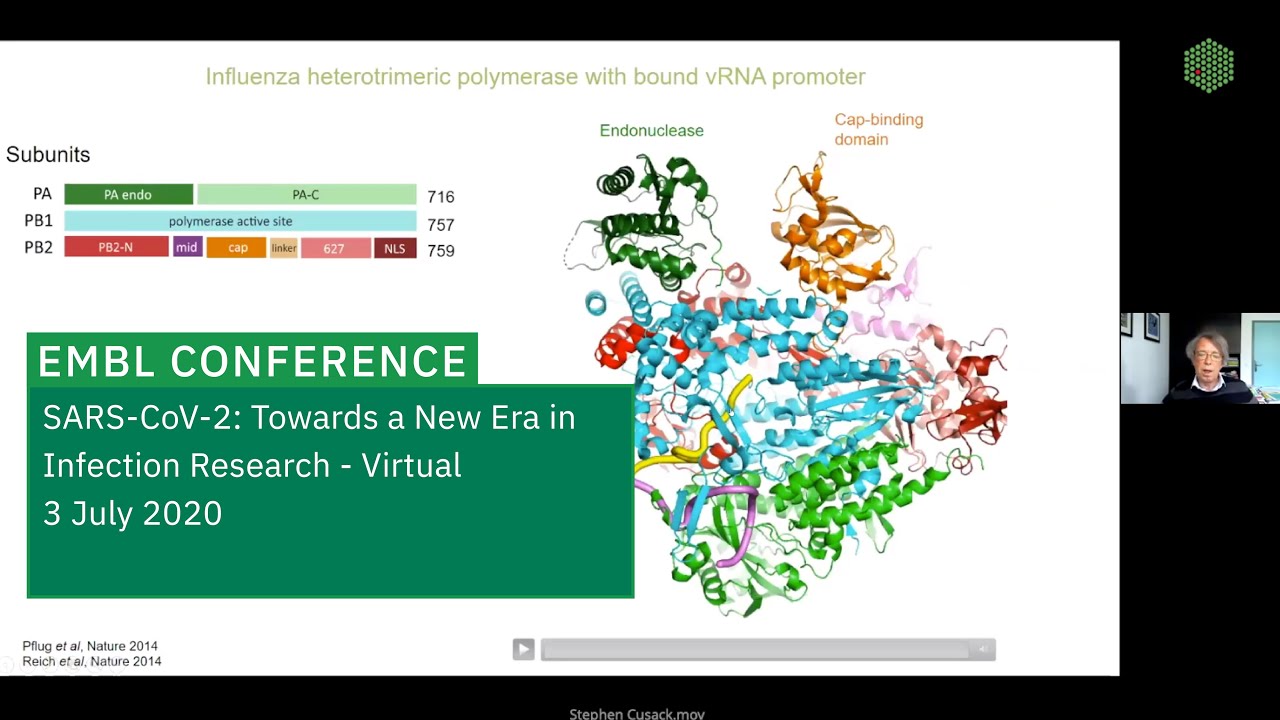
S.Cusack-Structural insights into the transcription mechanism&drug-targeting of influenza polymerase
Title history
- S.Cusack-Structural insights into the transcription mechanism&drug-targeting of influenza polymerase — observed on 20261026-1536 UTC (YouTube)
Keywords
Summary
157 words
Critical Evaluation
Value of the Information & Strength of the Argument
The presentation delivers high-value information by directly linking structural findings to functional mechanisms and therapeutic strategies. The use of high-resolution cryo-EM structures provides unambiguous evidence for the proposed transcription model, including the novel secondary binding site. The argumentation is logically structured: from polymerase architecture to cap-snatching, then to drug targeting and cross-virus comparisons. The speaker effectively explains how the unique features of influenza polymerase can be exploited for drug design, and discusses the potential repurposing of nucleoside analogues for COVID-19. The Q&A section adds further credibility, addressing mechanistic questions and drug specificity, demonstrating a deep understanding of the subject.
Scientific Rigor, Source Quality, Title Accuracy
The talk is scientifically rigorous, grounded in recently published cryo-EM studies (e.g., a paper in Cell) and complementary structural work. The speaker clearly distinguishes between established findings and hypotheses, and references specific studies, though full citations are not provided in the description. The title accurately reflects the content, focusing on structural insights and drug targeting. No discrepancies are noted between the title and the talk. The presentation adheres to high standards of scientific discourse, with appropriate caveats about drug efficacy and potential toxicity. The conference context (EMBL) ensures authoritative content.
204 words
Title / Content Match
The title accurately reflects the content, focusing on structural insights into influenza polymerase transcription and drug targeting.
Quality & Reliability
9/10
High scientific quality based on peer-reviewed structural biology research, presented by an EMBL group leader. The talk describes recent cryo-EM structures published in a leading journal, and includes cross-validated mechanisms. However, as a conference presentation, some details are condensed, and the content is not independently peer-reviewed here.
Key Moments
Markers derived by PSI from the transcript: the creator did not define chapters.
- Introduction: influenza and COVID-19 double peak, importance of influenza research.
- Overview of influenza virus, polymerase structure, and cap-snatching.
- Structure of influenza polymerase with promoter binding and unique domains.
- Cap-snatching mechanism: binding to host Pol II CTD and endonuclease cleavage.
- Cryo-EM snapshots of transcribing polymerase, discovery of secondary binding site.
- Drug development: cap-dependent endonuclease inhibitors (baloxavir, VX-787) and nucleoside analogues.
- Comparison with other RNA viruses, potential broad-spectrum antivirals, and summary.
Contribution & Novelties
The main novelty is the cryo-EM visualization of actively transcribing influenza polymerase, revealing a previously unknown secondary binding site for the template’s 3’ end that is critical for transcription processivity. This structural insight not only clarifies the transcription mechanism but also identifies a potential new drug target. The talk also highlights the translational relevance of flu antivirals for COVID-19, demonstrating structural similarities in the polymerase core across RNA viruses.
Pour aller plus loin :
- Cap snatching — Overview of the mechanism used by influenza and other viruses.
- Influenza virus RNA polymerase — Detailed description of the polymerase complex and its functions.
- Baloxavir marboxil — The endonuclease inhibitor discussed as a recent anti-influenza drug.
- Favipiravir — Nucleoside analogue with activity against multiple RNA viruses, including influenza and SARS-CoV-2.
127 words
Radar Profile
The radar profile shows high scores in all four dimensions, with particular strengths in technical level and fiabilité, reflecting a specialized yet reliable scientific presentation. The slightly lower quantity score indicates a focused talk rather than a broad review, but the depth compensates.