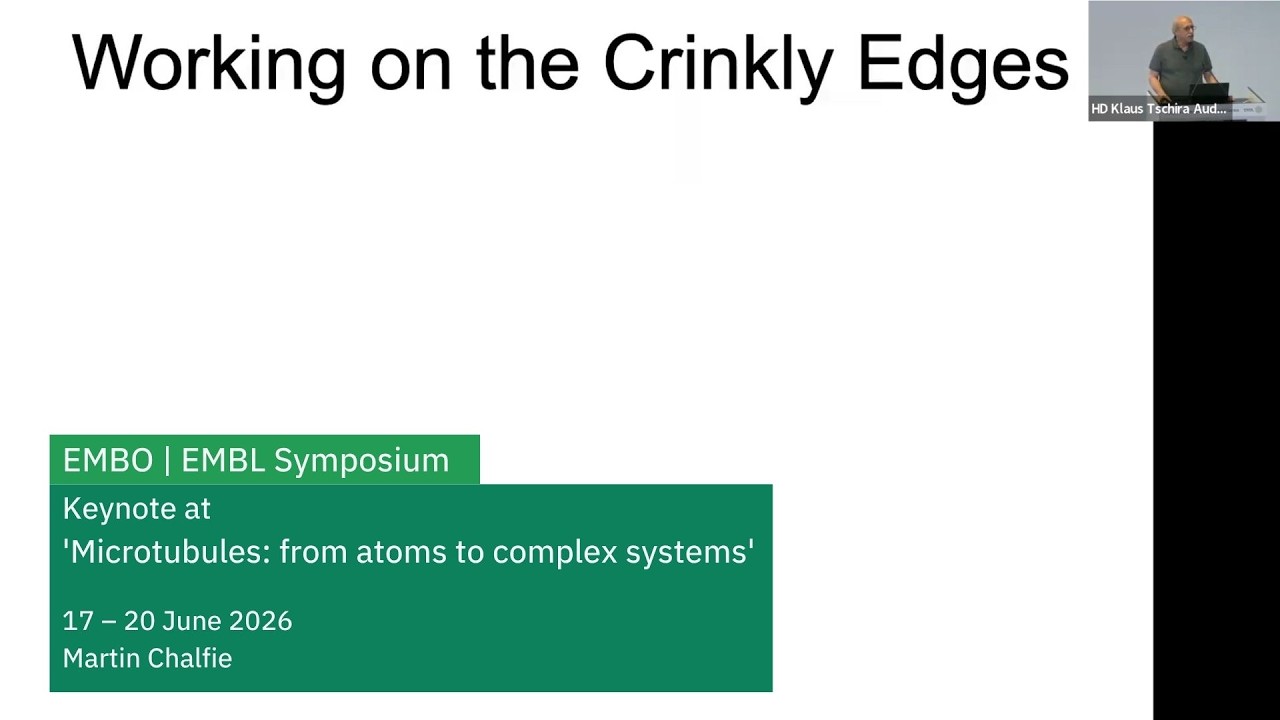
EMBL Keynote Lecture: Working on the crinkly edges, Martin Chalfie
Title history
- EMBL Keynote Lecture: Working on the crinkly edges, Martin Chalfie — observed on 20261026-1938 UTC (YouTube)
Keywords
Summary
171 words
Critical Evaluation
Value of the Information & Strength of the Argument
The talk provides unique first-hand insights into decades of meticulous genetic and cell biological research, demonstrating how careful observation and genetic screens can uncover fundamental biology. The argumentation is solid, based on experimental evidence, including serial section reconstructions, drug studies, and mutation analysis. The speaker effectively uses anecdotal narratives to illustrate the scientific process, but also presents quantitative data. He acknowledges unresolved questions and suggests future directions, which enhances the intellectual honesty of the presentation.
Scientific Rigor, Source Quality, Title Accuracy
The scientific rigor is high, with detailed descriptions of experimental procedures and references to specific papers, though not all citations are formally given. The talk is grounded in published work and his own laboratory’s findings, but it reflects personal perspectives. The title, while creative, may not immediately convey the scientific content, but the lecture does live up to it by exploring the ‘crinkly edges’ of known biology—unexpected exceptions and puzzles. Overall, the content matches the title in a meaningful way.
170 words
Title / Content Match
The title is metaphorical, referencing a quote from Hitchhiker's Guide to the Galaxy, but it aptly reflects the speaker's journey exploring unexpected discoveries in microtubule biology; it is somewhat indirect but fits the narrative.
Quality & Reliability
9/10
Highly reliable due to the speaker's authoritative background as a Nobel laureate and the detailed account of decades of experimental research, with evidence from genetic, structural, and functional studies.
Key Moments
Markers derived by PSI from the transcript: the creator did not define chapters.
- Introduction and homage to John Sulston, explaining the title's origin from Hitchhiker's Guide to the Galaxy.
- Discovery that microtubules in touch receptor neurons are not continuous, with serial sections showing independent starts and stops.
- Unusual protofilament numbers and selective sensitivity to drugs like colchicine, leading to genetic screens.
- Identification of a feedback loop involving MAP kinase pathway and its role in regulating differentiation.
- New findings on benomyl resistance using the Million Mutation Project, revealing redundancy of the BEn1 beta-tubulin.
Contribution & Novelties
The talk offers a distinctive first-person account of nearly four decades of research, revealing how chance observations and systematic genetic screens reshaped understanding of microtubule organization. It highlights the unexpected discovery of non-continuous microtubules, the unique 15-protofilament structure, and the role of acetylation, while introducing recent unpublished data on benomyl resistance. The original contribution is both a review of established work and an announcement of new findings, emphasizing the value of curiosity-driven science.
Pour aller plus loin :
- Caenorhabditis elegans — Model organism central to the talk.
- Microtubule — Core cellular structure discussed, dynamic behavior and structural variants.
- Tubulin — Protein family including alpha and beta tubulin, mutations and drug interactions.
111 words
Radar Profile
The radar profile shows a balanced high performance across all dimensions, with particularly strong scores in technical level and fiabilité, reflecting the speaker's expertise and the rigorous presentation of research details.