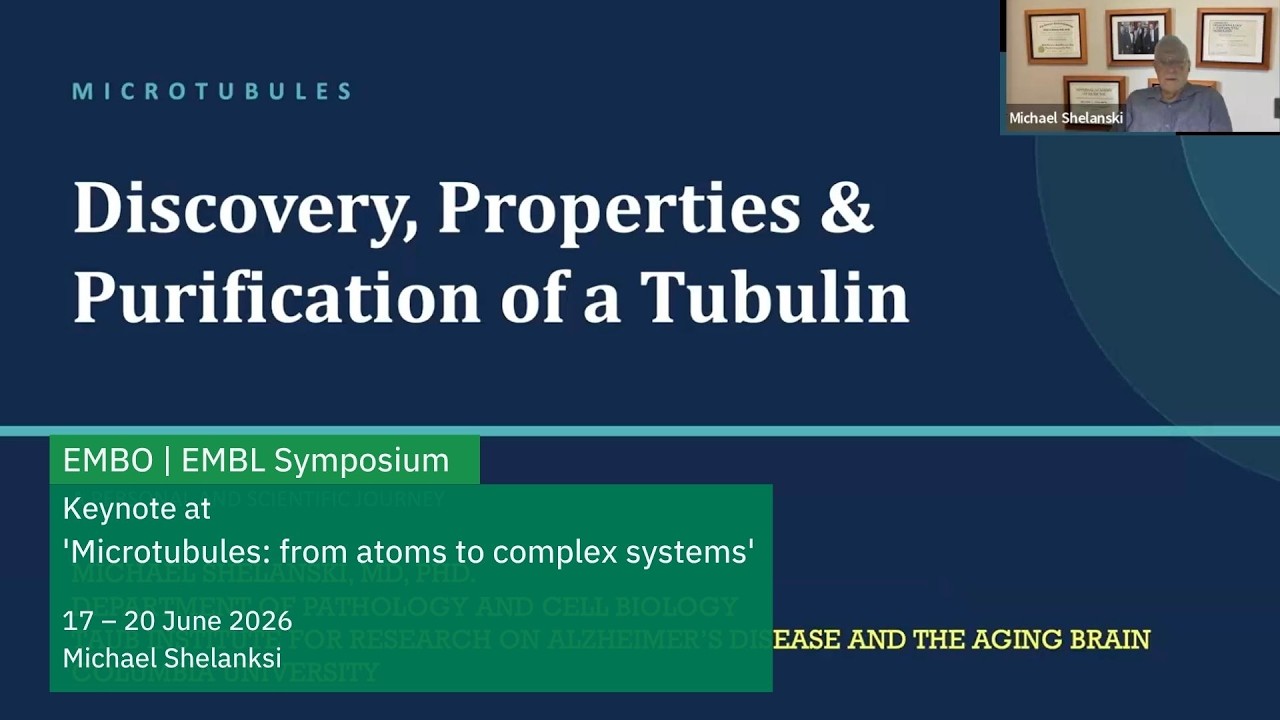
EMBL Keynote Lecture: Discovery, Properties & Purification of a Tubulin, Michael Shelanski
Title history
- EMBL Keynote Lecture: Discovery, Properties & Purification of a Tubulin, Michael Shelanski — observed on 20261026-1722 UTC (YouTube)
Keywords
Summary
184 words
Critical Evaluation
Value of the Information & Strength of the Argument
The value of this talk lies in its first-hand historical account of a seminal period in cell biology, offering unique insights into the personalities, challenges, and methodological constraints of the time. The argumentation is coherent and persuasive, combining personal anecdotes with concrete experimental results, though it lacks formal citations and relies heavily on memory. The speaker’s authority and direct involvement add weight to the narrative, but the lack of verifiable sources limits its scholarly rigor.
Scientific Rigor, Source Quality, Title Accuracy
The talk is scientifically rigorous in its factual claims, as the speaker was a key participant in the discoveries described. However, specific references to published papers are often implicit rather than explicit, and external sources are not cited. The title accurately reflects the content, which systematically covers the discovery, properties, and purification of tubulin, though it does not prepare the viewer for the personal and historical framing.
157 words
Title / Content Match
The title accurately describes the content, covering the discovery, properties, and purification of tubulin.
Quality & Reliability
8/10
The speaker is a prominent researcher directly involved in the discoveries, and the talk is from a professional symposium. However, it relies on anecdotal recollections and does not provide formal citations.
Key Moments
Markers derived by PSI from the transcript: the creator did not define chapters.
- Introduction and personal background, including early influences from cybernetics and artificial intelligence.
- Historical context of microtubule discovery, electron microscopy, and the problem of fixation.
- Ed Taylor's use of radioactive colchicine to identify tubulin, with contributions from Gary Borisy.
- Attempts to purify tubulin and the formation of paracrystals with vinblastine, leading to insights on chemotherapy side effects.
- Weisenberg's breakthrough in reassembling microtubules in vitro, and the subsequent development of thermal cycling purification.
- Turbidimetric measurement of assembly, the missed observation of dynamic instability, and later work on fluorescent labeling.
Contribution & Novelties
This talk provides an original, first-person perspective on the discovery and purification of tubulin, offering personal stories and insights that are not available in primary literature. It highlights the collaborative and often serendipitous nature of scientific discovery, and the importance of mentorship. The main novelty is the historical context and the human element behind landmark experiments.
Pour aller plus loin :
- Tubulin — Overview of the protein family and its role.
- Microtubule — Structure, dynamics, and cellular functions.
- Colchicine — The drug used to identify tubulin, including its mechanism of action.
- Dynamic instability — Concept that Shelanski admits to missing, central to microtubule behavior.
104 words
Radar Profile
The profile shows a content with high quality and reliability, moderate quantity and technical depth, fitting a historical review by an expert.