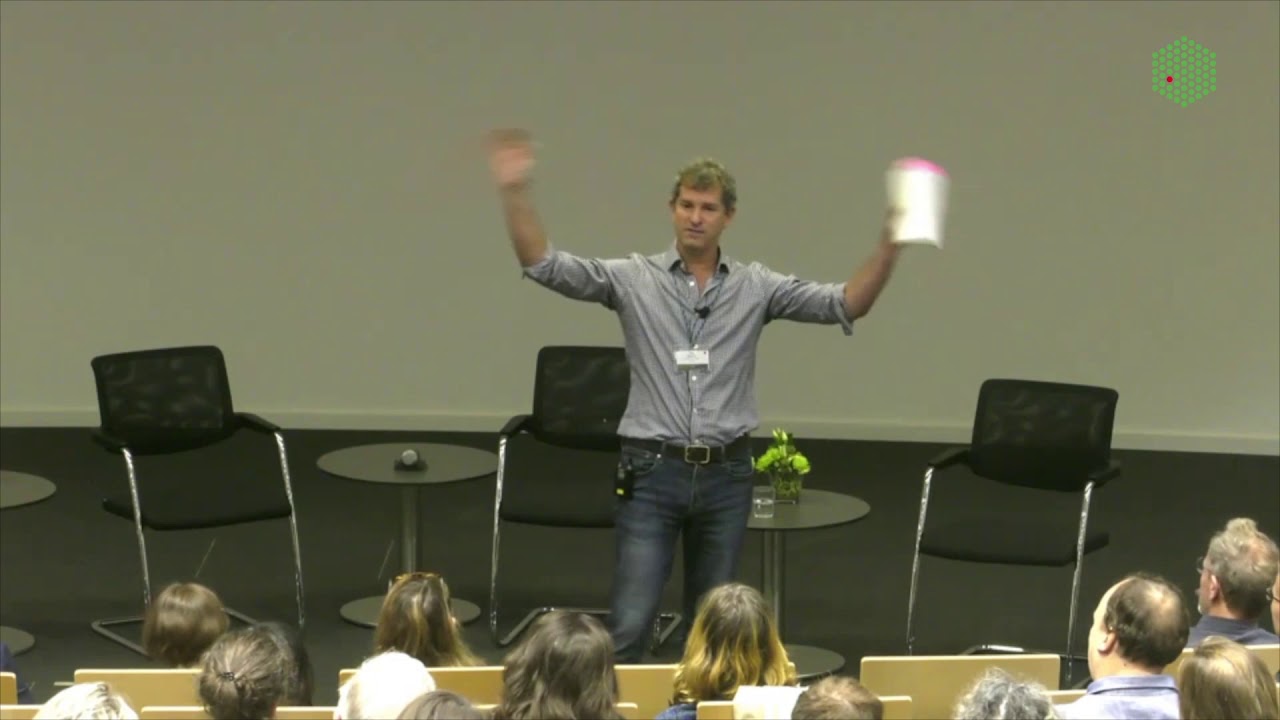
EMBL Keynote Lecture - Evolutions: Fifteen myths that explain our world, Oren Harman
Title history
- EMBL Keynote Lecture - Evolutions: Fifteen myths that explain our world, Oren Harman — observed on 20261026-2036 UTC (YouTube)
Keywords
Summary
133 words
Critical Evaluation
Value of the Information & Strength of the Argument
The value of the information lies in its creative synthesis of scientific knowledge with timeless mythological themes. Harman’s argument is compelling when he demonstrates how scientific discoveries (like the Moon’s origin or RNA’s dual role) can be wrapped into narratives that resonate psychologically. He builds a case for science as a form of storytelling, using historical examples (epicycles, ether, Aristotle’s teeth) to show that cultural frameworks shape scientific perception. His argumentation is persuasive in that it avoids reductionism and respects the scientific method while acknowledging its embeddedness in human culture. However, some claims, such as the philosophical implication that the future’s existence depends on its unknowability, are speculative and not empirically testable, which weakens the overall rigor.
Scientific Rigor, Source Quality, Title Accuracy
The speaker is a professor at Bar Ilan University and presents in a scientific conference, lending credibility. He references actual scientific concepts (RNA world, giant impact hypothesis, whale evolution) and names scientists like Wally Gilbert and Samuel Butler, but no formal citations or external links are provided. The title accurately reflects the content, as the lecture clearly centers on the book and its theme of myths explained by science. The talk is not a peer-reviewed study, but rather a personal and philosophical reflection grounded in established science, which is appropriate for a keynote presentation.
226 words
Title / Content Match
The title accurately reflects the content, as the lecture focuses on the book 'Evolutions' and presents several myths explained through scientific narratives.
Quality & Reliability
7/10
The lecture is delivered by a professor and is intellectually engaging, but it represents a personal opinion and creative interpretation rather than a peer-reviewed study. Scientific facts are accurately conveyed, though the philosophical conclusions are subjective.
Key Moments
Markers derived by PSI from the transcript: the creator did not define chapters.
- Introduction to the book and the author's childhood fascination with mythology.
- Discussion of the myth of motherhood using the Moon's origin via the giant impact theory.
- Explanation of the RNA world hypothesis and the chicken-and-egg problem of life's origin.
- Introduction of the whale evolution myth and the theme of sacrifice.
- Philosophical discussion on science as competitive storytelling and the influence of culture on scientific facts.
Cited Sources
- Evolutions: Fifteen Myths That Explain Our World — Harman's book, the central subject of the lecture, which juxtaposes ancient myths with modern science.
Contribution & Novelties
The lecture contributes a unique perspective by blending literary mythology with scientific discoveries, offering a fresh lens to view both. It challenges the dichotomy between science and myth, proposing that science itself is a form of storytelling with its own cultural dependencies. The original approach lies in presenting well-established scientific knowledge in narrative form to address existential questions.
Pour aller plus loin :
- RNA world hypothesis — This concept underpins the discussion on life’s origin.
- Giant-impact hypothesis — The scientific explanation for the Moon’s formation, used in the motherhood myth.
- Science wars — The debate between realists and social constructionists, referenced in the lecture.
104 words
Radar Profile
The radar profile shows high scores in quantity and quality of information, with moderate technical level and reliability. This reflects a talk that provides substantive content but is more conceptual than technical, and is based on expert opinion rather than original research.