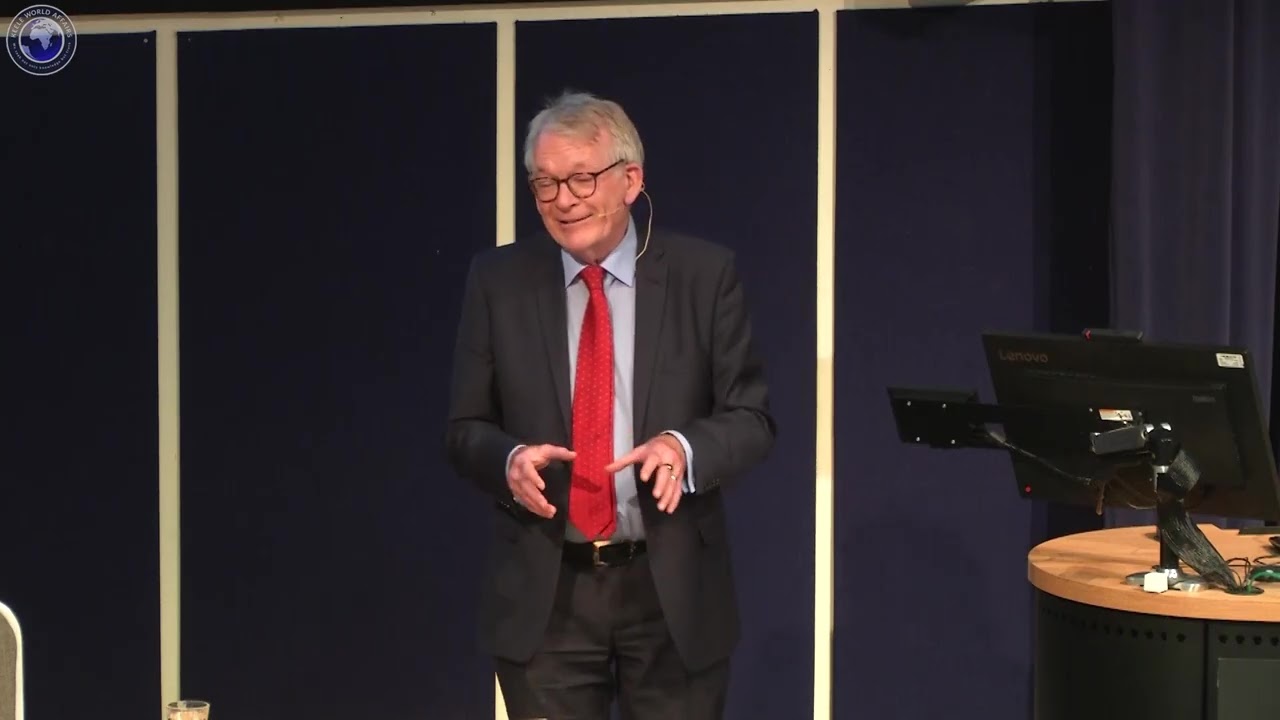
Global Finance in a Divided World - Professor David Marsh CBE
Keywords
Summary
266 words
Critical Evaluation
Value of the Information & Strength of the Argument
The value of the lecture lies chiefly in its synthesis rather than in new empirical findings. Marsh combines monetary history, European integration, defence policy and welfare-state economics into a single narrative, and the ‘six Ds’ provide a memorable organising device for a wide range of constraints. His practitioner experience at the Financial Times, in banking and at OMFIF gives the talk an insider’s texture, especially on the euro’s political origins, the 2010 crisis and the UK-EU relationship. The argument is generally coherent: Europe’s problem is framed less as survival than as prosperity, and the policy trade-offs between defence, welfare, debt and growth are stated plainly. The causal chain from the fall of the Berlin Wall to German reunification, the euro, the Greek crisis, the rescue packages and the Brexit referendum is presented as a ‘concatenation’, which gives the narrative force. However, the argumentation is essayistic rather than demonstrative. Several claims are asserted rather than tested, including the idea that the euro would not have been created at that time without the Wall falling, that the rescue packages led to the Brexit referendum, and that the UK will not rejoin the EU for 10-15 years. Counterfactuals are not developed, alternative explanations are not weighed systematically, and quantitative evidence is sparse. The talk is strongest where it identifies constraints and trade-offs; it is weaker where it converts plausible political interpretation into causal certainty.
Scientific Rigor, Source Quality, Title Accuracy
The lecture has the rigour of an informed policy essay rather than a research paper. Marsh names relevant reference points, including the 2024 Draghi report, the 2025 UK Strategic Defence Review associated with George Robertson, the 1955 treaty commitments on German reunification, and his own book Can Europe Survive?, and he mentions interviews with around 150 people. But the transcript shows no formal citations, no data tables and no systematic engagement with competing scholarship. Authority rests on his career and personal networks, which is valuable for insight but not a substitute for documented evidence. The title ‘Global Finance in a Divided World’ is broader than the lecture’s actual centre of gravity, which is Europe, the euro, debt, defence and UK-EU relations; finance is a recurring thread rather than the sole subject. The fit is therefore partial: the talk is relevant to global finance and geopolitics, but a reader expecting a systematic global-finance analysis would find a Europe-focused political-economic tour d’horizon.
406 words
Title / Content Match
The title promises a broad treatment of global finance in a divided world; the lecture delivers a Europe-centred political-economic tour d'horizon with substantial coverage of the euro, debt, defence and UK-EU relations, so the fit is partial but defensible.
Quality & Reliability
6/10
Expert practitioner synthesis with historical depth and named policy references, but largely assertion-based, without systematic citations, data or counter-argument; forward-looking claims are speculative.
Key Moments
Markers derived by PSI from the transcript: the creator did not define chapters.
- Welcome and introduction of David Marsh by the Keele World Affairs host.
- Marsh thanks the host, notes the forum's impending end and frames the talk around Europe in a divided world.
- Explains the book's origins and the question of how Europe should deal with US power after the 2022 Ukraine war.
- Contrasts Europe's attractiveness as a place to live with its GDP growth and technology lag, citing the Draghi report.
- Introduces the six Ds: demography, digitalisation, decarbonisation, deglobalisation, defence and debt.
- Discusses defence spending, welfare trade-offs, the 3%-of-GDP target and the Europeanisation of NATO.
- Recounts the fall of the Berlin Wall, Kohl's reunification policy and the subsequent collapse of the Soviet Union.
- Argues that the euro was the political price of German reunification and was created too early without full convergence.
- Links the euro, the Greek crisis, the 2010 rescue packages and the Brexit referendum in a single causal narrative.
- Assesses UK-EU relations: no rejoin in 10-15 years, but rapprochement and a 'winning team' argument for eventual shift.
Cited Sources
- Can Europe Survive? (book by David Marsh) — Central text referenced throughout the lecture; the paperback edition with a new chapter is discussed.
- Draghi report on European competitiveness (2024) — Cited as a diagnosis of Europe's growth, technology and productivity shortcomings.
- UK Strategic Defence Review (2025) — Discussed via George Robertson's role and in relation to the target of 3% of GDP for defence by 2030.
- Official Monetary and Financial Institutions Forum (OMFIF) — Marsh's organisation, described as a meeting point for central bankers and finance officials.
- 1955 treaty commitments on German reunification — Invoked to argue that British support for German reunification was formally signed but politically forgotten.
Concurring Sources
- German reunification — Supports the factual sequence of the fall of the Berlin Wall and German unification discussed by Marsh.
- European debt crisis — Provides background for the Greek and Irish crises and the rescue packages mentioned in the lecture.
- Brexit — Contextualises the 2016 referendum and the UK-EU relationship discussed in the final part.
- NATO — Background for the defence-spending and Europeanisation-of-NATO themes.
Dissenting Sources
- History of the euro — A broader historical account stresses the long preparatory process, including the Werner Plan, the Delors Report and the Maastricht criteria, and may qualify the lecture's emphasis on German reunification as the proximate cause of monetary union.
Contribution & Novelties
The originality lies less in new empirical findings than in a practitioner’s synthesis. Marsh links the euro’s birth to German reunification, treats the euro crisis and Brexit as a ‘concatenation’ of events, and organises Europe’s predicament around the ‘six Ds’. He also blends financial-market experience with defence and welfare-state trade-offs, giving a usable map of policy constraints rather than a formal model.
Further reading:
- Euro — Background to the single currency’s political and economic history.
- German reunification — Context for Marsh’s claim that the euro was the price of unification.
- European debt crisis — Reference point for the Greek and Irish crises after 2010.
- Brexit — Context for the UK-EU argument and the 2016 referendum.
- NATO — Background for defence spending and the ‘Europeanisation of NATO’ theme.
- Draghi competitiveness report (2024), no URL asserted here — Policy diagnosis of EU productivity and technology gaps.
144 words
Radar Profile
The profile is high on information quantity and moderate on technical depth: the talk ranges widely across history, finance and strategy without formal modelling. Reliability is middling because it rests on expert interpretation rather than documented evidence, while overall quality reflects a coherent but personal synthesis.