Video Title - Video Speaker
Title history
- Video Title - Video Speaker — observed on 20261109-0801 UTC (YouTube)
Keywords
Summary
217 words
Critical Evaluation
Value of the Information & Strength of the Argument
The value of this talk lies in its rigorous, data-driven examination of FPTP using the criteria its defenders themselves propose. Curtice does not simply rehash the fairness debate but instead tests whether the system actually delivers what it promises: exaggerating leads, fostering two-party politics, and enabling decisive government. He marshals extensive historical election data, illustrating trends in marginal seats, vote-seat disproportionality, and bias. His argumentation is exceptionally clear and logical, building from Duverger’s theoretical framework to real-world evidence from the 1950s to 2024. He honestly shows where the system works and where it fails, such as the 2017 and 2024 elections. The distinction between exaggeration and bias is particularly insightful, as is his concept of ‘votes wasted’ in safe seats. The talk is persuasive not through rhetoric but through careful measurement and interpretation, making it a valuable contribution to the debate.
Scientific Rigor, Source Quality, Title Accuracy
The scientific rigor is high. Curtice is a distinguished political scientist specializing in electoral behaviour, and he grounds his claims in official election statistics and established academic work, notably Maurice Duverger’s ‘Political Parties’ and the ‘cube rule’ derived from empirical patterns. He explains the mathematical model transparently, even while cautioning that it relies on unrealistic assumptions. He uses consistent measures (e.g., disproportionality indices) and systematically compares elections over decades. The title is fully adequate: the talk indeed addresses whether the electoral system’s functioning is a matter of geography, and it answers clearly that it is, since the system’s effects depend on how party votes are concentrated across constituencies. The presentation is professionally structured, with clear definitions and transitions, and the speaker engages critically even with his own field.
284 words
Title / Content Match
The title precisely poses the central question, and the talk directly addresses it by demonstrating how the electoral system's effects depend on geographical distribution of party support.
Quality & Reliability
9/10
Talk by a leading political scientist, based on extensive electoral data, historical analysis, and references to established literature such as Duverger's law. The argument is structured, well-evidenced, and critically evaluated against the system's own criteria.
Key Moments
Markers derived by PSI from the transcript: the creator did not define chapters.
- Introduction of Professor John Curtice and the talk's scope: evaluating FPTP by its own justifications.
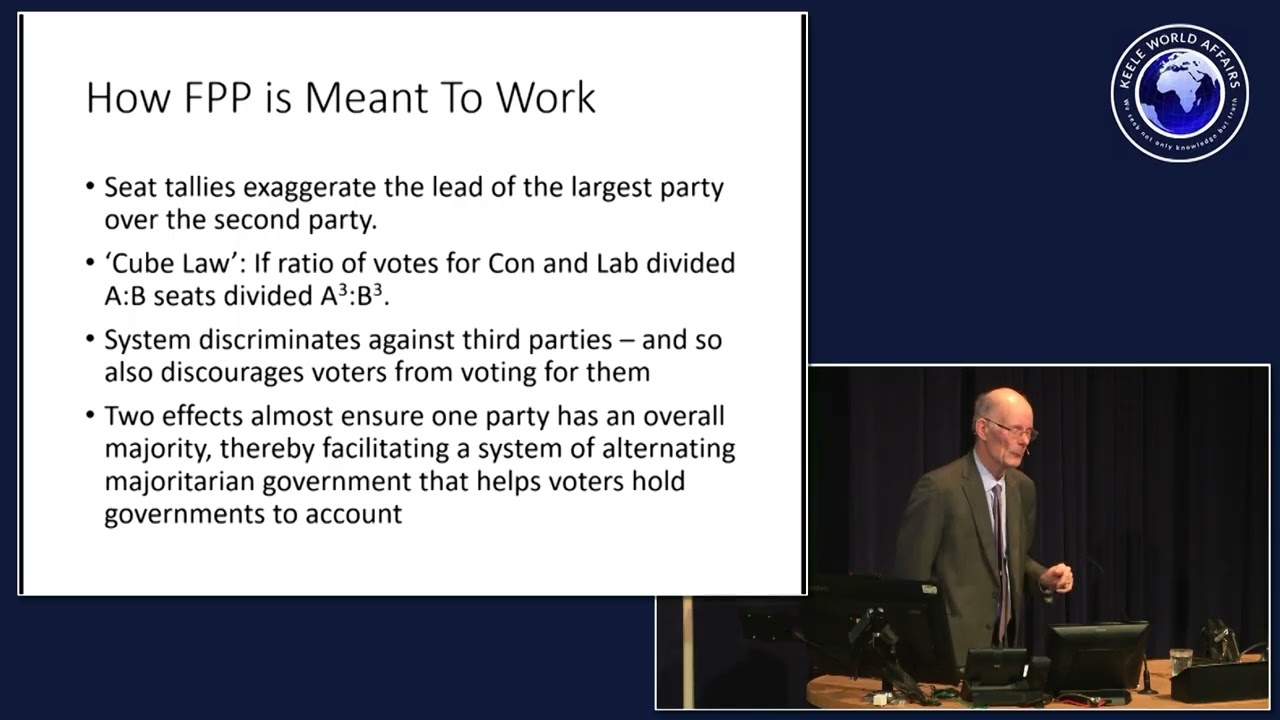
- Explanation of Duverger's law that FPTP favors two-party systems, and the cube rule approximation.
- Historical analysis of marginal seats, showing decline from ~180 in the 1950s to ~80 by 2019.
- Introduction of the concept of electoral bias: differences in constituency size, turnout, and vote efficiency benefit one party unfairly.
- Case study of 2019 election: hypothetical equal vote shares still give Tories 50 more seats due to Labour's inefficient vote distribution.
- Analysis of 2024 election: Labour's landslide with 35% vote share, lowest for a majority, and the collapse of Conservative vote in safe seats.
- Discussion of third parties: Liberal Democrats' success in 2024, and the system's failure to deter voting for smaller parties.
- Conclusion on public attitudes toward electoral reform and whether the system remains fit for purpose.
Cited Sources
- Political Parties — Curtice cites Maurice Duverger's classic work to introduce the law that FPTP tends to produce two-party systems.
- Duverger's law — Reference to the theoretical proposition that single-member districts favor two-party competition.
- Cube rule (electoral studies) — Curtice describes the mathematical approximation that seats are divided in proportion to the cube of the vote shares.
Concurring Sources
- UK Parliament - First past the post — General description of the FPTP system, consistent with Curtice's description.
Dissenting Sources
- None explicitly — No sources contradicting the presenter's analysis were identified; he relies on widely accepted electoral data and academic literature.
Contribution & Novelties
The talk offers a fresh evaluation of FPTP by assessing it according to its own traditional justifications, revealing that the system’s performance has deteriorated as geographic polarization increased. It provides a robust empirical demonstration of how the system’s outcomes are heavily dependent on where votes are concentrated, and it quantifies growing electoral bias. The 2024 election is used as a striking contemporary example of the system’s anomalies.
Pour aller plus loin :
- Duverger’s law — Explains the theoretical link between electoral systems and party systems; directly relevant to the talk’s foundation.
- Cube rule — Historical empirical pattern that Curtice uses to illustrate exaggeration; good for understanding the mathematics.
- Gallagher index — A measure of disproportionality used in electoral systems; not mentioned but highly relevant to measuring fairness.
- Electoral bias in the UK — Not directly cited, but the talk discusses this concept; a good further reading.
- First-past-the-post voting — General overview of the system, useful context.
156 words
Radar Profile
The radar profile shows uniformly high scores across information quantity, quality, and reliability, with a slightly lower technical level (8/10) reflecting that the presentation is accessible to a non-specialist audience while still containing rigorous analysis. The overall impression is of a comprehensive, trustworthy, and well-structured lecture.