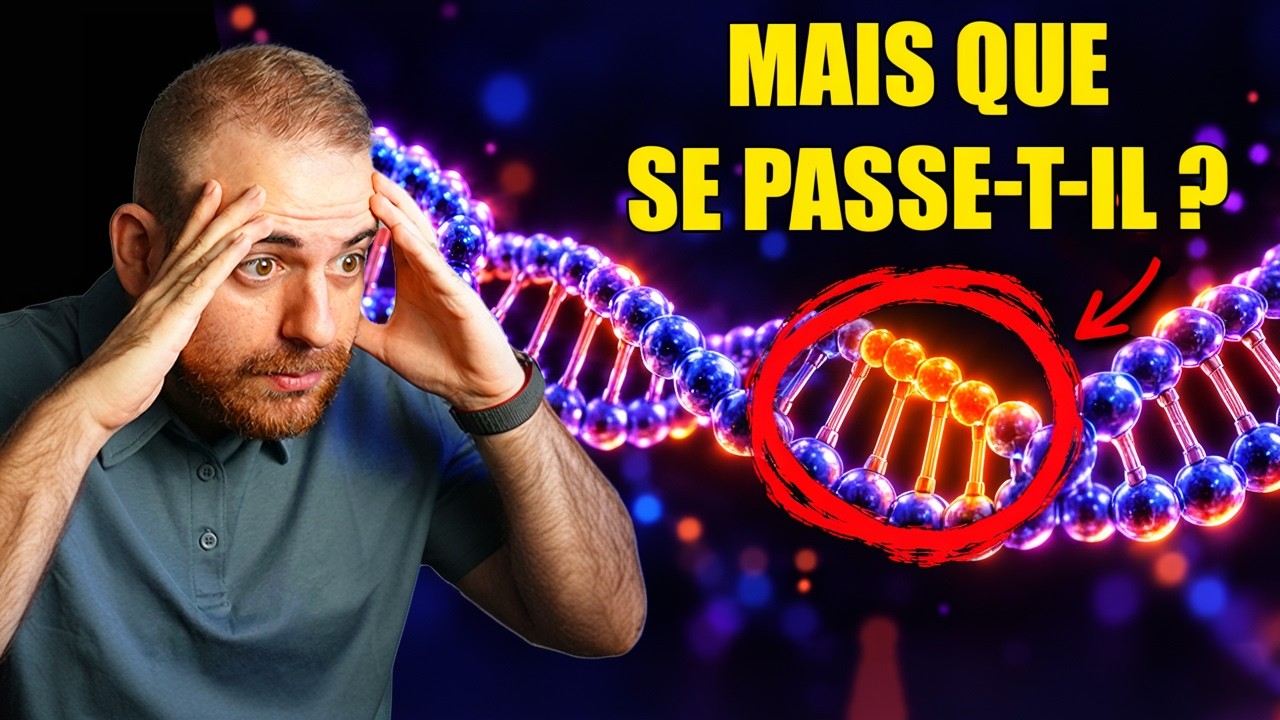
Voici ce que l'IA vient de trouver dans l'ADN
Here is what AI just found in DNA
Keywords
Summary
168 words
Critical Evaluation
Value of the Information & Strength of the Argument
VALEUR DES INFORMATIONS: The video provides a genuinely interesting case study of AI-driven biological discovery, explaining key concepts (CRISPR, reverse transcriptase, genomic databases) in accessible terms. It includes rare details about the experimental design — 950 agents, 21 hours, 210 million tokens — and emphasizes the non-deterministic nature of the finding, noting that repeat runs didn’t reproduce the exact result. The financial comparison (thousands vs. millions of dollars) is illustrative. However, the value is partially undercut by the absence of direct links to the original research paper and the blurring of fact and commentary (e.g., market reactions are stated but not attributed).
SOLIDITÉ DE L’ARGUMENTATION: The argumentation is coherent and avoids exaggeration, acknowledging the uncertainty (the repeatability problem, pending peer review, the unknown function of the system). The claim that ‘agents saw something humans missed’ is supported by the description of the 2021 publication of the phage genome. The creator makes a fair distinction between exploration (AI) and validation (human scientists). Yet the logic jumps — from this single discovery to the claim that AI will compress decades of progress into years — rely on extrapolation, and the argument weakens as it shifts into promotional territory.
Scientific Rigor, Source Quality, Title Accuracy
RIGUEUR SCIENTIFIQUE: The video presents the discovery accurately without overstating its maturity, explicitly saying the system ‘remains to be proven.’ It cites several credible researchers (Jacob Stern, Feng Zhang’s reaction, Dario Amodei’s essay) and correctly situates the contribution within the context of prior work (2021 publication, recognized enzyme). The method description is precise enough to be followed, and the limits (no reproducibility across 10 runs) are honestly acknowledged.
QUALITÉ DES SOURCES: The creator references well-known figures (Emmanuelle Charpentier, Jennifer Doudna, John Jumper) but provides no direct URLs. The only links in the description are to the creator’s own academy and newsletter, so the viewer cannot verify the core claims directly. This is a notable weakness.
ADÉQUATION TITRE/CONTENU: The title accurately suggests the video will explain what the AI found; a more precise title might mention ‘genome editing’ or ‘Claude,’ but the current one is fair.
356 words
Title / Content Match
The title accurately reflects the video's central theme — an AI (Claude/Mythos) discovering a new biological system in DNA — though it is engagingly dramatic.
Quality & Reliability
6/10
The video reports a genuine scientific development (Anthropic's AI discovering a CRISPR-like system in viral DNA) with specific technical details and references, but the information is presented without direct citations to the original paper, and the presentation is interwoven with strong promotional segments. The core claims are plausible and consistent with known AI trends, yet some extrapolations (e.g., Wall Street reactions, cost estimates) are stated without transparent sourcing. The creator's own commentary mixes factual reporting with personal interpretation, reducing overall reliability.
Chapters
Cited Sources
- Vision IA Academy (promotional link) — In the description, used for the in-video promotion of a paid AI training program.
- Vision IA Newsletter — In the description, offered as a free newsletter for daily tech news.
Concurring Sources
- CRISPR gene editing - Wikipedia — Background information on CRISPR, used to verify the video's description of the CRISPR system.
- Reverse transcriptase - Wikipedia — Background on reverse transcriptase, matching the video's explanation of the enzyme the AI found.
- AlphaFold - Wikipedia — Background on AI-driven biology, consistent with the video's reference to John Jumper and his Nobel Prize.
Contribution & Novelties
The video popularizes a recent, concrete instance of AI autonomously discovering a potential new gene-editing system. Its main contribution is to make a technical genomics discovery accessible to a general audience, while raising an important epistemological point: the discovery was not reproducible in subsequent runs, suggesting that current AI ‘scientific intuition’ is not yet stable or fully understood. The observation that internal activations preceded verbalization of the discovery offers a unique glimpse into the model’s cognitive-like behavior, which is rarely discussed at this level in mainstream media.
Pour aller plus loin :
- CRISPR gene editing — Wikipedia article explaining the CRISPR-Cas system, the framework for the video’s core biological reference.
- Reverse transcriptase — Wikipedia article describing the enzyme class that the AI discovered, including its role in retroviruses.
- AlphaFold — Wikipedia article on the AI protein-structure prediction model, relevant to the video’s mention of John Jumper and AI in biology.
- Retrotransposons (no URL provided) — Related to reverse transcription in eukaryotic genomes; useful context for understanding where RT arrays might originate.
171 words
Radar Profile
The radar profile shows a balanced but not exceptional pattern: information quantity (7/10) and quality (6/10) are moderate, while technical depth (5/10) and global reliability (5/10) are near the middle. This reflects a video that presents interesting scientific content but is limited by its promotional nature and lack of direct primary-source links.