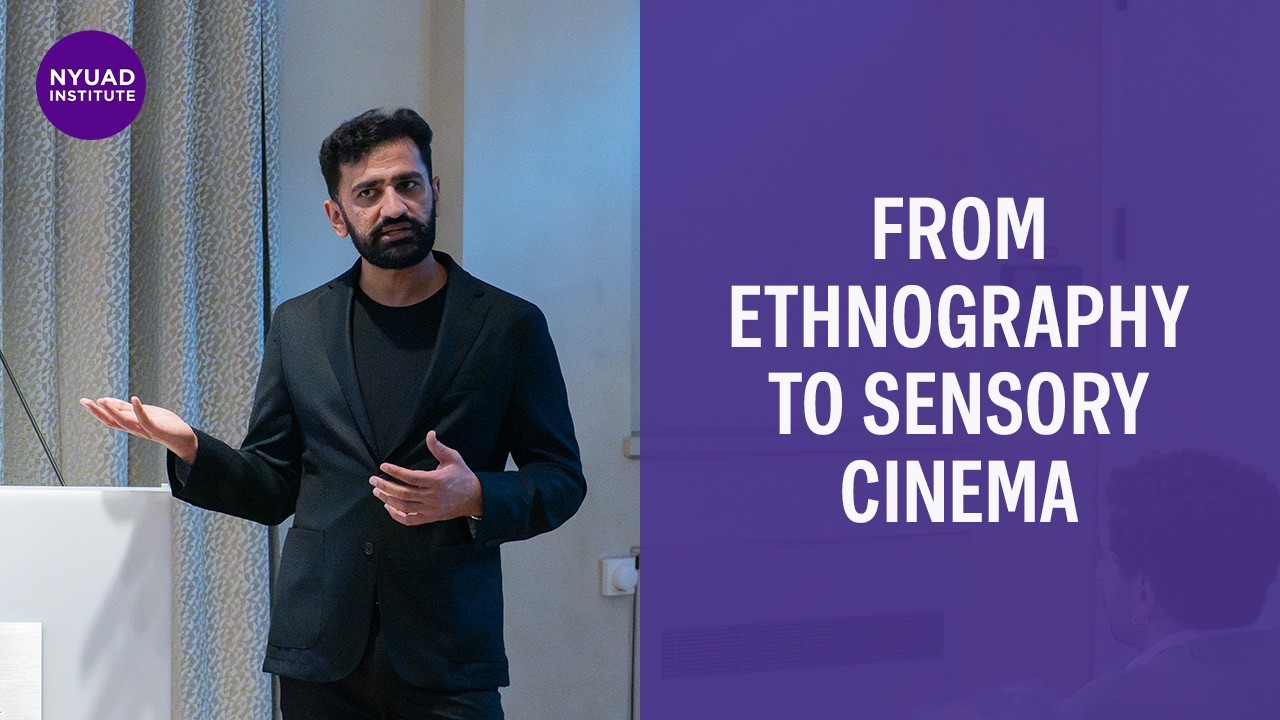
From Ethnography to Sensory Cinema
Title history
- From Ethnography to Sensory Cinema — observed on 20261113-2201 UTC (YouTube)
Keywords
Summary
163 words
Critical Evaluation
Value of the Information & Strength of the Argument
The talk offers valuable insight into an alternative filmmaking methodology that prioritizes inner experience over factual explanation. Bilal’s argument is grounded in his personal practice, showing how adopting the philosophy of surrender from Sufi culture transformed his approach to both shooting and editing. His argumentation is coherent and compelling, though largely anecdotal, lacking engagement with broader theoretical literature on sensory ethnography beyond brief mentions of summer schools and visual anthropology.
Scientific Rigor, Source Quality, Title Accuracy
The talk demonstrates a modest level of scientific rigor; Bilal references his own footage and experiences but does not cite external academic sources or specific ethnographic studies. He mentions participating in summer schools in visual anthropology but does not elaborate on any named authors or works. The title is perfectly apt, as the talk traces his journey from an ethnographic perspective to a sensory, experiential cinematic form. No comments were provided for analysis.
158 words
Title / Content Match
The title accurately reflects the talk's structure: from initial ethnographic research to a sensory cinematic approach.
Quality & Reliability
6/10
The talk is a personal account by an experienced filmmaker, hosted by an academic institution, but its content relies heavily on subjective experience and anecdotal evidence rather than verifiable scientific sources.
Key Moments
Markers derived by PSI from the transcript: the creator did not define chapters.
- Introduction of the talk and speaker by Sharon Haken Bergman.
- Umair Bilal introduces his film 'As Light as Air' and its premiere at Locarno Film Festival.
- Bilal explains his initial documentary approach and the sense of missing soul in the footage.
- He describes the shift to a 'surrendering' method after a conversation with a shrine caretaker.
- Encounter with an old man whose monologue becomes the film's voice.
- Discussion of editing process, using abstraction to reach the ritual's inner core.
Cited Sources
- NYUAD Institute — Description provides general information about the institute hosting the talk.
- 19 Washington Square North — Venue of the event mentioned in the talk's introduction.
- NYUAD Institute Event Mailing List — Sign-up link provided in the description to stay informed about future events.
Contribution & Novelties
Bilal’s original contribution lies in his integration of ethnographic immersion with sensory cinematic techniques, particularly the application of the Sufi principle of surrender to the filmmaking process itself. He demonstrates how the texture and structure of a documentary can emerge from a deep listening to the place rather than from external narrative conventions. His method of using long static shots and abstract visual transitions derived from ritual experiences offers a novel way to convey spiritual states without explanation.
Pour aller plus loin :
- Sensory ethnography — Relevant to the methodological approach Bilal describes, focusing on the sensory body in ethnographic research.
- Visual anthropology (https://en.wikipedia.org/wiki/Visual_anthropology ) — Related field that studies the visual aspects of culture and includes documentary filmmaking.
- Sufism — The mystical Islamic belief and practice central to the film’s context and Bilal’s subject.
135 words
Radar Profile
The radar profile shows a balanced but modest performance across information quantity, quality, technical depth, and reliability. The strongest areas are information quantity and quality, reflecting the rich first-hand details, while technical level and reliability are lower due to the subjective nature of the presentation and lack of external verification.