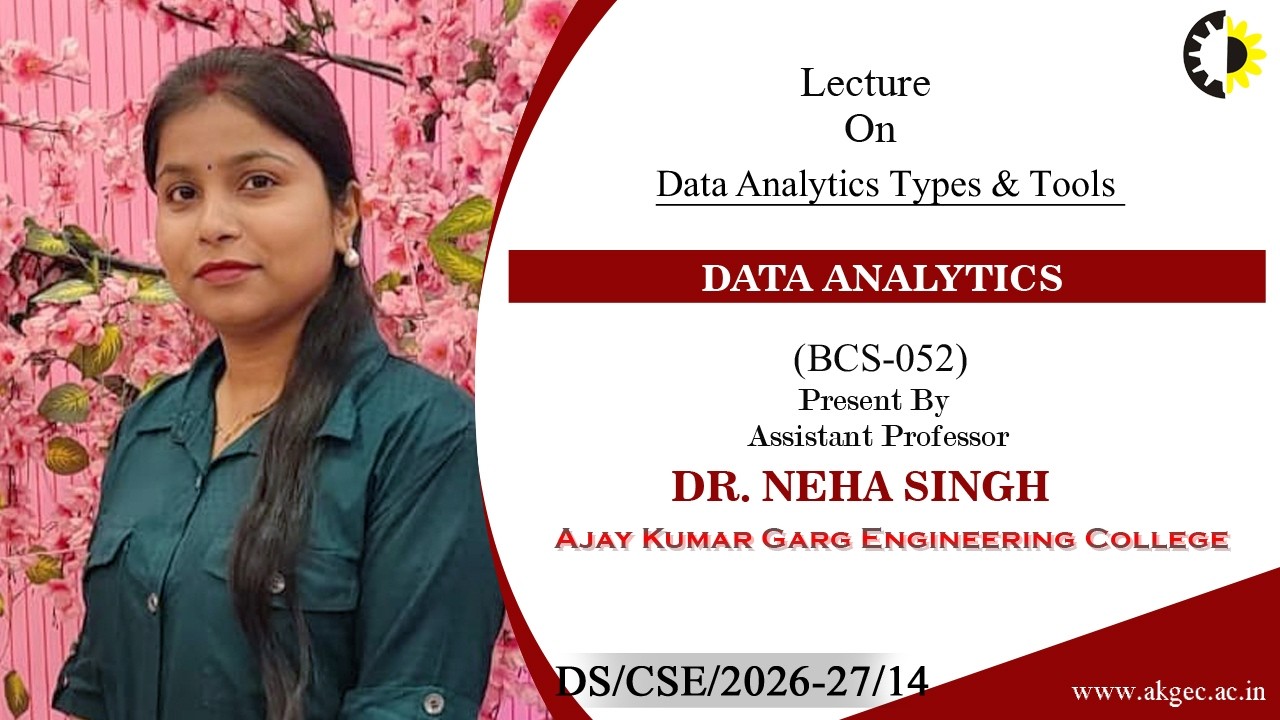
DATA ANALYTICS TYPES & TOOLS | DATA ANALYTICS | LECTURE 01 BY DR. NEHA SINGH | AKGEC
Title history
- DATA ANALYTICS TYPES & TOOLS | DATA ANALYTICS | LECTURE 01 BY DR. NEHA SINGH | AKGEC — observed on 20261025-1527 UTC (YouTube)
Keywords
Summary
143 words
Critical Evaluation
Value of the Information & Strength of the Argument
The value of this lecture lies in its comprehensive yet accessible overview of data analytics types and tools, making it suitable for students new to the subject. The argumentation is structured logically: it first defines each type of analytics with clear examples, then lists tools, and finally differentiates analysis from reporting. However, the presentation is mostly descriptive and lacks critical evaluation or comparative analysis of tools. The absence of concrete use cases or case studies weakens the applied value, and the discussion remains at an introductory level without engaging with real-world complexities. The argumentation is coherent but does not go beyond surface-level explanations, making it more of a survey than a deep dive.
Scientific Rigor, Source Quality, Title Accuracy
The scientific rigor is moderate; the lecture is factually correct but does not cite explicit sources, relying on common knowledge in the field. The only reference is the institutional website of AKGEC, which does not provide supporting material for the content. The quality of sources is thus limited to the speaker’s expertise, though as an assistant professor she is credible. The title adequately matches the content, which is a straightforward lecture on types and tools. No contradictions or controversial claims are presented, and the information aligns with standard educational material. The absence of citations or links to further literature reduces the academic depth, but for a basic course lecture this is acceptable.
240 words
Title / Content Match
The title is accurate and specific, directly reflecting the lecture's coverage of both data analytics types and tools.
Quality & Reliability
6/10
The lecture provides a clear and accurate introduction to data analytics types and tools, but it lacks depth and explicit citation of sources. It relies on standard knowledge in the field, appropriate for an educational setting, yet does not engage with recent research or advanced methods.
Key Moments
Markers derived by PSI from the transcript: the creator did not define chapters.
- Introduction and overview of data analytics types
- Descriptive data analytics explained
- Diagnostic analytics and why it happened
- Predictive analytics and future forecasting
- Prescriptive analytics and recommended actions
- Traditional data analytics tools overview
- Difference between analysis and reporting
- Modern data analytics tools introduction
Cited Sources
- AKGEC Official Website — Institutional website providing information about the college and its programs.
Contribution & Novelties
This lecture serves as an introductory educational resource, consolidating standard knowledge on data analytics types and commonly used tools. While it offers no original research or novel insights, it provides a structured overview that can benefit students. For deeper understanding, the following resources are recommended:
Pour aller plus loin :
- Data Analytics (Wikipedia) — Comprehensive overview of the field, including methods, applications, and history.
- Descriptive Analytics (Wikipedia) — Detailed explanation of the descriptive type, with examples and usage contexts.
- Predictive Analytics (Wikipedia) — Further insights into techniques and models used for forecasting.
92 words
Radar Profile
The radar profile shows a balanced but modest performance, with quantity of information slightly higher than quality and technical level. This indicates a broad overview without deep technical depth, suitable for beginners but not for advanced learners. The reliability is moderate, reflecting the lack of citations and reliance on basic knowledge.