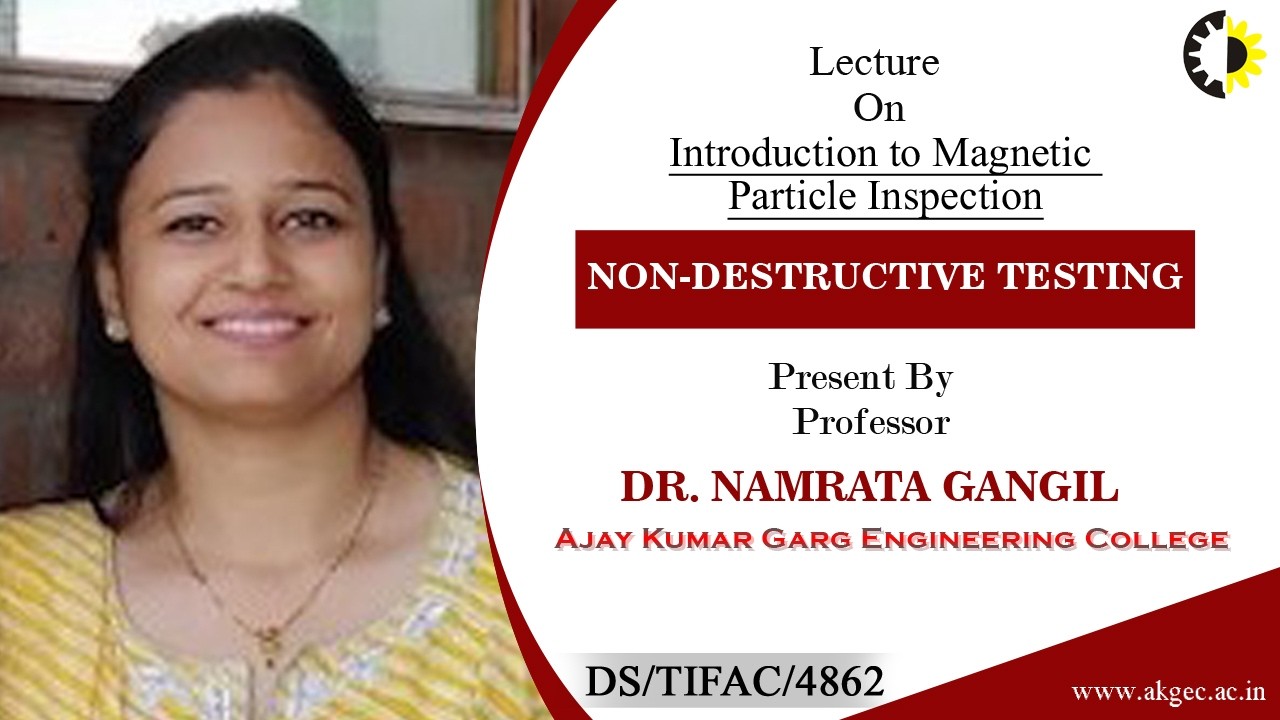
INTRODUCTION TO MAGNETIC PARTICLE INSPECTION | NDT | LECTURE 01 BY DR. NAMRATA GANGIL | AKGEC
Keywords
Summary
139 words
Critical Evaluation
Value of the Information & Strength of the Argument
The value of this lecture lies in its clear, systematic explanation of MPI fundamentals, making it accessible for engineering students and beginners. The reasoning follows a logical pedagogical flow: starting with basic concepts of magnetism, moving to the principle of flux leakage, and then detailing procedural and equipment aspects. The instructor effectively uses analogies (e.g., Earth’s magnetic field) and simple schematics to convey complex ideas. However, the argumentation is largely descriptive with little critical analysis or comparison with alternative NDT methods. The treatment is superficial, lacking quantitative examples, standards, or practical case studies, which limits its value for professionals. The spoken style is informal and occasionally repetitive, but the core technical content is sound and consistent with standard MPI practice.
Scientific Rigor, Source Quality, Title Accuracy
The scientific rigor is generally good: the physics of magnetism and the principles of MPI are correctly presented, and the described magnetization techniques match standard industrial practice. However, no external references or standards are cited in the video or description apart from institutional links, which reduces verifiability. The lecture relies primarily on the instructor’s expertise, which is plausible given her academic role, but no peer-reviewed sources are mentioned. The title accurately reflects the content, as the video is indeed an introductory lecture on MPI within an NDT course. The description includes useful links to the institution’s website and a playlist for the full course, aiding context. Overall, the content is reliable for an educational introduction, but would benefit from explicit citation of standards like ASTM E1444 or ISO 9934.
264 words
Title / Content Match
The title accurately reflects the content: it is an introductory lecture on Magnetic Particle Inspection within NDT, delivered by Dr. Namrata Gangil at AKGEC.
Quality & Reliability
7/10
Content is accurate and pedagogically sound, covering standard MPI principles, but limited in depth and scope as an introductory lecture. The instructor is qualified, yet the video lacks visual aids and interactive elements, and the lecture is somewhat informal with repetitive phrasing.
Key Moments
Markers derived by PSI from the transcript: the creator did not define chapters.
- Introduction and overview of Magnetic Particle Inspection (MPI) as an NDT method.
- Explanation of magnetism, Earth's field analogy, and alignment of magnetic domains in ferromagnetic materials.
- Principle of MPI demonstrated with a horseshoe magnet and flux leakage at a crack.
- Detailed procedure: surface preparation, magnetization, particle application, inspection, demagnetization, documentation.
- Importance of field direction: longitudinal vs. circular magnetic fields and effect on detecting differently oriented defects.
- Direct magnetization techniques: headshot and prod methods, highlighting their workings and limitations.
- Indirect magnetization techniques: coil, central conductor, and yoke methods, explaining how they produce desired fields.
- Conclusion and recap of key points, with thanks to the audience.
Cited Sources
- AKGEC Official Website — Institutional website for Ajay Kumar Garg Engineering College, where the lecture is hosted.
- Non-Destructive Testing Playlist — YouTube playlist of all five units for the NDT course, providing full lecture series.
Concurring Sources
- Non-Destructive Testing Playlist — Complementary lectures from the same series cover other NDT methods, supporting the context of MPI.
Contribution & Novelties
This video serves as a pedagogical introduction rather than novel research. It contributes to engineering education by delivering clear, fundamental concepts of MPI in a structured manner, suitable for students. Its originality is limited to the teaching approach and oral explanation; the technical content is standard and widely documented.
Pour aller plus loin :
- Magnetic particle inspection — Wikipedia article covering principles, techniques, and equipment, offering a broader overview.
- ASTM E1444 Standard Practice for Magnetic Particle Testing — Official standard defining recommended practices for MPI, enhancing practical rigor.
- ASNT (American Society for Nondestructive Testing) — Professional society with educational resources on NDT methods, including MPI certification materials.
107 words
Radar Profile
The radar profile shows moderate scores across all dimensions, with slightly higher reliability and information quantity compared to technical depth. This indicates a solid introductory educational resource that is accurate and informative but not highly technical or innovative. The low-specificity score reflects its basic level.