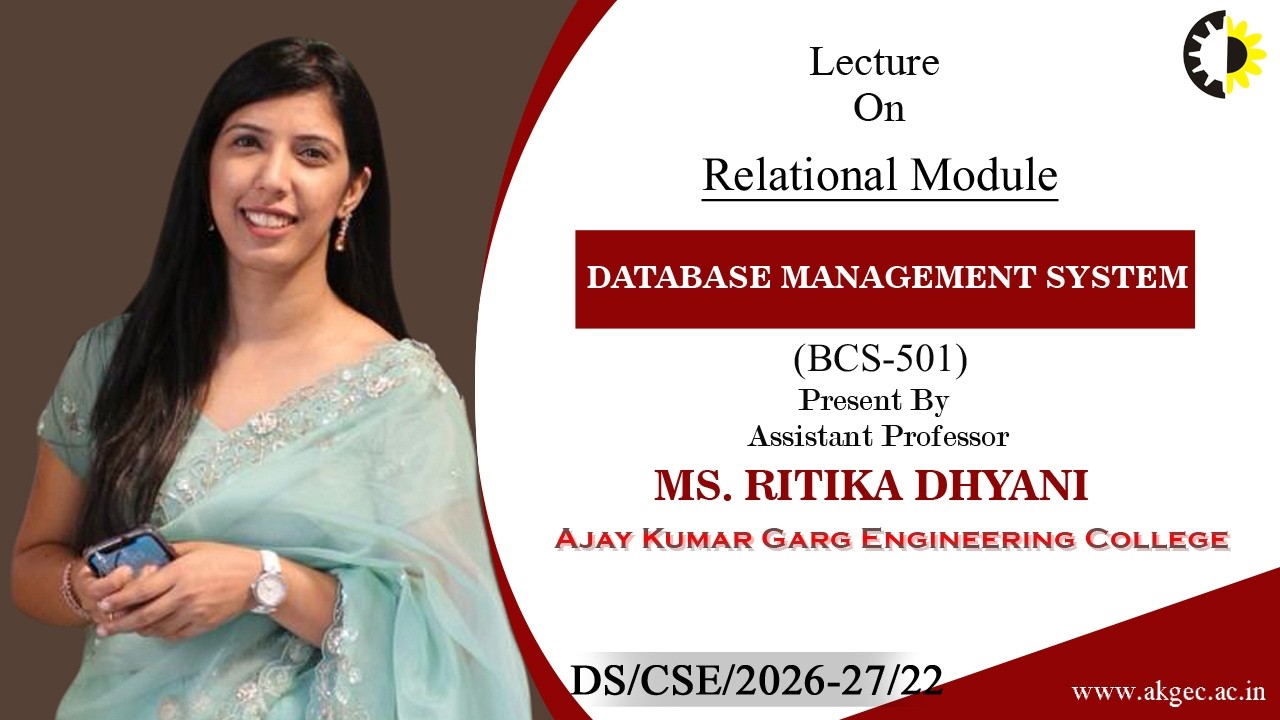
RELATIONAL MODEL | DATABASE MANAGEMENT SYSTEM | LECTURE 01 BY MS. RITIKA DHYANI | AKGEC
Title history
- RELATIONAL MODEL | DATABASE MANAGEMENT SYSTEM | LECTURE 01 BY MS. RITIKA DHYANI | AKGEC — observed on 20261103-1138 UTC (YouTube)
Keywords
Summary
127 words
Critical Evaluation
Value of the Information & Strength of the Argument
The lecture offers solid educational value for beginners. It systematically introduces core concepts of the relational model, using a simple student example to illustrate each term. The argumentation is logical: concepts are defined, examples are provided, and relationships between concepts (e.g., super key to primary key) are clearly articulated. The presenter explains nuances, such as why certain attributes cannot serve as primary keys, reinforcing understanding. While not groundbreaking, it provides a coherent foundation for further study.
Scientific Rigor, Source Quality, Title Accuracy
The content adheres to standard database principles as found in academic textbooks. No external sources are cited, but the material is classic. The title precisely reflects the subject and scope. The explanation is consistent and without evident errors. The video’s pedagogical approach is disciplined, with a clear sequence from basics to constraints. No claims are made beyond the established curriculum, so the reliability is high for an introductory lecture.
160 words
Title / Content Match
Title accurately reflects the content: a focused tutorial on the relational model within a DBMS course.
Quality & Reliability
7/10
The lecture provides accurate, standard content on the relational model, covering core concepts with clear examples. It is reliable but introductory, lacking depth or critical analysis.
Key Moments
Markers derived by PSI from the transcript: the creator did not define chapters.
- Introduction by instructor and course context
- Explanation of the relational model using a table example with attributes and rows
- Definition of key terminologies: attribute, relation schema, tuple, relation instance, degree, cardinality, null values
- Discussion on keys: super key, primary key, candidate key
- Explanation of foreign key, unique key, and alternate key with examples
- Overview of integrity constraints: domain, key, entity integrity, referential integrity
- Anomalies in relational model and cascading effects
- Advantages, disadvantages, and characteristics of the relational model
Contribution & Novelties
This lecture serves as a comprehensive introduction to the relational model, consolidating foundational concepts in a single session. Its main contribution is pedagogical clarity, linking theory to a practical example. It does not present new research but acts as a stepping stone for deeper topics.
Pour aller plus loin :
- Relational model — The foundational concept explained in detail, including historical context and formal definitions.
- Integrity constraints — Expands on the constraints discussed in the lecture, with examples of each type.
- Database normalization — A key extension of relational design that reduces redundancy and anomalies.
- SQL — The language used to interact with relational databases, complementing the model with practical manipulation.
111 words
Radar Profile
The radar profile shows a robust lecture with high scores on information quantity and reliability, but moderate technical depth. This reflects its introductory nature, focusing on breadth of concepts rather than advanced implementation details.