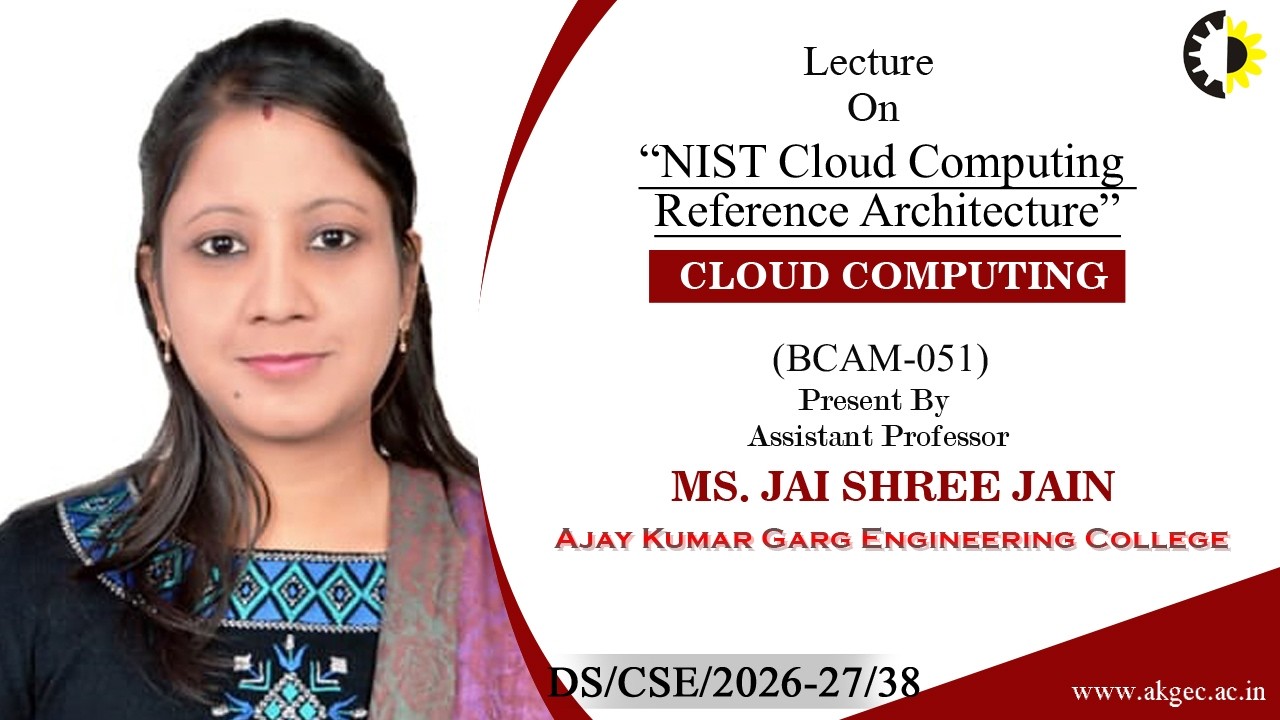
NIST CLOUD COMPUTING REFERENCE ARCHITECTURE | CLOUD COMPUTING | LECTURE 03 BY DR. JAISHREE JAIN |
Title history
- NIST CLOUD COMPUTING REFERENCE ARCHITECTURE | CLOUD COMPUTING | LECTURE 03 BY DR. JAISHREE JAIN | — observed on 20261103-1223 UTC (YouTube)
Keywords
Summary
129 words
Critical Evaluation
Value of the Information & Strength of the Argument
The video provides a valuable pedagogical overview of the NIST cloud computing reference architecture, making the material accessible through a structured breakdown of actors and services. The argumentation is coherent, proceeding from general principles to specific roles and components. However, the explanation is mostly descriptive rather than critical, and the lecturer occasionally repeats points without offering deeper insights into trade-offs or implementation challenges. The use of simple metaphors (e.g., Make My Trip as a broker) aids comprehension but does not substitute for rigorous technical analysis. Overall, the information is useful for beginners but lacks advanced depth.
Scientific Rigor, Source Quality, Title Accuracy
The lecture is based on the NIST standard, though the speaker does not cite specific publications or offer sources beyond the official college website. The content aligns with well-known NIST SP 500-292 concepts, but without direct references, the presentation relies on the instructor’s expertise. The title is perfectly adequate, clearly stating the subject and the lecture number. The presentation is systematic but occasionally tangentially elaborated, and the lack of citations reduces its academic rigor. The video is suitable for introductory courses, but viewers seeking verified references would need to consult external materials.
203 words
Title / Content Match
The title accurately reflects the content, which focuses on the NIST cloud computing reference architecture and its components.
Quality & Reliability
6/10
The lecture provides a clear overview of the NIST cloud computing reference architecture, covering the five actors, service models, and deployment models. However, it lacks precise citations and depth in some technical areas.
Key Moments
Markers derived by PSI from the transcript: the creator did not define chapters.
- Introduction of Dr. Jaishree Jain and the topic of NIST Cloud Computing Reference Architecture.
- Definition and purpose of the NIST reference architecture as a vendor-neutral template.
- Introduction of the five major components: consumer, provider, broker, auditor, and carrier.
- Detailed explanation of cloud consumer and provider roles, including SLA and resource management.
- Discussion of cloud broker and auditor functions, including service intermediation and aggregation.
- Explanation of cloud carrier, connectivity, and the role of network providers.
- Overview of cloud service management, business support, and deployment models (public, private, hybrid, community).
Cited Sources
- AKGEC Official Website — The college website where the lecturer is associated; the only external link provided in the video description.
Contribution & Novelties
This lecture serves as an educational introduction to the NIST Cloud Computing Reference Architecture, with a clear explanation of the five actors and their interactions. Its novelty lies in the pedagogical simplification for undergraduate students, using real-world analogies. However, it does not introduce new research or original insights.
Pour aller plus loin :
- NIST Cloud Computing Reference Architecture — Official NIST publication detailing the standard.
- Cloud computing - Wikipedia — Broad overview of cloud computing concepts and service models.
- Infrastructure as a Service - Wikipedia — Detailed explanation of IaaS, one of the main service models discussed.
97 words
Radar Profile
The radar profile shows moderate scores across all dimensions, with slightly higher quantity and quality of information compared to technical level and reliability. This indicates a lecture that is informative and clear but not deeply technical or highly rigorous in sourcing.