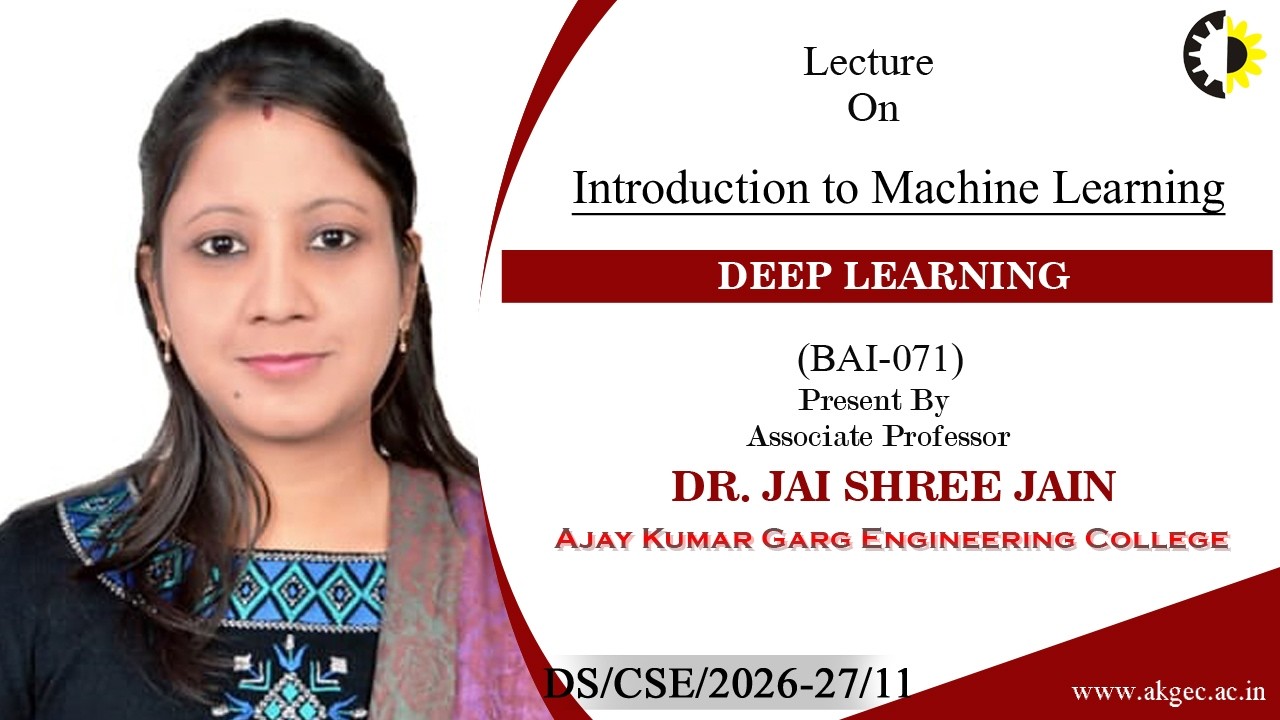
INTRODUCTION TO MACHINE LEARNING | DEEP LEARNING | LECTURE 01 BY DR JAISHREE JAIN | AKGEC
Keywords
Summary
186 words
Critical Evaluation
Value of the Information & Strength of the Argument
The value lies in its clear, systematic introduction to machine learning concepts, making it a useful starting point for beginners. The argumentation is coherent, moving from the definition of ML to its process and types, supported by relatable examples like email filtering and game playing. However, the reasoning is descriptive rather than critical, and the lecture does not engage with potential limitations or challenges of ML, such as overfitting or bias, which limits its depth. The pedagogical approach is effective for novices, but it does not offer substantial novel insights beyond standard textbook coverage.
Scientific Rigor, Source Quality, Title Accuracy
The scientific rigor is moderate: the lecture provides accurate definitions and categorizations but lacks citations to specific research or authoritative sources. The quality of sources is limited to institutional links (AKGEC website and LinkedIn) rather than academic references. The title accurately represents the content, and the lecture stays on-topic. No user comments were provided, so no public reception analysis is included.
170 words
Title / Content Match
The title accurately reflects the content: an introductory lecture on machine learning, covering basic concepts and types, with a mention of deep learning as part of the AI umbrella.
Quality & Reliability
7/10
The lecture provides a clear, structured introduction to machine learning concepts, suitable for beginners. The content is accurate and aligns with standard definitions, though it lacks depth and formal rigor typical of an academic course.
Key Moments
Markers derived by PSI from the transcript: the creator did not define chapters.
- Definition of machine learning as a subset of AI and its core idea of learning from data.
- Comparison between traditional programming and machine learning approach.
- Need for ML due to data overflow and computational power; applications like email filtering.
- Steps of ML: data collection, preprocessing, dimensionality reduction, model training, and testing.
- Types of learning: supervised learning with labeled data, using the student example.
- Unsupervised learning: clustering based on similarity, without labels.
- Reinforcement learning: agent-environment interaction with rewards and punishments.
- Goal of ML: pattern detection and prediction; lifecycle of ML model and applications.
Cited Sources
- AKGEC Official Website — Institution hosting the lecture.
- AKGEC LinkedIn — Institutional social media presence.
Contribution & Novelties
This lecture offers a straightforward introduction to machine learning, primarily serving as a pedagogical resource rather than presenting novel research. Its contribution is in organizing foundational concepts clearly for beginners, emphasizing the taxonomy of learning types and the ML lifecycle.
Pour aller plus loin :
- Machine Learning (Wikipedia) — Provides an overview, history, and applications, offering depth beyond the lecture.
- Supervised Learning (Wikipedia) — Details on labeled data and common algorithms like regression and classification.
- Unsupervised Learning (Wikipedia) — Explores clustering and dimensionality reduction techniques.
- Reinforcement Learning (Wikipedia) — Covers agent-based learning, Markov decision processes, and applications.
97 words
Radar Profile
The radar profile shows a balanced but modest assessment: information quantity and quality are moderate, technical level is low, and reliability is acceptable. This indicates a solid introductory lecture that is accurate but shallow, suitable for beginners but not for advanced learners.