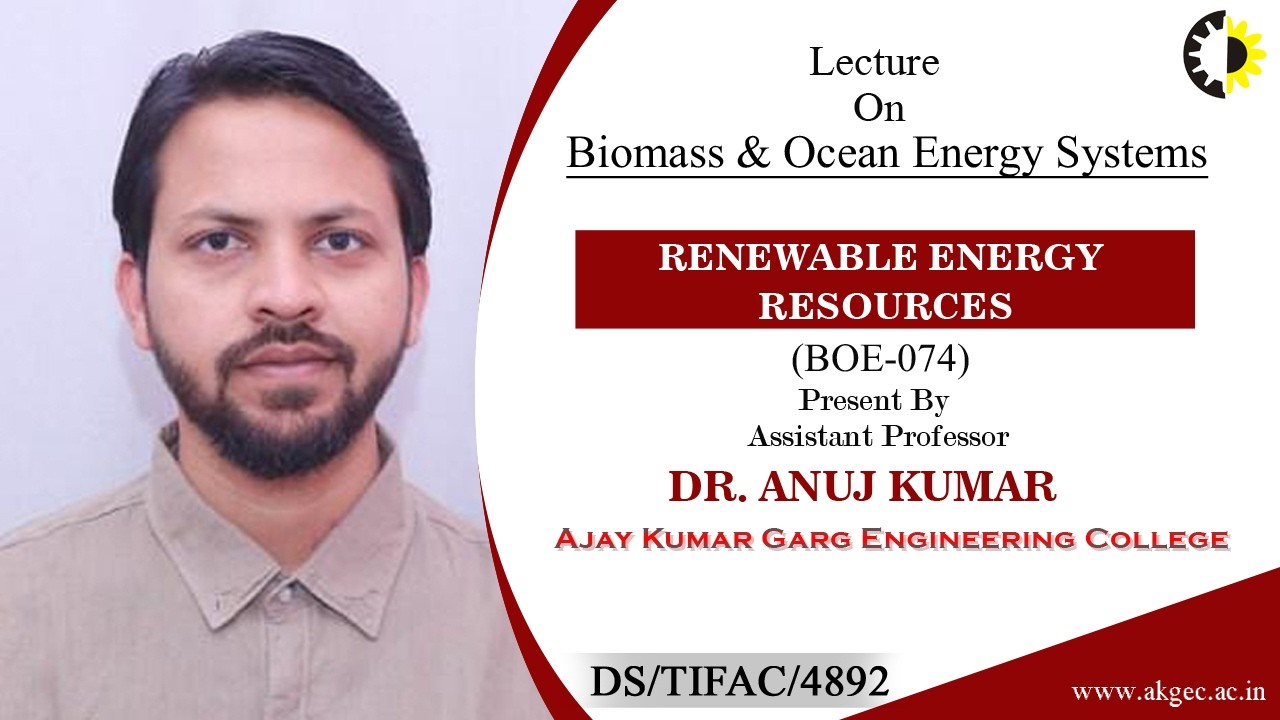
BIOMASS & OCEAN ENERGY SYSTEMS | RENEWABLE ENERGY RESOURCES | LECTURE 05 BY DR. ANUJ KUMAR | AKGEC
Keywords
Summary
119 words
Critical Evaluation
Value of the Information & Strength of the Argument
The lecture offers a clear, structured educational value, ideal for engineering students beginning to explore renewable energy. The argumentation follows a logical sequence: defining biomass and its sources, explaining conversion technologies, then moving to ocean energy with its various mechanisms. The lecturer uses simple analogies (e.g., solar energy as an indirect driver for biomass) and contrasts technologies to illustrate trade-offs. However, the argumentation remains at a conceptual level; it does not delve into quantitative performance metrics, real-world project case studies, or comparative efficiency data, limiting its depth. The absence of specific data or references weakens the persuasive power beyond the classroom setting.
Scientific Rigor, Source Quality, Title Accuracy
The lecture demonstrates moderate scientific rigor: the information is accurate and aligned with fundamental principles of renewable energy, but no external sources are cited directly. The title is fully appropriate, as the content matches the announced topic. The presentation flow is coherent, with a clear introduction, body, and conclusion. However, the lack of citations for claims like the methane percentage in biogas or the predictability of tidal energy reduces the ability to verify statements independently. The institution’s website and a course playlist are provided in the description, offering supplementary context but not specific research references. Overall, the content is trustworthy for an introductory lecture, but not at the level of a peer-reviewed scientific discussion.
231 words
Title / Content Match
The title precisely reflects the lecture content, which addresses both biomass and ocean energy systems as part of a renewable energy course.
Quality & Reliability
6/10
The lecture provides a logically organized introduction to biomass and ocean energy systems, but lacks explicit citations and in-depth quantitative data. It accurately conveys established principles, making it reliable for teaching but not as a rigorous scientific source.
Key Moments
Markers derived by PSI from the transcript: the creator did not define chapters.
- Introduction to the lecture series and overview of renewable energy topics.
- Explanation of biomass energy cycle, sources, and available residues in India.
- Details of biogas plants, anaerobic digestion, and the role of methane.
- Introduction to ocean energy, including ocean thermal energy conversion (OTEC).
- Wave and tidal energy principles, including predictability and current status.
- Comparison of all renewable sources, advantages, limitations, and final conclusion.
Cited Sources
- AKGEC Website — Institution website providing general information about the college.
- Renewable Energy Resources Playlist — Playlist containing all lectures of the course, where this lecture is part.
Contribution & Novelties
This lecture serves as a pedagogical introduction to biomass and ocean energy, consolidating existing knowledge without presenting new research. Its contribution lies in structuring the content for undergraduate engineering students, linking concepts to the Indian agricultural context and emphasizing practical applications. For deeper understanding, the following resources are recommended:
Pour aller plus loin :
- Biomass — Comprehensive overview of biomass sources and conversion technologies.
- Ocean thermal energy conversion — Detailed explanation of OTEC principles and working cycles.
- Tidal energy — Review of tidal power generation methods and global projects.
89 words
Radar Profile
The radar profile shows moderate scores across all dimensions, reflecting a balanced but not deeply technical lecture. The fiabilité is relatively higher than quantity and quality, likely because the content is accurate but lacks depth and citations.